


Introduction
Vasyl Semenovych Stus (Ukrainian: Васи́ль Семе́нович Стус; 8 January 1938, Rakhnivka, Ukrainian SSR – 4 September 1985, Perm-36, Kuchino, Russian SFSR) was a Ukrainian poet and publicist, one of the most active members of Ukrainian dissident movement. For his political convictions, his works were banned by the Soviet regime and he spent 23 years (about a half of his life) in detention. On November 26, 2005 he was posthumously given the title Hero of Ukraine by order of the state.
Biography
Vasyl Stus was born on January 6, 1938 into a peasant family in the village of Rakhnivka, Haisyn Raion, Vinnytsia Oblast (province), Ukrainian SSR. Next year, his parents Semen Demyanovych and Iryna Yakivna moved to the city of Stalino (now Donetsk). Their children joined them one year later. Vasyl first encountered the Ukrainian language and poetry from his mother who sang him Ukrainian folk songs.
After the secondary school, Vasyl Stus entered the Department of history and literature of the Pedagogical Institute in Stalino (nowadays Donetsk University). In 1959 he graduated from the institute with honours. Following graduation, Stus briefly worked as a high school teacher of Ukrainian language and literaturein Tauzhnia village of Kirovohrad Oblast, and then was conscripted to the Soviet Army for two years. During the study and military service in the Ural mountains he started to write poetry and translated into Ukrainian more than a hundred verses by Johann Wolfgang von Goethe and Rainer Maria Rilke. The original copies of his translations were later confiscated by KGB and they were lost.
After the military service, Vasyl Stus worked as an editor in the newspaper Sotsialistychnyi Donbas (Socialist Donbas) in 1960-1963. In 1963, he entered a Doctoral (PhD) program at the Shevchenko Institute of Literature of Ukrainian Academy of Sciences in Kiev. At the same time he published his selected poetry.
In 1965 Stus has got married; his son, Dmytro was born in 1966.
On September 4, 1965 during the premiere of the Shadows of Forgotten Ancestors movie in Kiev's Ukrayina cinema, Vasyl Stus took part in a protest against arrests of Ukrainian intelligentsia. For the protest participation, on September 20 he was expelled from the Institute and later lost his job at the State Historical Archive. He then worked in a few places as a building constructor, a fireman, and an engineer, continuing his intensive work on poetry. In 1965 he submitted his first book Circulation (Круговерть) for publishing, but it was rejected due to discrepancy with Soviet ideology and artistic style. His next poetry book Winter Trees (Зимові дерева) was also rejected, regardless of positive reviews from a poet Ivan Drach and a critic Eugen Adelgejm. The book was published in 1970 in Belgium.
On January 12, 1972, Stus was arrested for "anti-Soviet agitation and propaganda". He served a 5-year sentence in a labor camp, and two more in exile in the Magadan Oblast.




In August 1979, having finished his sentence, he returned to Kiev and worked in a foundry. He spoke out in defense of members of the Ukrainian Helsinki group (UHG). Stus himself joined the UHG in October 1979.
“In Kiev I learned that people close to the Helsinki Group were being repressed in the most flagrant manner. This at least had been the case in the trials of Ovsiyenko, Horbal, Lytvyn, and they were soon to deal similarly with Chornovil and Rozumny. I didn’t want that kind of Kiev. Seeing that the Group had been left rudderless, I joined it because I couldn’t do otherwise … When life is taken away, I had no need of pitiful crumbs. Psychologically I understood that the prison gates had already opened for me and that any day now they would close behind me – and close for a long time. But what was I supposed to do? Ukrainians were not able to leave the country, and anyway I didn’t particularly want to go beyond those borders since who then, here, in Great Ukraine, would become the voice of indignation and protest? This was my fate, and you don’t choose your fate. You accept it, whatever that fate may be. And when you don’t accept it, it takes you by force … However I had no intention of bowing my head down, whatever happened. Behind me was Ukraine, my oppressed people, whose honour I had to defend or perish". (“Z tabornoho zoshyta" [“From the camp notebook"], 1983).
On 14 May 1980, prior to the 1980 Olympic Games in Moscow, he was arrested and received a 10-year sentence for "anti-Soviet activity". The later influential (in Ukrainian politics) Viktor Medvedchuk defended poet Stus during this trial in 1980. In the closing speech from the defence Medvedchuk stated all of Stus’ crimes deserved punishment; he also told the court to make sure that the defendant fulfilled his daily norm at the factory where he worked at the time, despite alleged serious stomach problems. Stus's requests to get another public defender were dismissed by the court.
Vasyl Stus died after he declared hunger strike on September 4, 1985 in a Soviet forced labor camp for political prisoners Perm-36 [1] near the village of Kuchino, Perm Oblast, Russian SFSR, where he had been transferred in November 1980. Danylo Shumuk reported that the commandant, a certain Maj. Zhuravkov, committed suicide after the death of Vasyl Stus. In the Kuchino camp, out of 56 inmates kept there between 1980 and 1987, 8 died, including 4 members of the Ukrainian Helsinki Group.
In August 1990 the Supreme Court of the Soviet Union cancelled Stus's verdict and the case was closed due to lack of evidence.
Legacy
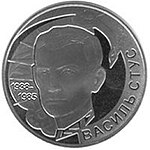
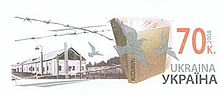
In 1985, an international committee of scholars, writers, and poets nominated Stus as a candidate for the 1986 Nobel Prize in Literature, but he died before the nomination materialized. He was nominated by a German writer Heinrich Böll, who publicly stated that he expected Stus to win the prestigious prize.
On 19 November 1989 the remains of Vasyl Stus, Oleksa Tykhy and Yury Lytvyn were brought back to Kyiv and reburied at the Baikove Cemetery in a ceremony attended by more than 30,000 people.
In January 1989, the first non-governmental Vasyl Stus Prizes were awarded for “talent and courage". This Prize was set up by the Ukrainian Association of the Independent Creative Intelligentsia, and is awarded every year on the poet’s date of birth in Lviv. In 1993 Stus was posthumously awarded the Taras Shevchenko State Prize for Literature.
On 8 January 2008, the National bank of Ukraine issued a commemorative coin dedicated to Vasyl Stus and on 25 January 2008 Ukrposhta issued a stamp in his memory.
In December 2008, a group of current and former students of the Donetsk National University sent an appeal to the Minister of Education, Ivan Vakarchuk, asking that the university be named after one of its alumni, Vasyl Stus. The Minister supported the initiative and approached the Rector of the university with a request to discuss the issue among staff and at the academic council. On 17 February 2009 62 out of 63 members of the university's academic council voted against renaming the university to Vasyl Stus or Volodomyr Degtyaryov (61 voted against this), 63 voted for not changing the name of the institute. On 13 February 2009, representatives of the university's students voted in the same fashion. The Donetsk National University, relocated to Vinnytsia due to the War in Donbass, was eventually renamed named after Stus on 10 June 2016. The new name was approved by 75 votes out of 105 of the university's academic council.
After it was taken over by the pro-Russian rebels during the War in Donbass, the university building in Donetsk removed its commemorative plaque of Stus in 2015.
Stus is highly regarded among intellectuals in Ukraine.
Awards
- Antonovych prize (1982)