


Introduction
Sultan Bahu (also spelled Bahoo; ca 1630–1691) was a Sufi mystic, poet and scholar active mostly in the present-day Punjab province of Pakistan. He belonged to the Sufi order known as Qadiri, and the mystic tradition he started has been known as Sarwari Qadiri.
Little is known of Bahu's life, other than a hagiography written by a descendant of his seven generations later, entitled Manaqib-i Sultani. Sultan Bahu was born in Shorekot, Jhang in the current Punjab Province of Pakistan. More than forty books on Sufism are attributed to him, mostly in Persian, and largely dealing with specialised aspects of Islam and Islamic mysticism. However, it is his Punjabi poetry which had popular appeal and earned him lasting fame. His verses are sung in many genres of Sufi music including qawwali and kafi, and tradition has established a unique style of singing his couplets.
Education
Sultan Bahu's education began with his mother, Mai Rasti, herself a pious woman who has her own mausoleum in Shorkot. She told him to seek spiritual guidance from Hazrat Shah Habib Gilani whose shrine is found in the village of Baghdad Sharif, near Mian Channu, to this day.
Around 1668 Sultan Bahu moved to Delhi for further training under the guidance of Syed Abdul Rehman Jilani Dehlvi, a notable Sufi saint of the Qadri (or Qadiriyya) Order in the Indian Subcontinent, and thereafter returned to Punjab where he spent the rest of his life.
Literary works
The exact number of books written by Sultan Bahu is not known but it is assumed to be more than one hundred, forty of them on Sufism and Islamic mysticism alone. Most of his writings are in the Persian Language except Abyat-e-Bahoo which is written as Punjabi poetry. Only The following books written by Sultan Bahu can be found today.
- Abyat e Bahu
- Risala e Ruhi
- Sultan ul Waham
- Nur ul Huda
- Aql e Baidar
- Mahq ul Faqr
- Aurang e Shahi
- Jami ul Israr
- Taufiq e Hidiyat
- Kalid Tauheed
- Ain ul Faqr
- Israr e Qadri
- Kaleed e Jannat
- Muhqam ul Faqr
- Majalis un Nabi
- Muftah ul Arifeen
- Hujjat ul Israr
- Kashf ul Israar
- Mahabat ul Israr
- Ganj ul Israr
- Fazl ul Liqa
- Dewaan e Bahu
Spiritual lineage
In his writings, Sultan Bahu refers to Abdul Qadir Jilani as his spiritual master, even though Jilani died long before the birth of Sultan Bahu. However, most Sufis maintain that Abdul Qadir Jilani plays a special role in the mystic world and that all orders and saints are forever indebted to him in some way either directly or indirectly. While acknowledging that he is a follower of Jilani's Qadiriyya tradition, Sultan Bahu initiated an offshoot of his own which he named Sarwari Qadiri.
Bahu's Sarwari Qadiri tradition (or Sufi order) is similar in its overall philosophy to the Qadiri order. However, unlike many other Sufi orders, the Sarwari Qadiri tradition does not prescribe a specific dress code, ascetic practices, breathing exercises, etc., and instead focuses on mental exercise, an important one being visualisation of the word الله (Allah, God) as written on one's own heart.
According to tradition, the lineage reaches Sultan Bahu as follows:
- Mohammad
- Ali ibn Abi Talib
- Hasan al Basri
- Habib al Ajami
- Dawud Tai
- Maruf Karkhi
- Sirri Saqti
- Junaid Baghdadi
- Abu Bakr Shibli
- Abdul Aziz bin Hars bin Asad Yemeni Tamimi
- Abu Al Fazal Abdul Wahid Yemeni Tamimi
- Mohammad Yousaf Abu al-Farah Tartusi
- Abu-al-Hassan Ali Bin Mohammad Qureshi Hankari
- Abu Saeed Mubarak Makhzoomi
- Abdul Qadir Jilani
- Abdul Razzaq Jilani
- Abdul Jabbar Jilani
- Syed Mohammad Sadiq Yahya
- Najm-ud-Din Burhan Puri
- Abdul Fattah
- Abdul Sattar
- Abdul Baqqa
- Abdul Jaleel
- Syed Abdul Rehman Jilani Dehlvi
- Sultan Bahu
The Sultan Bahu tradition is continued to this day through Sultan Bahu's successors.
Shrine
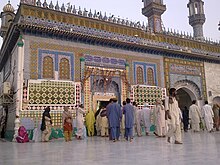
The shrine of Sultan Bahu, located in Garh Maharaja, Punjab, was originally built on his grave but has had to be moved twice when the Chenab River changed its course. It is a popular Sufi shrine, and the annual Urs festival commemorating his death is celebrated there with great fervour on the first Thursday of Jumada al-Thani month. People come from far off places to join the celebrations.
Sultan Bahu also used to hold an annual Urs to commemorate the martyrs of Karbala from the 1st to the 10th day of the month of Muharram. This tradition continues to this day and every year, thousands of pilgrims visit the shrine during the first 10 days of Muharram.