
Katherine Maher
Introduction

Katherine Roberts Maher (/mɑːr/; born April 18, 1983) is a former chief executive officer and executive director of the Wikimedia Foundation, positions she held from 2019 to April 2021 and from 2016 to April 2021 respectively. Previously, she was chief communications officer. She has a background in the field of information and communications technology and worked in the non-profit and international sectors, focusing on the use of technology to empower human rights and international development.
Early life and education
Maher grew up in Wilton, Connecticut and attended Wilton High School. After high school, Maher graduated from the Arabic Language Institute's Arabic Language Intensive Program of The American University in Cairo in 2003, which she said was a formative experience that instilled a deep love of the Middle East. Maher subsequently studied at the Institut français d’études arabes de Damasin Syria and spent time in Lebanon and Tunisia.
In 2005, Maher received a bachelor's degree from New York University in Middle Eastern and Islamic Studies.
Maher originally thought she was going to be an academic and worked for human rights and international development organizations.
Career
After internships at the Council on Foreign Relations and Eurasia Group, in 2005, Maher began working at HSBC in London, Germany, and Canada as part of their international manager development program.
In 2007, Maher returned to New York City where from 2007 to 2010 she worked at UNICEF as an innovation and communication officer. She worked to promote the use of technology to improve people's lives and traveled extensively to work on issues related to maternal health, HIV/AIDS prevention, and youth participation in technology. One of her first projects at UNICEF involved testing MediaWiki extensions related to accessibility in Ethiopia. Another project received USAid Development 2.0 Challenge grant funding to work on the use of mobile phones to monitor nutrition in children in Malawi.
From 2010 to 2011, Maher worked at the National Democratic Institute as an ICT Program Officer. From 2011 to 2013, Maher worked at the World Bank as an ICT innovation specialist and consulted on technology for international development and democratization, working on ICT for accountability and governance with a focus on the role of mobile phones and other technologies in facilitating civil society and institutional reform, particularly in the Middle East and Africa. She co-authored a chapter on "Making Government Mobile" of a World Bank publication titled Information and Communications for Development 2012: Maximizing Mobile. In 2012, Maher's Twitter feed on issues related to the Middle East was noted for its coverage of the Arab Spring.
From 2013 to 2014, Maher was advocacy director at the Washington, D.C.-based Access Now. As part of this work, she focused on the impact on people of laws about cyber security, morality, and defamation of the state that increase state censorship and reduce dissent. Access was a signatory of the Declaration of Internet Freedom.
Maher states that she focuses on global digital inclusion as a way to improve and protect the rights of people to information through technology.
Wikimedia Foundation
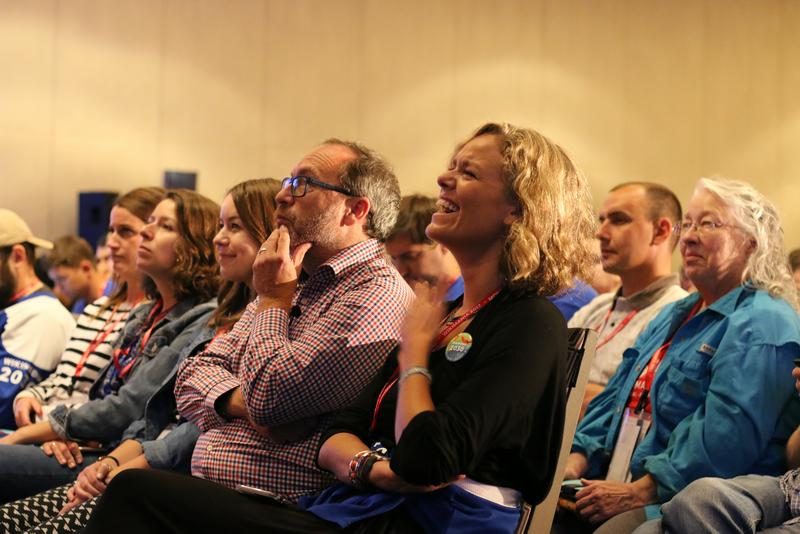
Maher was chief communications officer of the Wikimedia Foundation from April 2014 to March 2016. She was interviewed by The Washington Post on United States copyright law.
Maher became interim executive director of the Wikimedia Foundation in March 2016 following the resignation of executive director Lila Tretikov and was appointed executive director in June 2016. Wikipedia founder Jimmy Wales announced the appointment on June 24 at Wikimania 2016 in Esino Lario, Italy, effective June 23, 2016.
In 2019, Maher became CEO of Wikimedia.
In February 2021, she announced her intention to step down from her positions as CEO and executive director of the Wikimedia Foundation on April 15, 2021. Maryana Iskander was appointed as her successor.
Personal life
In 2021, Maher said that she intended to move to the East Coast of the United States.
Honors
- In 2013, The Diplomatic Courier named her as one of 99 leading foreign policy professionals under age 33.
Affiliations
- American University of Beirut, Member of the Board
- Council on Foreign Relations, Member
- Sunlight Foundation, Member of the Board
- 2011: Youth for Technology Foundation, Member of the Board
- 2013: Truman National Security Project, Policy Fellow, National Security Fellow, and Research Fellow, Democracy & Human Rights Initiative
- 2013: Open Technology Fund, Advisory Committee Member
- 2016: World Economic Forum, Member, Global Network Council on the Future of Human Rights
- 2018: Oxford Union, on Technology and Empire
- 2019: World Economic Forum Young Global Leader
Works and publications
- Maher, Katherine (December 2010). "Food Fights—Nick Cullather's The Hungry World: America's Cold War Battle Against Poverty in Asia". Bookforum.
- Maher, Katherine (March 21, 2011). "SXSW festival takes on board use of technology for social impact". The Guardian.
- Maher, Katherine (August 17, 2012). "Did the Bounds of Cyber War Just Expand to Banks and Neutral States?". The Atlantic.
- Raja, Siddhartha; Melhem, Samia; Cruse, Matthew; Goldstein, Joshua; Maher, Katherine; Minges, Michael; Surya, Priya (August 2012). "Chapter 6: Making Government Mobile" (PDF). Information and Communications for Development 2012: Maximizing Mobile. Washington, DC: World Bank. pp. 87–101. doi:10.1596/9780821389911_ch06. ISBN 978-0-8213-8991-1. OCLC 895048866.
- Maher, Katherine; York, Jillian C. (2013). "Origins of the Tunisian Internet".In Hussain, Muzammil M.; Howard, Philip N. (eds.). State Power 2.0: Authoritarian Entrenchment and Political Engagement Worldwide. Burlington, VT: Ashgate Publishing Group. ISBN 978-1-4094-5469-4. OCLC 940726016.
- Maher, Katherine (February 25, 2013). "The New Westphalian Web: The future of the Internet may lie in the past. And that's not a good thing". Foreign Policy. Archived from the original on March 5, 2015.
- Maher, Katherine (March 19, 2014). "No, the U.S. Isn't 'Giving Up Control' of the Internet". Politico.
- Maher, Katherine (December 5, 2016). "The Sum of All Knowledge" (Video). Google Talks.
- Maher, Katherine (October 4, 2017). "How Wikipedia Changed The Exchange Of Knowledge (And Where It's Going Next)". Forbes.
- Maher, Katherine (October 17, 2017). "Will Wikipedia Exist in 20 Years?" (Video). Berkman Klein Center for Internet and Society at Harvard University.
- Maher, Katherine (March 12, 2019). "Without Humans, A.I. Can Wreak Havoc". The New York Times.