



Introduction
Henrietta Emma Ratcliffe Rae (30 December 1859 – 26 January 1928) was a prominent English painter of the late Victorian era. Her most well known painting is Miss Nightingale at Scutari (1891) which has frequently been reproduced as The Lady with the Lamp.
Biography
Henrietta Emma Ratcliffe Rae was born on 30 December 1859 in Hammersmith, London. Rae was the youngest of seven children. Her father was a civil servant and her mother was a musically-talented student of Felix Mendelssohn. Her uncle, Charles Rae, was an artist and a student of George Cruikshank.
Henrietta began studying art at the age of thirteen and was educated at Heatherley's School of Fine Art, where she was the school's first female pupil, and also at the British Museum. Rae reportedly applied to the Royal Academy of Arts at least five times before eventually gaining a seven-year scholarship. Her teachers there included Frank Bernard Dicksee, William Powell Frith and Sir Lawrence Alma-Tadema; the last of these having the strongest influence on Rae's later work.
Beginning in 1881, Rae became a frequent exhibitor at the annual Royal Academy shows. She gained recognition and success early in her career, specialising in classical, allegorical and literary subjects. Her Psyche at the Throne of Venus (1894) measured 12 by 7 feet (370 by 210 cm) and contained 13 figures. Among her many other paintings in the classical vein, Eurydice (1886) won medals at exhibitions in Paris and at the 1893 World's Columbian Exposition in Chicago.
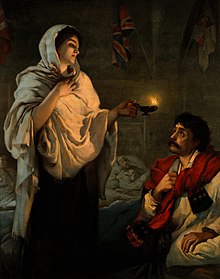
Her painting Elaine Guarding the Shield of Lancelot (1885) drew inspiration from the Tennyson poem Lancelot and Elaine. Her painting Sir Richard Whittington Dispensing His Charities (1900) from the was a about Richard Whittington a medieval merchant and four-time Lord Mayor of London. She also painted many socially prominent people, including Lord Dufferin in 1901. Rae's 1891 picture of Florence Nightingale (founder of modern nursing) entitled Miss Nightingale at Scutari (1854), has frequently been reproduced and referred to as The Lady with the Lamp, which is recognised as her best-known work.
In 1884, she married fellow artist, Ernest Normand. They had two children, a son (born in 1886) and a daughter (born in 1893). Henrietta Rae kept her maiden name after marriage as she had already begun to establish her reputation under its use — an choice that was considered unusual at the time. She and her husband lived in Holland Park with many other artists of the day where they were "adopted as the proteges of the older artists among whom they lived. Their studio was constantly visited by Leighton, Millais, Prinsep, Watts, and others."
However, the attention was not always welcomed. In her memoirs, Rae described the overbearing attitudes and conduct of some of the more senior artists. In one such case, Prinsep dipped his thumb in cobalt blue paint and marked up one of Rae's pictures. In retaliation, Rae "accidentally" burnt his hat on her stove.
The Normands travelled to Paris in 1890 to study at the Académie Julian with Jules Joseph Lefebvre and Jean-Joseph Benjamin-Constant. In 1893, the Normands moved to Upper Norwood, into a studio that was custom-built for them by Normand's father. Like some other female artists of her time, Rae was a supporter of feminism and women's suffrage. In 1897 Rae organised an exhibition of the work of female artists for the Jubilee of Queen Victoria.
She died on the 26th of January, 1928.
Works
- Love's young dream (1883)
- Elaine guarding the shield of Lancelot (1885)
- Ariadne (1885)
- Eurydice (1886)
- Zephyrus and Flora (1888)
- Miss Nightingale at Scutari (1854) (1891)
- Psyche at the throne of Venus (1894)
- Apollo and Daphne (1895)
- Diana and Calisto (1899)
- The Marquess of Dufferin and Ava(1901)
- Hylas and the water nymphs (1910)
- Sir Richard Whittington dispensing his Charities (1900) Mural at the Royal Exchange, London