


Introduction
Faisal bin Abdulaziz Al Saud (Arabic: فيصل بن عبدالعزيز آل سعود Fayṣal ibn ʿAbd al ʿAzīz Āl Suʿūd,[fajsˤal ben ˈʕabd alʕaˈziːz ʔaːl saˈʕuːd]; 14 April 1906 – 25 March 1975) was a Saudi Arabian statesman and diplomat who was the King of Saudi Arabia from 2 November 1964 until his assassination in 1975. He was the third son of King Abdulaziz, the founder of modern Saudi Arabia, and the second of Abdulaziz's six sons who were kings.
Faisal was the son of Abdulaziz and Tarfa bint Abdullah Al Sheikh. His father was still reigning as Emir of Nejd at the time of Faisal's birth, and his mother was from the Al ash-Sheikh family which has produced many prominent Saudi religious leaders. Faisal emerged as an influential royal politician during the reigns of his father, Abdulaziz, and his half-brother Saud. He was the Saudi foreign minister from 1930 and prime minister from 1954 until his death, except for a two-year break (1960–1962) in both positions. Faisal was crown prince of Saudi Arabia after Saud's accession in 1953, and in that position he outlawed slavery in Saudi Arabia. He persuaded King Saud to abdicate in his favour in 1964 with the help of other members of the royal family and his first cousin, Grand Mufti Muhammad ibn Ibrahim Al ash-Sheikh.
Faisal implemented a policy of modernization and reform. His main foreign policy themes were pan-Islamism, anti-communism, and pro-Palestinianism. He attempted to limit the power of Islamic religious officials. Protesting against support that Israel received from the West, he led the oil embargo which caused the 1973 oil crisis. Faisal successfully stabilized the kingdom's bureaucracy, and his reign had significant popularity among Saudi Arabians despite his reforms facing some controversy. In 1975, he was assassinated by his nephew Faisal bin Musaid. King Faisal was succeeded by his half-brother Khalid bin Abdulaziz.
Early life and education
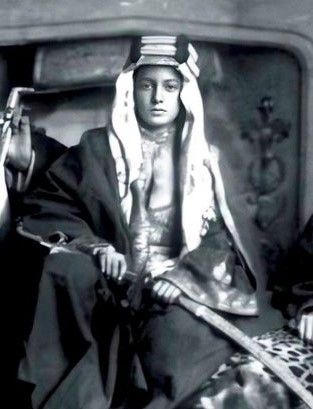
Faisal bin Abdulaziz was born in Riyadh on 14 April 1906. He was the third son of Abdulaziz, then Emir of Nejd; Faisal was the first of his father's sons who was born in Riyadh. His mother was Tarfa bint Abdullah Al Sheikh, whom Abdulaziz had married in 1902 after capturing Riyadh. Tarfa was a descendant of the religious leader Muhammad bin Abdul Wahhab. Faisal's grandfather Abdullah bin Abdullatif Al Sheikh was one of Abdulaziz's principal religious teachers and advisers. Faisal had an older full sister, Noura, who married her cousin Khalid bin Muhammad, a son of King Abdulaziz's half-brother Muhammad bin Abdul Rahman.
Tarfa bint Abdullah died in 1906 when Faisal was six months old. He then began to live with his maternal grandparents, Abdullah bin Abdullatif and Haya bint Abdul Rahman Al Muqbel, and Abdullah educated his grandson. According to Helen Chapin Metz, Faisal, and most of his generation, was raised in an atmosphere in which courage was extremely valued and reinforced. From 1916 he was tutored by Hafiz Wahba who later served in various governmental posts.
In 1919 the British government invited Abdulaziz to visit London. He could not go, but he assigned his eldest son Prince Turki as his envoy. However, Prince Turki died due to Spanish flu before the visit. Therefore, Prince Faisal was sent to London instead, making him the first ever Saudi Arabian royal to visit England. His visit lasted for five months, and he met with British officials. During the same period, he also visited France, again being the first Saudi Arabian royal to pay an official visit there.
Early political experience
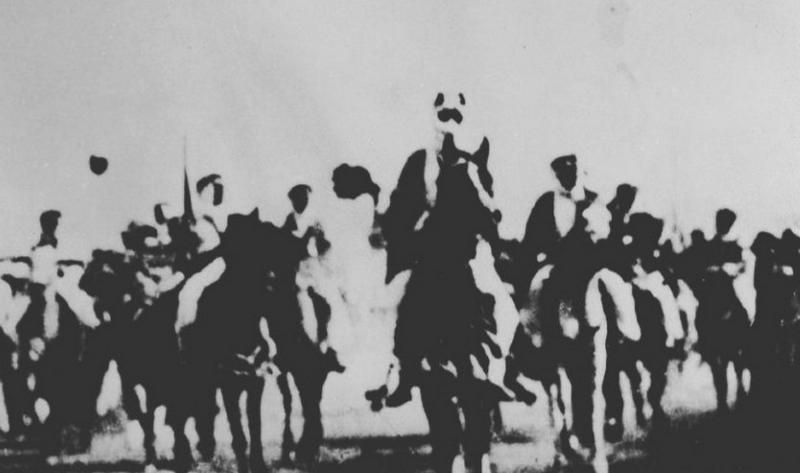
As one of Abdulaziz's eldest sons, Prince Faisal was given numerous responsibilities to consolidate control over Arabia. After the capture of Hail and initial control over Asir in 1922, he was sent to these provinces with nearly six thousand fighters. He achieved complete control over Asir at the end of the year. Prince Faisal was appointed viceroy of Hejaz on 9 February 1926 following his father's takeover of the region. He often consulted with local leaders during his tenure. In addition, Prince Faisal was the president of the consultative assembly and the minister of interior.
In December 1931 following the announcement of the constitution of the council of deputies (Majlis al Wukala) he became the president of the four-member council and minister of foreign affairs, and continued to hold his previous titles, viceroy of Hejaz, the president of the consultative assembly and the minister of interior. He would continue to oversee Saudi foreign policy until his death—even as king, with only a two-year break between 1960 and 1962.
Faisal visited several countries in this period, including Iran in May 1932, Poland in 1932 and Russia (as part of the USSR) in 1933. On 8 July 1932 Faisal visited Turkey and met with Kemal Atatürk, founder of modern Turkey.
He commanded a campaign during the Saudi–Yemeni War in 1934, resulting in a Saudi victory. He and his half-brother Khalid visited the US in October 1943 following the invitation of President Franklin D. Roosevelt. This is one of the early contacts between Saudi Arabia and the USA.
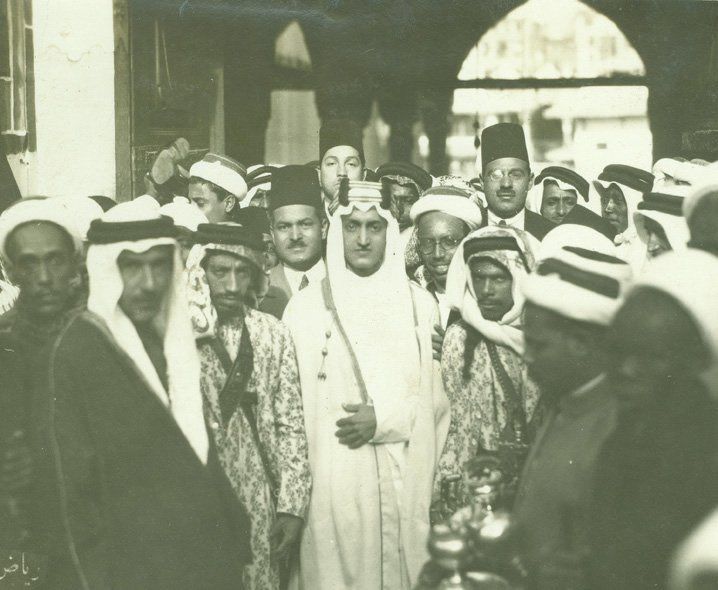
After he became foreign minister, Prince Faisal was recognized for his support for the Palestinian cause. His involvement with the Palestinian cause began in 1938, when he represented his father in the London Conference on the Palestine issue, where he delivered an important address opposing the partition plan. He wrote a message to the Saudi people in 1948 in which he discussed the Palestinian struggle and the suffering of the Palestinian people.
As King Abdulaziz neared the end of his life, he favored Prince Faisal as a possible successor over his eldest living son, Crown Prince Saud, due to Faisal's extensive knowledge, as well as his years of experience. Since Faisal was a child, Abdulaziz recognized him as the most brilliant of his sons and often tasked him with responsibilities in war and diplomacy. In addition, Faisal was known to embrace a simple Bedouin lifestyle. "I only wish I had three Faisals", King Abdulaziz once said when discussing who would succeed him. However, King Abdulaziz made the decision to keep Saud as crown prince in the fear that otherwise would lead to decreased stability.
Crown prince and prime minister
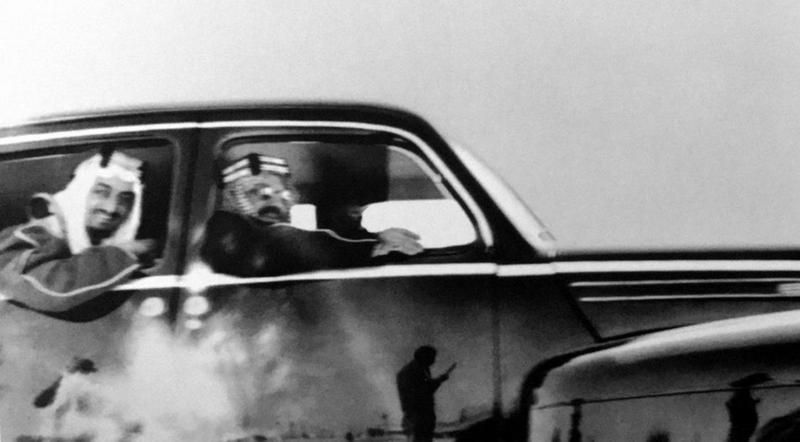
King Abdulaziz died on 9 November 1953, and Prince Faisal was at his side. Prince Faisal's elder half-brother, Saud, became king. Faisal was then appointed crown prince. On 16 August 1954 he was made prime minister.
King Saud embarked on a spending program that included the construction of a massive royal residence on the outskirts of the capital, Riyadh. He also faced pressure from neighboring Egypt, where Gamal Abdel Nasser had overthrown the monarchy in 1952. Nasser was able to cultivate a group of dissident princes (known as the Free Princes) led by Prince Talal bin Abdulaziz, who defected to Egypt. Fearing that King Saud's financial policies were bringing the state to the brink of collapse, and that his handling of foreign affairs was inept, senior members of the royal family and the ulema (religious leadership) pressured Saud into appointing Faisal to the position of prime minister in 1958, giving Faisal wide executive powers.
A power struggle ensued between King Saud and Crown Prince Faisal, and on 18 December 1960, Crown Prince Faisal resigned as prime minister in protest, arguing that King Saud was frustrating his financial reforms. King Saud took back his executive powers and, having induced Prince Talal to return from Egypt, appointed him as minister of finance in July 1958. In 1962, however, Crown Prince Faisal rallied enough support within the royal family to install himself as prime minister for a second time. Less than a month before this event Crown Prince Faisal and US President John F. Kennedy held a secret meeting in Washington, D.C. on 4 October 1962. The same year Crown Prince Faisal announced a historic plan, known as Ten Point Program, which laid out Saudi Arabia's path to becoming an industrialized nation by adopting economic, financial, political, and legal principles. Among the highlights were:
- Issuing a basic system of governance derived from Islamic Sharia and developing the system of governance and the Council of Ministers.
- Establishing a system for the provinces, clarifying the method of local government, in the various regions of the Kingdom.
- Establishing a system for the independence of the judiciary, under the control of a Supreme Judicial Council, and establishing the Ministry of Justice.
- Establishing a Supreme Council for issuing fatwas, comprising twenty members of jurists.
- Improving the social level of the Saudi people, through free medical treatment, free education, and the exemption of many foodstuffs from customs duties. In addition, a social security system and a system to protect workers from unemployment were established.
- Establishing a program for economic recovery, strengthening the financial position of the Kingdom, developing a program to raise the standard of living of citizens, establishing a road network linking parts of the Kingdom and its cities, providing water sources for drinking and agriculture, and ensuring the protection of light and heavy national industries. This includes allocating all the additional sums that the government will receive from Aramco for its rights claimed by the companies for the past years, and harnessing them to serve development projects.
- Continuing to develop girls' education as well as the advancement of women.
- The liberation of slaves and the abolition of slavery, once and for all in Saudi Arabia.
Crown Prince Faisal founded Economic Development Committee in 1958. He was instrumental in the establishment of the Islamic University of Madinah in 1961. In 1962 he helped found the Muslim World League, a worldwide charity to which the Saudi royal family has reportedly since donated more than a billion dollars. In 1963 he established the country's first television station, though actual broadcasts would not begin for another two years.
Struggle with King Saud
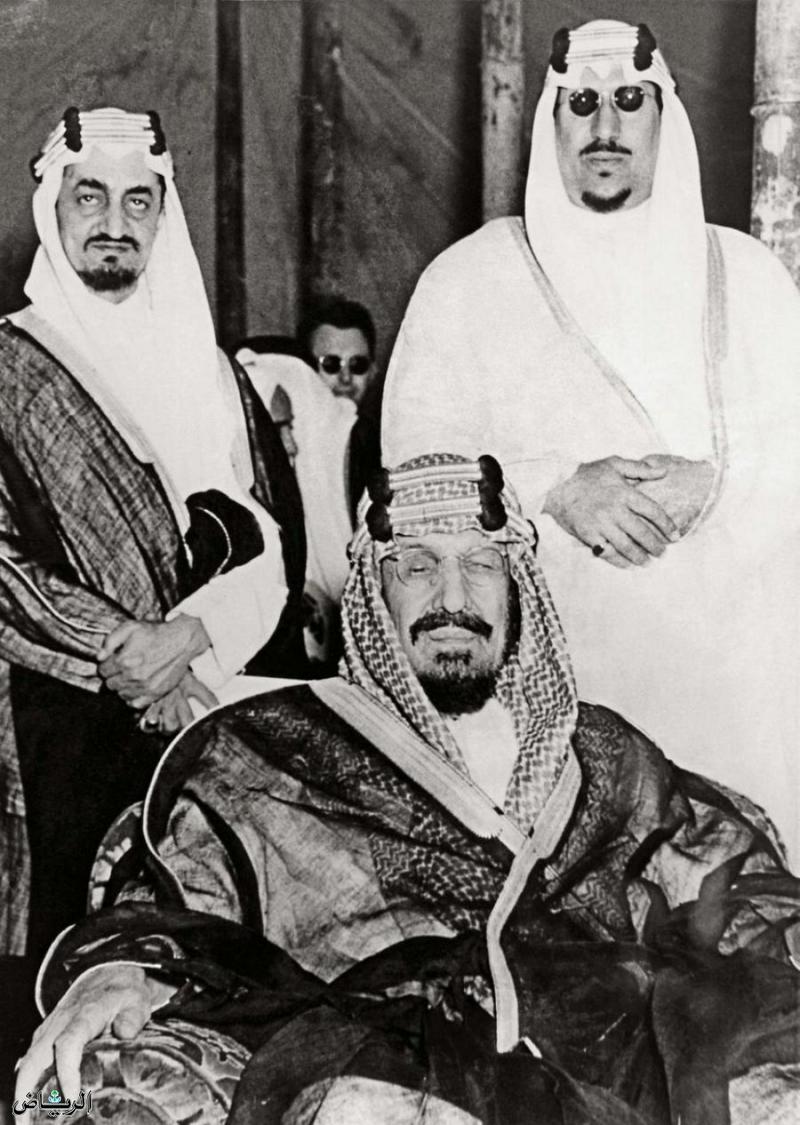
The struggle with King Saud continued in the background during this time. Taking advantage of the king's absence from the country for medical reasons in early 1963, Faisal began amassing more power for himself. He removed many of Saud's loyalists from their posts and appointed like-minded princes in key military and security positions, such as his half-brother Prince Abdullah, to whom he gave command of the National Guard in 1962. Upon King Saud's return, Crown Prince Faisal demanded that he be made regent and that King Saud be reduced to a purely ceremonial role. In this, he had the crucial backing of the ulema (elite Islamic scholars), including a fatwā (edict) issued by the grand mufti of Saudi Arabia, a relative of Crown Prince Faisal on his mother's side, calling on King Saud to accede to his brother's demands.
King Saud refused, however, and made a last-ditch attempt to retake executive powers, leading Crown Prince Faisal to order the National Guard to surround King Saud's palace. His loyalists outnumbered and outgunned, King Saud relented, and on 4 March 1964, Crown Prince Faisal was appointed regent. A meeting of the elders of the royal family and the ulema was convened later that year, and a second fatwā was decreed by the grand mufti, calling on King Saud to abdicate the throne in favor of his brother. The royal family supported the fatwā and immediately informed King Saud of their decision. King Saud, by now shorn of all his powers, agreed, and Faisal was proclaimed king on 2 November 1964. Saud then went into exile, finding refuge in Egypt before eventually settling in Greece.
King of Saudi Arabia
In a speech shortly after he came to power on 2 November 1964, Faisal said:
I beg of you, brothers, to look upon me as both brother and servant. 'Majesty' is reserved to God alone and 'the throne' is the throne of the Heavens and Earth.
One of the earliest actions Faisal took as king was to establish a council to deal with future succession issues. The members were two of his uncles, Prince Abdullah and Prince Musaid, and five of his half-brothers, Crown Prince Khalid, Prince Fahd, Prince Abdullah, Prince Sultan and Prince Nawwaf. In 1967 King Faisal established the post of second prime minister and appointed Prince Fahd to this post. The reason for this newly established body was Crown Prince Khalid's request and suggestion. King Faisal's most senior adviser during his reign was Rashad Pharaon, his father's private physician. Another adviser was Mohammad ibn Ibrahim Al Sheikh, who was influential in shaping the king's political role in the Arab world.
Modernization
Early in his rule, King Faisal issued an edict that all Saudi princes had to school their children inside the country, rather than sending them abroad; this had the effect of making it popular for upper-class families to bring their sons back to study in the Kingdom. King Faisal also introduced the country's current system of administrative regions, and laid the foundations for a modern welfare system. In 1970 he established the Ministry of Justice and inaugurated the country's first "five-year plan" for economic development.
One of his modernization attempts was the new laws on media, publishing, and archiving and bilateral cultural cooperation protocols with foreign and corporate archives that kept records about mid-twentieth century Arabia. Television broadcasts officially began in 1965. The same year a nephew of Faisal attacked the newly established headquarters of Saudi television but was killed by security personnel. The attacker was the brother of Faisal's future assassin, and the incident is the most widely accepted motive for the murder. Although there was some discontent with the social changes he carried out, the Arab world grew to respect Faisal as a result of his policies modernizing Saudi Arabia, his management of the holy cities of Mecca and Medina, his reputation as a staunch opponent of Zionism, and the country's fast-rising financial strength.
Steps against coups d'état
The 1950s and 1960s saw numerous coups d'état in the region. Muammar Gaddafi's coup that overthrew the monarchy in oil-rich Libya in 1969 was especially threatening for Saudi Arabia due to the similarity between the two sparsely-populated desert countries. As a result, King Faisal undertook to build a sophisticated security apparatus and cracked down firmly on dissent. As in all affairs, King Faisal justified these policies in Islamic terms. Early in his reign, when faced with demands for a written constitution for the country, King Faisal responded that "our constitution is the Quran". In the summer of 1969 King Faisal ordered the arrest of hundreds of military officers, including some generals, alleging that a military coup d'état was being planned. The coup was planned primarily by air force officers and aimed at overthrowing the monarchy and founding a Nasserist regime in the country. The arrests were possibly based on a tip from American intelligence.
Religious inclusiveness
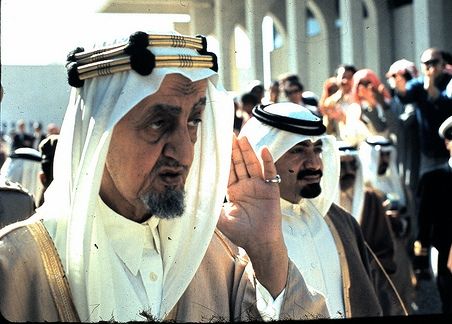
King Faisal seemed to hold the pluralist view, favouring limited, cautious accommodation of popular demands for inclusive reform, and made repeated attempts to broaden political representation, harking back to his temporarily successful national integration policy from 1965 to 1975. King Faisal acknowledged his country's religious and cultural diversity, which includes the predominantly Shia Al Ahsa in the east; the Asir in the southwest, with tribal affinities to Yemen, especially among the Ismaili tribes of Najran and Jizan; and the Kingdom of the Hejaz, with its capital Mecca. He included non-Wahhabi, cosmopolitan Sunni Hejazis from Mecca and Jeddah in the Saudi government. It was said that he would not take any decision regarding Mecca without seeking the advice of Sunni (Sufi) scholar al-Sayyid 'Alawi ibn 'Abbas al-Maliki al-Hasani, the father of Muhammad ibn 'Alawi al-Maliki. Similarly in 1962, in promoting a broader, non-sectarian form of pan-Islamism, King Faisal launched the Muslim World League where the Tijani Sufi scholar Ibrahim Niass was invited. Furthermore, he countered the outlook of certain prior Saudi rulers in declaring to the Saudi state clergy that, "All Muslims, from Egypt, India etc. are your brothers," However Mai Yamani argued that after his reign, discrimination based on sect, tribe, region, and gender became the order of the day and has remained as such until today.
The role and authority of the state clergy declined after the rise of King Faisal even though they had helped bring him to the throne in 1964. Despite his piety and biological relationship through his mother to the Al as Shaykh family, and his support for the pan-Islamic movement in his struggle against pan-Arabism, he decreased the ulema's power and influence. Unlike his successor King Khalid, King Faisal attempted to prevent radical clerics from controlling religious institutions such as the Council of Senior Ulema, the highest religious institution in Saudi Arabia, or taking religious offices such as Grand Mufti, responsible for preserving Islamic law. But his advisers warned that, once religious zealots had been motivated, disastrous effects would result.
Due to his status as a pious Muslim, Faisal was able to implement careful social reforms such as female education. Despite this, religious conservatives staged large protests. By holding talks with the conservatives, he was able to persuade them of the importance of progress in the coming years by using their own logic.
Corruption in the royal family was taken very seriously by religious figures in the Islamic theological colleges. They challenged some of the accepted theological interpretations adopted by the Saudi regime. One such influential figure was Shaykh Abdulaziz bin Baz, then rector of the Al Medina college of theology. King Faisal would not tolerate his criticism and had him removed from his position. However, his teachings had already radicalized some of his students one of which was Juhayman al-Otaybi.
Abolition of slavery
Slavery did not vanish in Saudi Arabia until King Faisal issued a decree for its total abolition in 1962. BBC presenter Peter Hobday stated that about 1,682 slaves were freed at that time, at a cost to the government of $2,000 each. The political analyst Bruce Riedel argued that the US began to raise the issue of slavery after the meeting between King Abdulaziz and US president Franklin D. Roosevelt in 1945 and that John F. Kennedy finally persuaded the House of Saud to abolish slavery in 1962.
Foreign relations
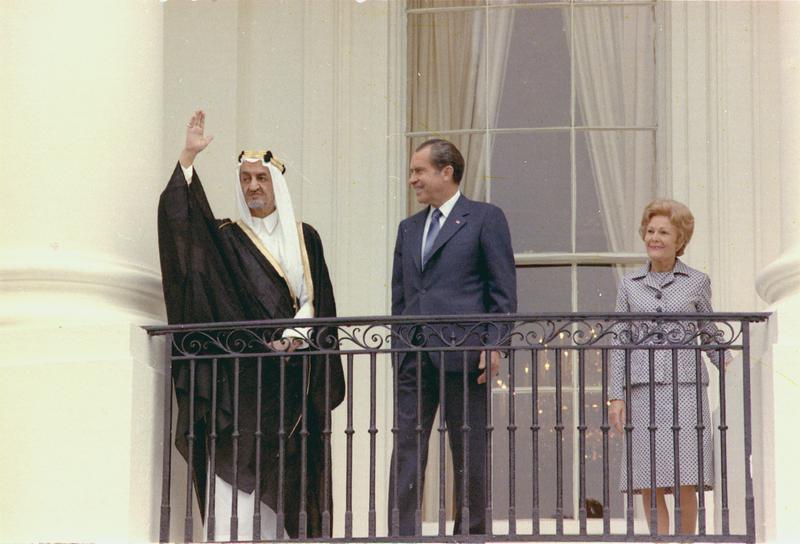
As king, Faisal employed Islam as one of Saudi Arabia's foreign policy tools which differentiated him from King Abdulaziz and King Saud. However, he continued the close alliance with the United States begun by King Abdulaziz, and relied on the US heavily for arming and training his armed forces. King Faisal was anti-communist. He refused any political ties with the Soviet Union and other Communist bloc countries, professing to see a complete incompatibility between communism and Islam. His first official visit as king to the US was in June 1966.
Faisal is said to have reminded the Shah of Iran, Mohammad Reza Pahlavi, in a correspondence that he was not "the Shah of France" and that he should keep in mind that Iran was a majority Muslim country. This was in response to comments from Mohammad Reza asking Faisal to modernise Saudi Arabia, allowing women to wear miniskirts and permitting the disco among other things. Otherwise, the Shah felt, he could not guarantee that the King would stay on the throne.
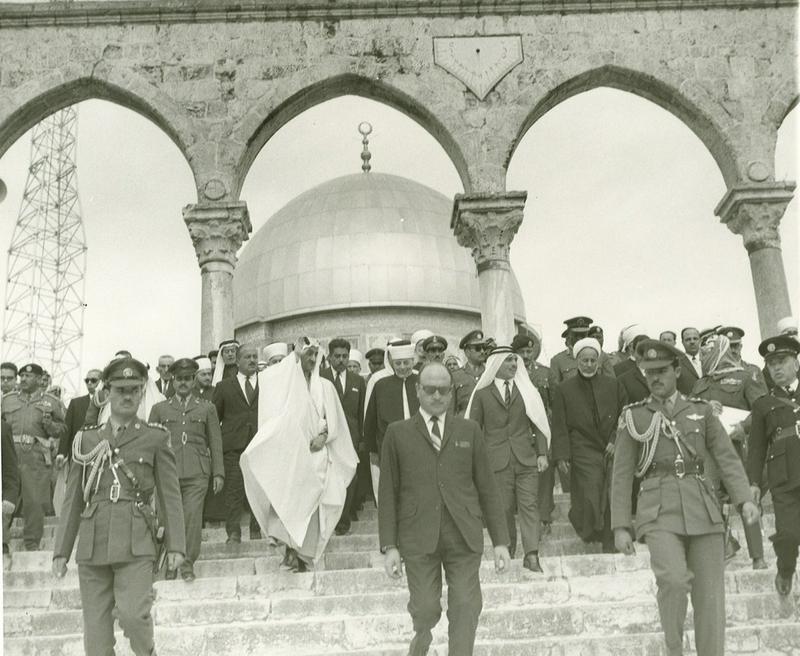
During the Six-Day War, King Faisal ordered the Saudi Arabian Armed Forces to be on alert, canceling all vacations and mobilizing forces in the Kingdom's north. Following that, orders were issued for a force of 20,000 Saudi soldiers to travel to Jordan to participate alongside the Arab forces. After the war, he directed that a Saudi force be stationed inside Jordanian territory to provide support and assistance as needed for ten years. Furthermore, at the Khartoum Conference, Saudi Arabia, Libya, and Kuwait agreed to establish a fund worth $378 million to be distributed among countries affected by the June 1967 War. Saudi Arabia would contribute $140 million.
Prince Amr bin Mohammed Al-Faisal said “I am told by my relatives, my other relatives, after 1967 and the fall of Jerusalem to the Israelis, that was a turning point in his life. He never smiled again, according to them. I didn't see him smile much, and he became very quiet and contemplative, and mostly he would spend his time listening rather than speaking himself.”
Between 23 and 25 September 1969, King Faisal convened a conference in Rabat, Morocco, to discuss the arson attack on the Al Aqsa Mosque that had occurred a month earlier. The leaders of 25 Muslim states attended and the conference called for Israel to give up territory conquered in 1967. The conference also set up the Organisation of Islamic Cooperation and pledged its support for the Palestinians.
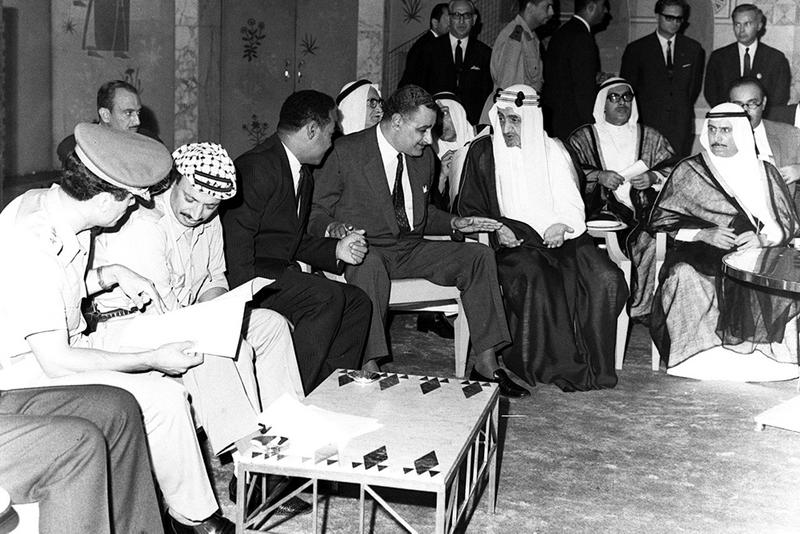
Following the death of Nasser in 1970, King Faisal drew closer to Egypt's new president, Anwar Sadat, who himself was planning a break with the Soviet Union and a move towards the pro-American camp. During the 1973 Arab–Israeli War launched by Sadat, King Faisal withdrew Saudi oil from world markets, in protest over Western support for Israel during the conflict. This action increased the price of oil and was the primary force behind the 1973 oil crisis. It was to be the defining act of King Faisal's career, and gained him lasting prestige among many Arabs and Muslims worldwide. In 1974 he was named Time magazine's Man of the Year, and the financial windfall generated by the crisis fueled the economic boom that occurred in Saudi Arabia after his death. The new oil revenue also allowed Faisal to greatly increase the aid and subsidies begun following the 1967 Six-Day War to Egypt, Syria, and the Palestine Liberation Organization. It is a commonly-held belief in Saudi Arabia, and the wider Arab world, that King Faisal's oil embargo was the real cause of his assassination, via a Western conspiracy.
Personal life
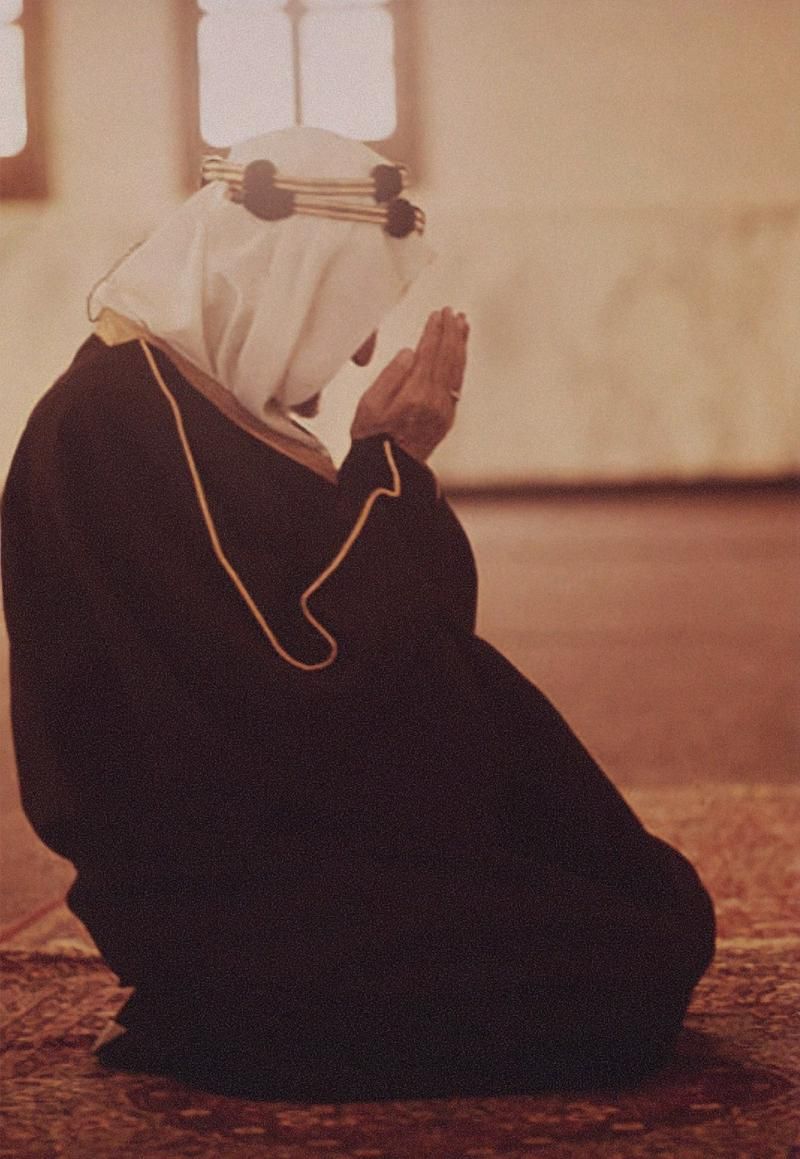
King Faisal married many times concurrently. His spouses were from powerful families: Al Kabir, Al Sudairi, Al Jiluwi and Al Thunayan. His wives were:
- Sultana bint Ahmed Al Sudairi, the mother of his eldest son Prince Abdullah, whom Faisal fathered when he was between 15 and 17. Sultana was from the Sudairi family and the younger sister of Hassa bint Ahmed, the mother of the Sudairi brothers.
- Iffat Al-Thunayan (1916–2000), who was born and raised in Turkey. Her ancestors were part of the Al Thunayan branch of the Al Saud family. They first met in Istanbul around 1932 while he was in Turkey for an official visit. They had nine children, including Prince Mohammed, Prince Saud, and Prince Turki. Iffat was credited with being the influence behind many of her husband's reforms, particularly with regard to women. Faisal also raised Iffat's younger half-brother, Kamal Adham. King Faisal later appointed Kamal as the first president of the Saudi intelligence agency, Al Mukhabarat Al A'amah. He was also an advisor to his royal brother-in-law.
- Al Jawhara bint Saud Al Kabir, the daughter of his aunt Noura bint Abdul Rahman and Saud Al Kabir bin Abdulaziz Al Saud. They married in October 1935. With Al Jawhara, Faisal had one daughter, Mashail (died October 2011).
- Haya bint Turki bin Abdulaziz Al Turki, the mother of Princess Noura, Prince Saad and Prince Khalid. She was a member of the Al Jiluwi clan.
- Hessa bint Muhammad bin Abdullah Al Muhanna Aba Al Khail, the mother of Princess Al Anoud (died June 2011) and Princess Al Jawhara (died April 2014).
- Munira bint Suhaim bin Hitimi Al Thunayan Al Mahasher, the mother of Princess Hessa (died in December 2020).
- Fatima bint Abdulaziz bin Mushait Al Shahrani, the mother of Princess Munira (died young).
King Faisal's children were well educated and had prominent roles in Saudi society and government. His daughters were educated abroad and they went on to graduate from a variety of schools and universities around the world. His sons were likewise educated abroad. Comparatively, only six of the 108 children of his half-brother and predecessor, King Saud, graduated from high school. King Faisal's son Prince Turki received formal education at prestigious schools in New Jersey, and he later attended Georgetown University, while Prince Saud was an alumnus of Princeton University. King Faisal's sons held important positions in the Saudi government. His eldest son, Prince Abdullah, held governmental positions for a while. Prince Khalid was the governor of Asir Province in southwestern Saudi Arabia for more than three decades before becoming governor of Makkah Province in 2007. Prince Saud was the Saudi foreign minister between 1975 and 2015. Prince Turki served as head of Saudi Intelligence, ambassador to the United Kingdom, and later ambassador to the United States. Prince Abdul Rahman who was a graduate of Sandhurst Military Academy died in March 2014. Prince Mohammed who died in 2017 was a businessman. Prince Saad died in April 2017. King Faisal's daughters also held important roles in Saudi society. From 2013 to 2016, his daughter Princess Sara served in the Shura Council. She is also a prominent activist for women's education and other social issues in Saudi Arabia, and so are her sisters Princess Lolowah, Princess Latifa, and Princess Haifa.
King Faisal's daughter Haifa is married to Prince Bandar, son of the king's half-brother Prince Sultan by a concubine. The marriage forced Prince Sultan to recognize Bandar as a legitimate prince. Another daughter of King Faisal, Lolowah, is a prominent activist for women's education in Saudi Arabia. In 1962 his daughter Sara founded one of the first charitable organizations, Al Nahda, which won the first Chaillot prize for human rights organisations in the Gulf in 2009. Her spouse was Prince Muhammed, one of King Saud's sons. One of his daughters, Princess Mishail, died at the age of 72 in October 2011. His granddaughter Reem bint Mohammed is a photographer and gallery owner based in Jeddah.
Unlike most of his half-brothers, King Faisal spoke fluent English and French. However, he preferred to speak in Arabic. When his translators made errors, Faisal would correct them.
Assassination and aftermath
On 25 March 1975, King Faisal was shot point-blank and killed by Faisal bin Musaid, son of his half-brother Musaid bin Abdulaziz. Prince Faisal bin Musaid had just come back from the United States. The murder occurred at a majlis (literally 'a place for sitting'), an event where the king or leader opens up his residence to the citizens to enter and petition him.
In the waiting room, Prince Faisal talked to Kuwaiti representatives who were also waiting to meet the king. When the prince went to embrace him, King Faisal leaned to kiss his nephew in accordance with Saudi custom. At that instant, Prince Faisal bin Musaid took out a pistol and shot him. The first shot hit King Faisal's chin and the second one went through his ear. A bodyguard hit Prince Faisal with a sheathed sword. Oil minister Zaki Yamani yelled repeatedly not to kill the prince.
King Faisal was quickly taken to a hospital. He was still alive as doctors massaged his heart and gave him a blood transfusion. Their efforts were unsuccessful, and King Faisal died shortly afterward. Both before and after the attack the assassin was reported to be calm. Following the killing, Riyadh had three days of mourning during which all government activities were suspended. The funeral service for King Faisal was performed in 'Id mosque in Riyadh, and he was buried in Al Oud cemetery on 26 March 1975. During the funeral, the newly ascended King Khalid wept over his murdered brother's body.
One theory for the murder of King Faisal was avenging the death of Prince Khalid bin Musaid, the brother of Prince Faisal bin Musaid. King Faisal instituted secular reforms that led to the installation of television, which provoked violent protests. Prince Khalid led an attack on a television station in 1966, and he was shot dead by a policeman.
According to claims by King Faisal's family and friends, Prince Faisal bin Musaid had informed his mother Watfa bint Muhammad Al Rashid of his assassination plans. Wafta then informed King Faisal, who said "if it is Allah's will, then it would happen." In a documentary entitled "Faisal, Legacy of a King", Faisal's grandson Amr bin Mohammed bin Faisal claims that the king had distanced himself from the world days before his death. Zaki Yamani claimed that King Faisal told his own relatives and friends about a dream he had in which his father, the late King Abdulaziz, was traveling in a car and asked him to get in. Yamani went on to say that if a dead person takes a living person in a dream, the living person will most likely die within a short amount of time according to Islamic beliefs.
Prince Faisal bin Musaid was captured directly after the attack. He was at first officially declared insane, but following the trial a panel of Saudi medical experts decided that he was sane when he shot the king. The nation's high religious court convicted him of regicide and sentenced him to execution. He was publicly beheaded in Deera Square in Riyadh.
Memorials and legacy
After his death, the King Faisal Foundation, a philanthropic organisation, was established in King Faisal's honour. King Faisal was eulogized by lyricist Robert Hunter in the title track of the Grateful Dead's 1975 album Blues for Allah.
Following the reign of King Faisal Gerald de Gaury published a biography of him entitled Faisal: King of Saudi Arabia. In 2013 Russian Arabist Alexei Vassiliev published another biography, King Faisal of Saudi Arabia: Personality, Faith and Times. A movie directed by Agustí Villaronga in 2019 entitled Born a King is about the visit of King Faisal to London in 1919 when he was thirteen years old.
In October 1976 King Khalid initiated the construction of Faisal Mosque in Islamabad, Pakistan. Lyallpur, the third largest city of Pakistan, was renamed Faisalabad (literally, "City of Faisal") in 1979 in his honor. One of the two major Pakistan Air Force bases in Pakistan's Sindh province's largest city, Karachi, is named "PAF Base Faisal" in honour of King Faisal.
His words
Generalized quotes
"The livers are broken, and the wings are torn apart when we hear or see our brothers in religion, in the homeland, and in blood, their sanctities are violated, they are displaced and abused daily, not for something they committed, nor for the aggression they attacked, but for the love of control and aggression and to commit injustice." –King Faisal bin Abdulaziz
- "The Islamic call, when it emerged from these places and spread its light to all parts of the earth, was a good call that calls for peace, calls for truth, calls for justice and calls for equality, and this is what our noble Sharia achieves, and this is what we must follow and adhere to."
- "We are not the ones who say, 'We will work, but we are used to God's power to say: We have worked."
- "Arm yourselves with science"
- "If I were not a king, I would be a teacher."
- "Our youth education is based on three pillars: belief, science and work."
- "We want this Kingdom to be a beacon of light for humanity, now and fifty years from now."
Israel and Palestine
- On March 28, 1965, Saudi Arabia's national radio broadcast a declaration by King Faisal about his country's willingness to use oil as a weapon against Israel. He said, "We consider the issue of Palestine our cause and the first Arab cause, and Palestine is more valuable to us than oil. Oil can be used as a weapon in battle if necessary. The Palestinian people must return to their homeland, even if it costs us all our lives.”
- Addressing the president of the American Tapline Company, King Faisal said: "Any drop of oil that goes to Israel will make me cut off the oil for you."
- The BBC conducted an interview with King Faisal. During the interview, the reporter asked him "what event you would like to see happen now in the Middle East." The king replied, "The first thing is the demise of Israel."
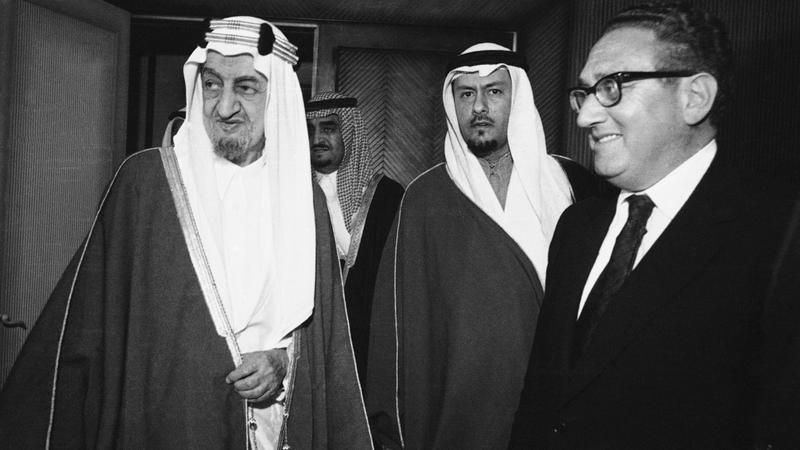
- When oil was cut off from the United States during the 1973 Arab-Israeli War, Henry Kissinger told Faisal "If Saudi Arabia does not lift the boycott, America will come and bomb the oilfields." King Faisal replied back "You are the ones who can't live without oil. You know, we come from the desert, and our ancestors lived on dates and milk and we can easily go back and live like that again."
- Henry Kissinger said in his memoirs that when he met King Faisal in Jeddah the king was sad, so he told a joke to King Faisal, "My plane ran out of oil so will your majesty order it to get supplied with oil and we are ready to pay at international rates?" Unamused, King Faisal said to Kissinger, "And I'm an old man who wishes to pray in Al-Aqsa before I die so will you help me in my wish?" At supper Faisal remarked to Kissinger, "You must have noticed, nothing in this dinner tonight carries foreign mark. The meat on the table comes from locally hunted camels. The delicacies all made on Arab land, from Arab resources. The lamps that give us light tonight, burn on fuel extracted from camel fat. If you dare come here, we would set our wells on fire and wander into the deserts. We, as you see, would survive. What would you do?"
Honors
Faisal has received numerous honors from the countries he visited both before and after assuming power. In 1983, the King Faisal Foundation, an international philanthropic organization founded by King Faisal's sons, established the King Faisal Center for Research and Islamic Studies in Riyadh. The honors and awards given to King Faisal are displayed there. The awards are as follows:
 Afghanistan, Order of the Sun and Collar, Order of Independence
 Belgium, Order of Leopold
 Chad, National Order of Chad
 Egypt, Order of Ismial (Kingdom), Order of the Nile Collar (Kingdom), and Order of the Nile Collar (Republic)
 France, Legion of Honor (First and Second Class)
 Greece, Order of George I
 Guinea, The National Order
 Indonesia, Order of the Republic
 Iran, Order of Pahlavi with collar and Order of Taj
 Iraq, Order of El-Rafidain and Order of Faisal I
 Italy, Order of the Crown
 Japan, Collar of the Supreme Order of the Chrysanthemum


 Jordan, Order of Al Hussein - Collar only and Order of Al Nahda (twice)
 Korea, Order of Distinguished Diplomatic Service
 Lebanon, Order of the Cedar
 Liberia, Order of the Pioneers of Liberia
 Libya, Order of Idris I (Kingdom)
 Malaysia, Order of the Crown
 Mauritania, Order of Mauritania
 Morocco, Order of Mohammed - Collar only
 Netherlands, Order of Orange-Nassau
 Niger, National Order of Niger and Order of Merit of Niger
 Oman, Order of Oman - Military and Collar
 Poland, Order of Polonia Restiituta
 Pakistan, Order of Imtiaz and Order of Pakistan
 Saudi Arabia, Order of King Abdulaziz
 Senegal, Order of Merit of Senegal
 Somalia, Order of the Somali Star and Collar
 Spain, The Order of Civil Merit and Collar
 Sudan, Collar of Honor
 Syria, Order of Omayyad
 Taiwan, Order of Brilliant Jade with Grand Cordon and Order of Brilliant Star
 Tunisia, Order of Iftikhar and Order of Independence and Collar
 Turkey, Gold Red Crescent Medal
 Uganda, Order of the Nile
 United Kingdom, Royal Victorian Chain, Order of the British Empire, and Order of St. Michael and St. George (2nd Class)
 Zaire, Order of the Leopard


