

Introduction
Egaku or Hui'Ewas a well-connected 9th century Japanese scholar-monkwho made frequent trips to Tang China for pilgrimage and bringing back Buddhist teachings to Japan. Egaku had a huge impact on the religious and cultural history of China and Japan. In Japan, he is famous for bringing the first Rinzai Zen monk Gikūand the works of the Chinese poet Bai Juyi to Japan. In China, he is renowned for his role in establishing a developed pilgrimage site in Putuoshan, one of the four major Buddhist pilgrimage sites in China today.
Life
Unlike his monastic contemporaries Saichō, Kūkai and Ennin, Egaku did not leave any travel diaries. The information known about him came from numerous Chinese and Japanese sources, and therefore, there are still many unclear points about him,such as the dates and specific location of his birth and death.However, he was a disciple of Saichō and possibly was an acquaintance of Kūkai.
Legacy in Japan
Egaku did not travel to Tang China as part of an official mission from Japan in contrast to some of his monastic contemporaries.However, his travel was on the personal behest of the Empress Dowager Tachibana Kachiko, a devout Buddhist with religious and literary renown, who was curious about Zen Buddhism after talking to Kūkai.Egaku after that went on several trips to Tang China, most of them on behalf of the Empress Dowager.
In 841 CE, Egaku went to Tang China on a pilgrimage to Mount Wutai, the bodhimaņḍa of Manjuśri Bodhisattva.From there, he traveled to Hangzhou where he visited and offered gifts from the Empress Dowager to Yanguan Qi'an, a renowned 9th generation Zen master descended from Mazu Daoyi. Egaku then returned to Japan.
In 844 CE, Egaku went again to Tang China.He visited and made religious offerings at Mount Wutai and Linchi Monastery;the Empress Dowager personally made embroidered monastic robes and religious banners for this purpose.On this trip, Egaku witnessed and personally experienced the effect of Emperor Wuzong's Huichang persecution, which delayed his return to Japan.With the ascension of Emperor Xuanzong in 846 CE, the abuse ended, and Egaku returned with Yanguan Qi'an's chief disciple Gikū who became the first Zen master in Japan.
Aristocratic Heian society enthusiastically received Gikū's arrival in Japan as he was the first Zen monk from China who exclusively taught Zen Buddhism in Japan.Tachibana Kachiko first housed him in the western wing of Tō-ji Temple; then moved him to Danrin Temple once it became completed. Gikū taught Zen Buddhism for several years there and then returned to Tang China.
Also in 846/847 CE, Egaku brought his hand-copied manuscript of the "Collected Works of Bai Juyi" to Japan. The poems of the famous Chinese poet Bai Juyi were already introduced earlier into Japan.However, Egaku's copy was a complete early copy and had a significant influence on subsequent Japanese Sinitic poetryand native literature such as The Tale of Genji and The Pillow Book.
The Kanazawa edition is a copy of Egaku's original document.Kept initially at the Kanazawa library founded in the Kamakura period, the Kanazawa edition is no longer a complete copy.The Kanazawa edition preserves the original form of the "Collected Works of Bai Juyi" as revised by Bai Juyi himself.This edition also has Egaku's annotated notes, which describe the historical circumstances facing Egaku when he was copying the text.
On possibly his last trip to Tang China (863 CE), Egaku accompanied the ex-crown prince turned Buddhist monk Takaoka Shinnō (高丘親王) into Tang China.Takaoka Shinnō later was reputed to have attempted travel to India by ship from Guangzhou in 865 CE, in pursuit of answers to his questions related to Buddhism. Unfortunately, he reportedly died in Singapore.
Egaku also had an "agate-colored stele" made on his behalf in Suzhou's Kaiyuan Monastery by the Chinese Zen monk Qieyuan, entitled "Record of the Nation of Japan’s First Zen School."This agate stele once stood in Heian-kyō's Rashōmon, and Tōdai-ji once preserved four large fragments of this stele. The significance of this agate stele is that it was one of the few contemporaneous records describing Egaku's recruitment of Gikū as the first Zen monk to Japan.It was one of the sources used by Kokan Shiren to write the Egaku article found in Japan's earliest Buddhist history, the Genkō Shakusho.
Legacy in China
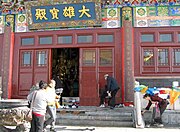
Egaku obtained a statue of Avalokitesvara from the Central Peak of Mount Wutai. The photo is of the modern temple.

Guanyin Leaps is on Mount Putuo. Silla Reef is to the east of Guanyin Leaps. Egaku's ship ran aground on Silla Reef.

Xifang Jingyuan is next to Guanyin Leaps on Mount Putuo. The temple houses a memorial hall commemorating Egaku.

Unwilling to Leave Guanyin Temple was the first permanent shrine for Egaku's statue of Avalokitesvara Bodhisattva on Mount Putuo.
In 863 Egaku went again on a pilgrimage to Mount Wutai. This time, he saw a wooden statue of Avalokiteśvara Bodhisattva with an elegant and refined appearance and an ever-joyful face while on a trip to a temple located in the central peak of Mount Wutai.Egaku wished to take this statue back to Japan and asked for the monks’ permission.The monks acquiesced to his request. He brought the statue to Ningbo's Kaiyuan Monastery on a palanquin, located the merchant Zhang Youxing's ship, and prepared to leave for Japan.However, the statue became extremely heavy, and he was unable to bring it onto the ship.Egaku succeeded in bringing the statue aboard the ship only with the combined efforts of numerous merchants from Silla. The boat then set sailed and approached the waters near Putuoshan where huge angry waves and violent winds impeded its progress.The ship went aground on Silla Reefand then it drifted to the Cave of Tidal Sounds.Egaku that evening had a dream where he saw a foreign monk who told him, "If you place me on this mountain, I will command the winds to send you on your way."Egaku told everyone aboard of his dream, and everyone was astonished.Still, they came ashore and built a straw hut to place the statue of Avalokiteśvara Bodhisattva.After making farewell obeisance to the statue, they boarded the ship and left for Japan.An inhabitant of Putuoshan surname Zhang witnessed these events and enshrined the statue in his house for worship. After his death, they built the first permanent shrine to Guanyin Bodhisattva on Putuoshan in 916 CE, named "Unwilling to Leave Guanyin Temple."Later generations of worshipers honored Egaku as the founder of the Avalokiteśvara bodhimanda on Putuoshan.Putuoshan now has an "Master Egaku Commemorative Hall" with a shrine dedicated to Egaku and thirty-three manifestations of Avalokitesvara located at Xifang Jingyuan, the temple next to Guanyin Leaps
Modern Discoveries
Archaeologists discovered a stone dharani pillar decorated with three entwining dragons and engraved with the text of the Uṣṇīṣa Vijaya Dhāraṇī Sūtra in Kyoto's Anshō-ji Temple in 1953.Egaku brought this column back to Japan either in 841 or 842 CE.One can see the column on display at the Kyoto National Museum.
Movies
In the acclaimed 2013 movie Avalokitesvara, a loose adaptation of the Putuoshan genesis story, Nagaizumi Hideo starred as Egaku.
Sources
- Binghenheimer, Marcus (2016). Island of Guanyin Mount Putuo and Its Gazetteers. Oxford University Press. ISBN 9780190456191.
- Chen, Chong (陈翀) (2010).慧萼东传枟白氏文集枠及普陀洛迦开山考 [On the Spread of Baishi Wenji to Japan by Hui E and the First Temple on Putuo‐Luojia Mountain]. 浙江大学学报 (人文社会科学版) Journal of Zhejiang University (Humanities and Social Sciences Edition) (in Chinese). 40 (5): 44–54.
- Foguangshan Foundation for Buddhist Culture and Education (佛光山文教基金會) (1989). 慧萼 [Hui'E]. 佛光山大詞典 (Foguangshan Dictionary of Buddhism) (in Chinese). p. 7605. ISBN 9789574571956. Retrieved 12 July 2019.
- Foguangshan Foundation for Buddhist Culture and Education (佛光山文教基金會) (1989). 齊安 [Qi'an]. 佛光山大詞典 (Foguangshan Dictionary of Buddhism) (in Chinese). p. 7472. ISBN 9789574571956. Retrieved 12 July 2019.
- Foguangshan Foundation for Buddhist Culture and Education (佛光山文教基金會) (1989). 義空 [Yikong]. 佛光山大詞典 (Foguangshan Dictionary of Buddhism) (in Chinese). p. 7010. ISBN 9789574571956. Retrieved 12 July 2019.
- Groner, Paul (1997). Ryogen and Mount Hiei: Japanese Tendai in the Tenth Century. University of Hawaii Press. ISBN 9780824822606.
- Hashimoto, Shinkichi (橋本進吉) (1972) [1922]. "慧蕚和尚年譜(Chronology of the Monk Egaku)".橋本進吉博士著作集 [Collected Works Authored by Dr. Hashimoto Shinkichi] (in Japanese). 12. 岩波書店.
- Hibino, Kō (日比野晃) (1972).禅の受容についての一考察―橘嘉智子と栄西の場合 [The Receptiveness of Zen in Japan-The Case Study on Tachibana Kachiko and Eisai]. 中日本自動車短期大学論叢 (in Japanese) (3–4): 107–114.
- Katsūra, Noriko (勝浦令子) (2017).平安期皇后・皇太后の<漢>文化受容――信仰を中心に―― [Acceptance of Chinese culture by the Empress and Empress Dowagers of the Heian Period ---From the Viewpoint of Religious Beliefs]. 中古文学会春季大会・平安文学における<漢>の受容ーーその日本化の様相 (in Japanese): 107–120.
- Ōtsuki, Yōko (大槻暢子) (2008).唐僧義空についての初歩的考察――唐商徐公祐から義空への書簡―― [Rudimentary Studies of Tang Priest Giku: The Letters Addressed to Tang Priest Giku from a Tang Merchant Jokoyu]. 東アジア文化交渉研究 (in Japanese). 1: 129–140.
- Park, Hyun-kyu (扑現圭[박현규]) (2003). Translated by Yang, Yulei (杨雨雷). (Original language in Korean).中国佛教圣地普陀山与新罗礁 [China’s Buddhist Holy Land Putuoshan and Silla Reef]. 浙江大学学报 (人文社会科学版) Journal of Zhejiang University (Humanities and Social Sciences Edition) (in Chinese). 33 (1): 39–46.
- Putuoshan (2017). 慧锷 [Hui E [Egaku]]. 普陀山佛教网 (in Chinese). Retrieved 12 July 2019.
- Reeves, Kristopher L. (2018). Of Poetry, Patronage and Politics: From Saga to Michizane, Sinitic Poetry in the Early Heian Court. Columbia University.
- Tanaka, Fumio (田中史生); Ge, Jiyong (葛継勇); Lee, Yonghyeon (李鎔賢[이용현]); Wang, Haiyan (王海燕) (1 June 2011). 入唐僧慧萼の求法活動に関する基礎的研究 [A Basic Study of the Japanese Monk, Egaku in the Tang Dynasty] (PDF). KAKEN (in Japanese). Retrieved 12 July 2019.
- Wang, Liansheng (王連胜) (2009).普陀名山溯源 [The Origin of the Famous Putuoshan]. 佛教文化 (Buddhist Culture) (in Chinese) (3): 12–19.
- Wang, Liansheng (王連胜) (2009).普陀山寺院通览 [An Overview of the Temples in Putuoshan]. 佛教文化 (Buddhist Culture) (in Chinese) (3): 50–67.
- Yü, Chün-Fang (2000). "P'u Tuo Shan". Kuan-yin, The Chinese Transformation of Avalokiteśvara. Columbia University Press. pp. 353–406. ISBN 9780231120296.