

Introduction
Charles Pierre Péguy (French: [ʃaʁl peɡi]; 7 January 1873 – 5 September 1914) was a noted French poet, essayist, and editor. His two main philosophies were socialism and nationalism, but by 1908 at the latest, after years of uneasy agnosticism, he had become a believing but non-practicing Roman Catholic. From that time, Catholicism strongly influenced his works.
Biography
Péguy was born to poverty in Orléans. His mother Cécile, widowed when he was an infant, mended chairs for a living. His father, Désiré Péguy, was a cabinet maker, who died in 1874 as a result of combat wounds. He studied at the Lycée Lakanal in Sceaux, winning a scholarship at the École Normale Supérieure, where he attended notably the lectures of Henri Bergson and Romain Rolland, whom he befriended. He formally left the École Normale Supérieure, without graduating, in 1897, even though he continued attending some lectures in 1898. Influenced by Lucien Herr (librarian of the École Normale Supérieure), he became an ardent Dreyfusard.
In 1897, at age 24, Péguy married Charlotte-Françoise Baudoin; they had one daughter and three sons, one of whom was born after Péguy's death. Around 1910 he fell deeply in love with Blanche Raphael, a young Jewish friend, however he was faithful to his wife.
From his earliest years, he was influenced by socialism. In 1895 Péguy joined the Socialist Party. From 1900 to his death in 1914, he was the main contributor and the editor of the literary magazine Les Cahiers de la Quinzaine, which first supported the Socialist Party director Jean Jaurès. Péguy ultimately ended his support after he began viewing Jaurès as a traitor to the nation and to socialism. In the Cahiers, Péguy published not only his own essays and poetry, but also works by important contemporary authors such as Romain Rolland.
His free verse poem, "Portico of the Mystery of the Second Virtue", has gone through more than 60 editions in France. It was a favorite book of Charles de Gaulle.
When the Great War broke out, Péguy became a lieutenant in the 19th company of the French 276th Infantry Regiment. He died in battle, shot in the forehead, near Villeroy, Seine-et-Marne on the day before the beginning of the Battle of the Marne. There is a memorial to Péguy near the field where he was killed.

Influence
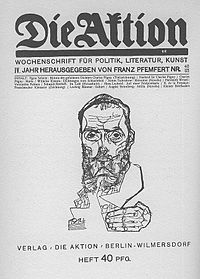
Benito Mussolini referred to Péguy as a "source" for Fascism, Péguy would have likely been horrified by this appropriation. During World War II both supporters and opponents of Vichy France cited Péguy. Edmond Michelet was the first of many members of the French Resistance to quote Péguy; de Gaulle, familiar with Péguy's writing, quoted him a 1942 speech. Those who opposed Vichy's anti-Semitism laws often cited him. By contrast, Robert Brasillach praised Péguy as a "French National Socialist", and his sons Pierre and Marcel wrote that their father was an inspiration for Vichy's National Revolution ideology and "above all, a racist".
The English novelist Graham Greene was aware of Péguy, alluding to him in Brighton Rock, while The Heart of the Matter "bears an epigraph from Péguy'". In The Lawless Roads Greene refers to "Péguy' challenging God in the cause of the damned".
In 1983, Geoffrey Hill published a poem as homage to Péguy, entitled The Mystery of the Charity of Charles Péguy.
Famous quotations
"The sinner is at the very heart of Christianity. Nobody is so competent as the sinner in matters of Christianity. Nobody, except the saint." This is the epigraph to Graham Greene's novel The Heart of the Matter (1951).
"It will never be known what acts of cowardice have been committed for fear of not looking sufficiently progressive." (Notre Patrie, 1905).
"Tyranny is always better organised than freedom".
"Kantian ethics has clean hands but, in a manner of speaking, actually no hands."
"How maddening, says God, it will be when there are no longer any Frenchmen"
"There will be things that I do that no one will be left to understand." (Le Mystère des saints Innocents)
"It is impossible to write ancient history because we do not have enough sources, and impossible to write modern history because we have too many". (Clio, 1909)
"Everything begins in mysticism and ends in politics." (Notre Jeunesse, 1909)
Works
Essays
- (1901). De la Raison.
- (1902). De Jean Coste.
- (1905). Notre Patrie.
- (1907–8). Situations.
- (1910). Notre Jeunesse.
- (1910). Victor-Marie, Comte Hugo.
- (1911). Un Nouveau Théologien.
- (1913). L'Argent.
- (1913). L'Argent Suite.
- (1914). Note sur M. Bergson et la Philosophie Bergsonienne.
- (1914). Note Conjointe sur M. Descartes et la Philosophie Cartésienne (posth.)
- (1931). Clio. Dialogue de l'Histoire et de l'âme Païenne (posth.)
- (1972). Véronique. Dialogue de l'Histoire et de l'âme Charnelle. Paris: Gallimard (posth.)
Poetry
- (1912). Le Porche du Mystère de la Deuxième Vertu.
- (1913). La Tapisserie de Sainte Geneviève et de Jeanne d'Arc.
- (1913). La Tapisserie de Notre-Dame.
- (1913). Ève.
Plays
- (1897). Jeanne d'Arc. Paris: Librairie de la Revue Socialiste.
- (1910). Le Mystère de la Charité de Jeanne d'Arc.
- (1912). Le Mystère des Saints Innocents.
Miscellany
- (1927). Lettres et Entretiens (posth.)
- (1980). Correspondance, 1905-1914: Charles Péguy - Pierre Marcel. Paris: Minard (posth.)
Collected Works
- (1916–55). Œuvres Complètes de Charles-Péguy. Paris: Gallimard (20 vols.)
- (1941). Œuvres Poétiques Complètes. Bibliothèque de la Pléiade: Gallimard.
- (1987–92). Œuvres en Prose Complètes:
- Tome I. Bibliothèque de la Pléiade: Gallimard, 1987.
- Tome II. Bibliothèque de la Pléiade: Gallimard, 1988.
- Tome III. Bibliothèque de la Pléiade: Gallimard, 1992.
Works in English translation
- (1943). "Freedom," Commonweal, January 8, p. 293.
- (1943). Basic Verities. Prose and Poetry, Trans. by Ann and Julien Green. New York: Pantheon Books Inc.
- (1944). Man and Saints. Prose and Poetry, Trans. by Ann and Julien Green. New York: Pantheon Books Inc.
- (1950). The Mystery of the Charity of Joan of Arc, Trans. by Julien Green. New York: Pantheon Books Inc. [London: Hollis & Carter, 1950; Carcanet, 1986].
- (1956). The Mystery of the Holy Innocents, Trans. by Pansy Pakenham. London: The Harvill Press [New York: Harper, 1956].
- (1999). "The Mystery of the Holy Innocents," Communio 26 (2).
- (1958). Temporal and Eternal, Tran. by Alexander Dru. London: The Harvill Press [New York: Harper, 1958; Liberty Fund, 2001].
- (1964). A Vision of Prayer. Mount Saint Bernard Abbey: Saint Bernard Press.
- (1965). God Speaks. New York: Pantheon Books Inc.
- (1970). The Portico of the Mystery of the Second Virtue, Trans. by Dorothy Brown Aspinwall. Metuchen, N.J.: Scarecrow Press.
- (1994). "On the Mystery of Hope," Communio 21 (3).
- (1996). The Portal of the Mystery of Hope, Trans. by David Louis Schindler Jr. Edinburgh: T. & T. Clark [Wm. B. Eerdmans Publishing Co., 2003; Continuum, 2005].
- (2009). "On Money," Communio 36 (3).