


Introduction
Brian O'Higgins (Irish: Brian Ó hUigínn; 1 July 1882 – 10 March 1963), also known as Brian na Banban, was an Irish revolutionary,poet, Gaelic revivalist, Sinn Féin politician and a founding member of the organisation. He was President of Sinn Féin from 1931 to 1933.
Early Life
O'Higgins was born in Kilskyre, County Meath in 1882 to a family with strong Fenian and Parnellite traditions. His grandfather was a poor scholar from County Tyrone and made his way down to Tara to take part in the 1798 Rising. He was eduacted at the Kilskyre National School for ten years from 1886 before becoming a draper's apprentice at nearby Clonmellon. He was also in this period contribute articles for local newspapers. He moved to Dublin in 1901 as a teenager to work as a barman and during his time there he joined the O'Growney Branch of the Gaelic League and Saint Finians Hurling Club. His health declined in 1903 and he returned to live in his native Meath. It was during his recuperation at home that he co-founded the local hurling club, whose grounds were later named in his memory (Páirc Uí hUigín).
O'Higgins was present at the first annual convention of the National Council of Sinn Féin on 28 November 1905, and wrote its first party anthem entitled 'Sinn Féin Amháin'. The song was sung at all gatherings of the organisation for a number of years.
After attending an Irish-language summer college at Ballingeary, Co. Cork, O'Higgins received a language teacher's certificate in 1906 and began work as a múinteoir taistil (travelling teacher) for the Gaelic League. During this time he founded Coláiste Uí Chomhraidhe, an Irish language college in Carrigaholt, County Clare.He became a good friend of Pádraig Pearse, after they first met in 1906.
Brian na Banban first published his poetry in book form in 1907 as The Voice of Banba: Songs and Recitations for Young Ireland. Some of O'Higgins' work is anodyne and sentimental stuff, as per his Christmas Stories and Sketches (1917), Hearts of Gold (1918) and Songs of the Sacred Heart (1921). These works were commended by the Bishop of Killaloe, the Sinn Féin-supporting Michael Fogarty, as being 'full of simple and profound religious feeling'.
Oh, who is Ireland's enemy? Not Germany nor Spain,
Nor Russia, France nor Austria, they forged for her no chain.
Nor quenched her hearths, nor razed her homes, nor laid her altars low,
Nor sent her sons across the hills amid the winter's snow.
Who murdered kingly Shane O'Neill? Who poisoned Owen Roe?
Who struck Red Hugh O'Donnell down? Who filled our land with woe?
By night and day a thousand times, in twice four hundred years,
'Till every blade of Irish grass was wet with blood and tears.— Brian na Banban, Who Is Ireland's Enemy?, 1917.
Republican Activity
O'Higgins was a founding member of the Irish Volunteers in 1913, which organised to work for Irish independence. On Easter Monday of 1916 he was in a group of Volunteers who were held at 41 Parnell Square as reserves, on account of their age, health or physical condition. This group was called to the GPO at six o'clock that evening. He was put on guard duty at the main entrance to the GPO and he later served under Quartermaster Michael Staines. He assisted in the evacuation of the wounded from the GPO on Friday evening and spent the night in a shed off Moore Street. He was deported to Stafford Gaol on May 1st and interned in Frongoch internment camp until February 1917.
In May 1918 he was arrested and deported to Birmingham Jail, and was elected Sinn Féin candidate for West Clare during the 1918 General Election.
In January 1919, Sinn Féin MPs who had been elected in the Westminster elections of 1918 refused to recognise the Parliament of the United Kingdom and instead assembled in Dublin as a revolutionary parliament called Dáil Éireann. He was involved in the establishment of the Republican courts in County Clare.
O'Higgins was re-elected as a Sinn Féin Teachta Dála (TD) at the 1921, 1922 and 1923 elections.
He opposed the Anglo-Irish Treaty and voted against it. During the Irish Civil War, he was imprisoned in Oriel House, Mountjoy Jail and Tintown and went on hunger strike for twenty five days.
He resigned from Sinn Féin in 1934 along with Mary MacSwiney in protest against the election of Fr. Michael O'Flanagan as President citing that O'Flanagan had a state job and was "on the pay-roll of a usurping government".
In December 1938, O'Higgins was one of a group of seven people, who had been elected to the Second Dáil in 1921, who met with the IRA Army Council under Seán Russell. At this meeting, the seven signed over what they believed was the authority of the Government of Dáil Éireann to the Army Council. Henceforth, the IRA Army Council perceived itself to be the legitimate government of the Irish Republic and, on this basis, the IRA and Sinn Féin justified their rejection of the states of the Republic of Ireland and Northern Ireland and political abstentionism from their parliamentary institutions.
Today, the Continuity IRA claim to be the heirs of this legitimacy and believe to be the legitimate continuation of the original Irish Republican Army or Óglaigh na hÉireann.
Later Life
From the late 1920's he ran a successful business publishing greeting cards, calendars and devotional materials decorated with Celtic designs and O'Higgins' own verses.
Following the suppression of An Phoblacht in 1937, he founded and edited the Wolfe Tone Weekly from 1937–1939 until it was also banned by the Free State Government. From 1932 to 1962 he published the Wolfe Tone Annual, volumes which gave popular accounts of episodes in Irish history from a republican viewpoint and he intended to cheer and inspire those true to 'the Separatist Idea and devoted to the vindication of all those who have sacrificed themselves for the full Independence and Gaelicisation of Ireland'.
He was a devout Catholic and was heavily critical of those who tried to link the Republican struggle with socialism and communism. Several of his children became Catholic priests.
Death
O'Higgins died during a retreat to Saint Anthony's Church in Clontarf, on 10 March 1963. He is buried in Glasnevin Cemetery.

Brian O'Higgins' gravestone.
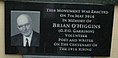
Plaque in Kilskyre erected in memory of Brian O'Higgins.

Irish Ballads, Poetry and Writings
Ó hUigínn's wrote numerous ballads and poems about Ireland throughout his life time. Many which are still sung at Feiseanna and Fleadh Ceoils.
Books, Journals, Newspapers
- A Bunch of Wild Flowers, Poems on Religious Subjects; published 1906.
- The Voice of Banba, Songs, Ballads and Satires; published 1907.
- By a Hearth in Éireann: Stories and Sketches; published 1908.
- At the Hill o' the Road, Songs and poems; published 1909
- Síol na Saoirse, Dánta; published 1910.
- Hearts of Gold: Stories and Sketches; published 1917.
- The Soldier's Story of Easter Week; published 1925.
- Poems of 1916 [and] Prison Letters, 1917 - 1920; (unpublished).
- Unconquered Ireland; published 1927
- Songs of Glen na Móna; published 1929.
- The Little Book of Christmas; published 1930.
- A Rosary of Song, Poems on Sacred Subjects; published 1932.
- Martyrs for Ireland: the story of MacCormick and Barnes; published 1940.
- Oliver of Ireland: The Story of Blessed Oliver Plunkett; published 1945.
- Brian O'Higgins Bulletin Christmas; published 1962.
- Wolfe Tone Journal
Ballads & Poems
- Brave Maurice Ó Néill (Ballad).