

Introduction
The Balšić (Serbian Cyrillic: Балшић, pl. Balšići / Балшићи; Latin: Balsich; Albanian: Balsha) was a noble family that ruled "Zeta and the coastlands" (southern Montenegro and northern Albania), from 1362 to 1421, during and after the fall of the Serbian Empire. Balša, the founder, was a petty nobleman who held only one village during the rule of Emperor Dušan the Mighty (r. 1331–1355), and only after the death of the emperor, his three sons gained power in Lower Zeta after acquiring the lands of gospodin Žarko (fl. 1336–1360) under unclear circumstances, and they then expanded into Upper Zeta by murdering voivode and čelnik Đuraš Ilijić (r. 1326–1362†). Nevertheless, they were acknowledged as oblastni gospodari of Zeta in edicts of Emperor Uroš the Weak (r. 1355–1371). The family is known to have seized control through trickery, such as against the Dukagjini family, and many people were deported or murdered. After the death of Uroš (1371), the family feuded with the Mrnjavčevići, who controlled Macedonia. In 1421, Balša III, on his death, passed the rule of Zeta to his uncle, Despot Stefan the Tall.
History
Origin
The Balšić family was first mentioned in a charter of Emperor Stefan Uroš V, dated 29 September 1360. Due to sources having nothing reliable to say about their ancestors, there has been speculation on their origin, which some deem unknown. Apart from Mavro Orbini's tale, there are really no other accounts on their origin. In oral tradition, they descended via Grand Prince Vukan Nemanjić. There exist fragmental assertions that they descended from "Emperor Nemanja". The oldest mention of a Balšić is from 1304, when Serbian Queen Helen of Anjou sent a letter in Slavic through her trustee Matija Balšić from Bar (Mata de Balsich de Antibaro) to Ragusa. A theory is that this Balšić married a female member of the Nemanjić royal family, and thus established the noble family of Balšić. There has been various opinions about the family's origin.
Karl Hopf (1832–1873) considered "unquestionably part of the Serb tribe". Ivan Stepanovich Yastrebov (1839–1894), Russian Consul in Shkodër and Prizren, when speaking of the Balšići, connected their name to the Roman town of Balletium (Baleč) located near modern Shkodër. According to Čedomilj Mijatović (1842–1934), the Balšić family had ultimate origin in the House of Baux from Provence (southeastern France); from that family sprung an Italian family (del Balzo), and from them the Balšići, and from them a Romanian family. Serbian historian Vladimir Ćorović (1885–1941) concluded, based on their name, that they had Roman (Vlach) origin. Croatian ethnologist Milan Šufflay (1879–1931) mentioned them as of "Romanian and Vlach origin". Croatian linguist Petar Skok considered them to have been of Vlach origin, and Serbian historian Milena Gecić supported his theory. Giuseppe Gelcich theorized on the origin in his La Zedda e la dinastia dei Balšidi: studi storici documentati (1899). The theory asserting them as descendants of the Frankish nobleman Bertrand III of Baux, a companion of Charles d'Anjou is regarded as highly improbable. German linguist Gustav Weigand (1860–1930) alleged a mixed Albanian-Aromanian origin after he noted that the family name was included in a list of early Albanian surnames in Romania.
In modern scholarship John Fine, Donald Nicol, Peter Bartl view the origin of the Balšić family as Serbian, while Robert Elsie mentions them as of "probably Slavic origin". Noel Malcolm suggests a dual Serbo-Albanian identity.
Early history
According to Mavro Orbini (writing in 1601), Balša, the eponymous founder, was a petty nobleman that held only one village in the area of Lake Skadar during the rule of Emperor Dušan the Mighty (r. 1331-1355). Only after the death of the emperor, Balša and his three sons gained power in Lower Zeta after acquiring the lands of gospodin Žarko (fl. 1336-1360) and by murdering voivode and čelnik Đuraš Ilijić (r. 1326-1362†), the holders of Lower and Upper Zeta, respectively. Balša dies the same year, and his sons, the Balšić brothers, continue in ruling the province spanning Podgorica, Budva, Bar and Skadar.
The Balšići managed to elevate themselves from petty nobility to provincial lords.
Heads
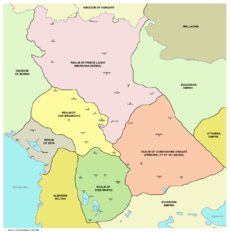

Zeta [Zoomed].
- Balša (I) (fl. 1360–62)
- Đurađ I (1362–1378), [Lord of] Skadar (Shkodër)
- Balša II (1378–1385), [Lord of] Skadar and Drač (Durrës)
- Đurađ II (1385–1403), [Lord of] Skadar, Budva, Podgorica, Drač, Drivast and Lješ (Lezhë), Autokrat of Zeta and the coastlands
- Balša III (1403–1421), [Lord of] Bar
Family tree
Simplified family tree:
- Balša (I) (fl. 1360–62)
- Stracimir
- Đurađ II Balšić
- Balša III
- Đurađ II Balšić
- Đurađ I, married Olivera Mrnjavčević (1st) and Teodora Dejanović (2nd)
- Jelisaveta or Jelisanta (d. 1443), Olivera's daughter
- Gojslava or Goisava (d. 1398), married Radič Sanković, lord of Nevesinje, Popovo Polje and Konavli
- Jevdokija, married Esau de' Buondelmonti, the ruler of Epirus (1385–1411)
- Giorgio de' Buondelmonti, ruler of Epirus 1411
- Konstantin, married Helena Thopia
- Stefan Balšić "Maramonte" (fl. 1419–40), pretender to Zeta
- Jelena
- Đurađ (illegitimate)
- Stefan Strez Balšić
- Ivan
- Gojko
- Stefan Strez Balšić
- Balša II
- Ruđina
- Vojislava, married Karl Topia, the "Prince of Albania", with whom she had one son, Gjergj Thopia, Duke of Durazzo, and two daughters, Elena Thopia, Lady of Krujë, married Konstantin Balšić, and Vojislava
- Stracimir