

Introduction
Adolf Erik Ehrnrooth (9 February 1905, Helsinki – 26 February 2004) was a Finnish general who served during the Winter and Continuation wars.
Early life
Born in Helsinki, Ehrnrooth entered cadet school in 1922 and served in the Uusimaa Dragoon Regiment (Uudenmaan Rakuunarykmentti). In 1958 he married a Danish countess Karin-Birgitte Schack who was a lady-in-waiting and a close friend of Queen Ingrid of Denmark. They had three children: Karin, Hans and Eva.
Military career
During the brief Winter War against the Soviet Union, he served on the staffs of the 7th Division and the Cavalry Brigade. When the Continuation War, also against the Soviet Union, broke out in June 1941, he served as the chief of staff of the 2nd Division until he was seriously wounded. After he recovered he was appointed to lead the 7th Infantry regiment (JR 7) of the 2nd Division. During the battles on the Karelian Isthmus, he was awarded the Mannerheim cross. He also received the Grand Cross of the Royal Swedish Order of the Sword.
After the war, he led an active military career until he retired in 1965.
Later life
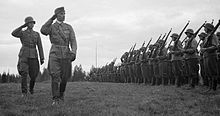
Adolf Ehrnrooth was the face and voice most associated with rehabilitation of the soldiers who secured Finland her independence. The long post-war era during which it simply was not progressive to value the military ended in the early 1990s, at which time his charismatic persona was at its height.
He became a figurehead for the whole veteran community—straight-talking and unapologetic. When he found out that many nationalist youths cited him as an idol, he blasted them squarely by saying that he might have in his own youth held nationalistic views, but that Finland's path was now in the European Union, a view the nationalists did not hold.
Voice impressionists have found his idiosyncratically emphasized speech patterns and overheavily guttural snarls a rich ground to harvest.For them he is one of the indispensable voices.

In his last statement he gave support to ProKarelia (Finnish NGO) and its plan for the Return of Ceded Territories. He said that he defended the borders of Finland declared in the Treaty of Tartu and considered them the only proper borders of Finland and that it was great injustice that the Soviet Union had taken these territories.
General Ehrnrooth died on 26 February 2004, and is buried in Hietaniemi cemetery, Helsinki. He was voted as the 4th greatest Finn of all time by the Finnish public during the Suuret suomalaiset (Great Finns) competition in 2004.