

Introduction
Janet Louise Yellen (born August 13, 1946) is an American economist, educator and government official who has served as the 78th United States secretary of the treasury since January 26, 2021. A member of the Democratic Party, she previously served as the 15th chair of the Federal Reserve from 2014 to 2018. She is the first woman to hold either role. She is also a professor emerita at Haas School of Business at the University of California, Berkeley, and formerly a distinguished fellow in residence at the Brookings Institution.
Yellen was a member of the Federal Reserve Board of Governors from 1994 to 1997 and again from 2010 to 2018. She chaired the Council of Economic Advisers under President Bill Clinton from 1997 to 1999 and was the president of the Federal Reserve Bank of San Francisco from 2004 to 2010. She served as vice chair of the Federal Reserve from 2010 to 2014. Yellen was nominated by President Barack Obama to succeed Ben Bernanke as chair of the Federal Reserve from 2014 to 2018. She served one term and was not re-appointed by President Donald Trump.
Early life and education
Yellen was born on August 13, 1946, to a family of Polish Jewish ancestry in the Bay Ridge neighborhood of New York City's Brooklyn borough, where she also grew up. Her mother was Anna Ruth (née Blumenthal; 1907–1986), an elementary school teacher, and her father was Julius Yellen (1906–1975), a family physician, who worked from the ground floor of their home. Her mother quit her job to take care of Janet and her older brother, John. Yellen graduated from local Fort Hamilton High School in 1962; she was the class valedictorian.
Yellen graduated summa cum laude and Phi Beta Kappa from Pembroke College in Brown University in 1967 with a bachelor's in economics. At Brown, she switched her planned major from philosophy to economics and was particularly influenced by professors George Borts and Herschel Grossman. She received her MA and PhD in economics from Yale University in 1971. Her dissertation was titled Employment, Output and Capital Accumulation in an Open Economy: A Disequilibrium Approach under the supervision of (later to be) Nobel laureate James Tobin. As a teaching assistant, Yellen was so meticulous in taking notes during Tobin's macroeconomic class that they ended up as the unofficial textbook circulated among generations of graduate students, and known as the "Yellen Notes". Her former professor Joseph Stiglitz, another Nobelist, has called her one of his brightest and most memorable students. Yellen was the only woman among the two dozen economists who earned their doctorates from Yale in 1971.
Academic career
After receiving her Ph.D, Yellen was appointed as an assistant professor of economics at Harvard University, where she taught from 1971 to 1976. In 1977, she was recruited to become an economist with the Federal Reserve Board of Governors by Edwin M. Truman, who had known Yellen from Yale. Truman was a junior professor and heard her oral exam, and had recently taken over the Fed's Division of International Finance. She was assigned to research international monetary reform.
While at the Fed, she met her husband George Akerlof in the bank's cafeteria; they wed in 1978, less than a year later. By the time of their marriage, Akerlof had already accepted a teaching position at the London School of Economics (LSE). Yellen left her post at the Fed to accompany him, and was employed as an economics lecturer by LSE. They remained in London for two years, then returned to the United States.
In 1980, Yellen joined the faculty at the Berkeley's Haas School of Business to conduct macroeconomics research and teach undergraduate and MBA students for more than two decades, also held a joint appointment with the University of California, Berkeley's Department of Economics from 1999 to 2003. She was just the second woman at Berkeley-Haas to earn tenure in 1982, as well as the title of full professor in 1985. Yellen was the Bernard T. Rocca, Jr. Professor of International Business and Trade from 1992 to 1994 and was named the Eugene E. and Catherine M. Trefethen Professor of Business Administration and Professor of Economics in 1999. During her time as active faculty member, Prof. Yellen earned the Haas School's outstanding teaching award twice. She subsequently became professor emeritus at UC Berkeley.
Yellen has also served as an adviser to the Congressional Budget Office, the Brookings Panel on Economic Activity and the National Science Foundation’s Panel in Economics. She was a research associate of the National Bureau of Economic Research.
Research and publications
Yellen has had a remarkable academic career, largely focused on analysis of the mechanisms of unemployment and labor markets, monetary and fiscal policies, and international trade. She's written a few widely cited papers, often collaborating with her husband professor George Akerlof on research.
Since 1980s, Yellen with Akerlof address what's known in the economics literature as "efficiency wage theory" – the idea that paying people more than the market wage does, in fact, increase their productivity. Their 1990 paper, entitled "The Fair-Wage Effort Hypothesis and Unemployment," christen "the fair wage-effort hypothesis," considered by economists a significant contribution to the topic: "is a precursor to the efficiency wage literature", "It had an influence, although the work on efficiency wage theory has had a bigger influence." Akerlof and Yellen introduced the gift-exchange game, a model in which argue that workers who receive less than what they perceive to be a fair wage will purposely work less hard as a way to take revenge on their employer.
Another important work, "An Analysis of Out-of-Wedlock Childbearing in the United States" co-written with Akerlof and Michael Katz and published in 1996, aims to explain why out of wedlock births had grown considerably in previous decades in the United States. Research study led to a theory called "reproductive technology shock," arguing that the increased availability of both abortion and contraception in the late 1960s and early 1970s eroded the social norms surrounding sex, pregnancy and marriage, leading to a sharp decline in the stigma of unwed motherhood.
Federal Reserve (1994–1997)
In August 1994, Yellen took leave from Berkeley for five years. President Bill Clinton appointed her as a member of the Federal Reserve Board of Governors. The Senate Banking Committee approved Yellen's nomination by a vote of 18 to 1. The only vote against her came from Senator Lauch Faircloth, Republican of North Carolina, who had told that her concerns should be limited to "inflation, inflation and inflation". Nomination was confirmed by the United States Senate by a vote of 94–6. Yellen succeeded Republican Wayne Angell on August 12, 1994, alongside Alan Blinder, who served as vice chairman, the first Democratic appointees to the Board since 1980.
In July 1996, the Federal Reserve under Chairman Alan Greenspan, resisted pressure to raise interest rates as unemployment declined. But Yellen marshaled academic research to dissuade Greenspan from committing the Fed to a zero inflation policy and demonstrate that the central bank should seek to moderate inflation rather than eliminate it. The study showed that a little inflation rate in the 2-4 percent range actually was better basis to minimize unemployment and increase economic growth than the goal of zero.
On February 17, 1997, Yellen left the Federal Reserve to become chair of the Council of Economic Advisers.
Council of Economic Advisers (1997–1999)
Yellen chaired President Clinton's Council of Economic Advisers (CEA) from February 18, 1997, replacing Joseph Stiglitz in office. She was confirmed unanimously by the Senate, the second woman to hold the job, following Laura Tyson. While at the CEA, she also chaired the Economic Policy Committee of the Organization for Economic Cooperation and Development from 1997 to 1999.
During her time with the Council of Economic Advisors, Yellen oversaw a landmark report "Explaining Trends in the Gender Wage Gap" focused on the gender pay divide in June 1998. Within this study, the Council analyzed data from 1969 to 1996 to determine the cause for women to earn substantially less than men. By observing trends attributable to issues like occupation/industry as well as familial status, it was determined that while the Equal Pay Act of 1963 was a step forward, there was no explanation as to why there was a 25 percent difference between average pay for women and men – an improvement from the 40 percent gap two decades earlier. It was concluded that this gap had no correlation with differences in productivity and, as such, was the repercussions of discrimination within the workforce.
In June 1999, Yellen announced that she was resigning from the CEA for personal reasons and would return to teaching at UC Berkeley.
Return to the Federal Reserve (2004–2018)
Federal Reserve Bank of San Francisco
On June 14, 2004, Yellen was assigned as president of the Federal Reserve Bank of San Francisco, the first woman to hold those position. She was a voting member of the Federal Open Market Committee (FOMC) on a rotating basis once every three years. During her time at the twelve Federal Reserve District Fed, she spoke publicly and in meetings of the Fed's monetary policy committee, regarding her concerns about the potential consequences of the boom in housing prices. However, Yellen did not lead the San Francisco Fed to "move to check [the] increasingly indiscriminate lending" of Countrywide Financial, the largest lender in the U.S. She served from 2004 to 2010, and left to take appointment as vice chair of the Federal Reserve Board of Governors.
In July 2009, Yellen was mentioned as a potential successor to Chairman Ben Bernanke when his term set to expire, before he was re-nominated by President Barack Obama.
Vice Chair of the Federal Reserve
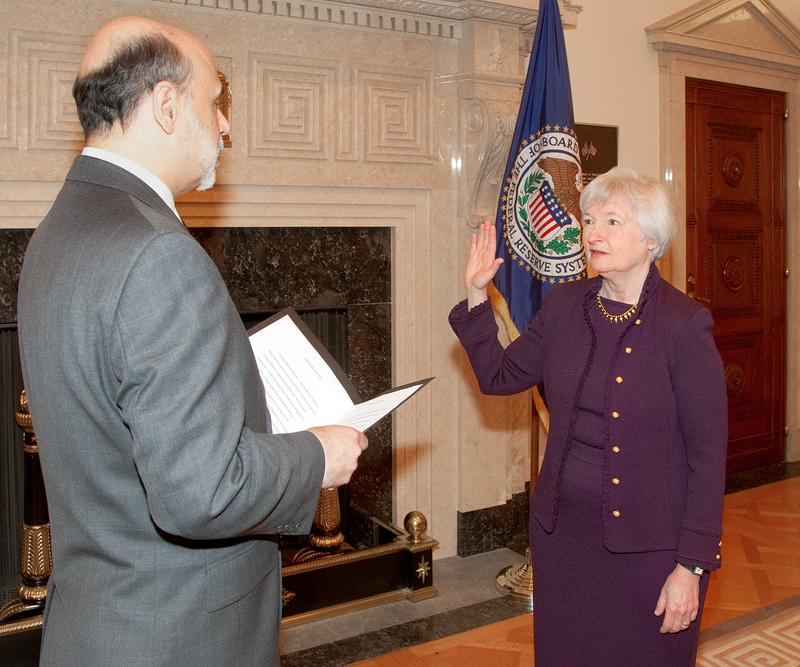
On April 28, 2010, President Obama nominated Yellen to succeed Donald Kohn as vice chair of the Federal Reserve. In July, the Senate Banking Committee voted 17–6 to confirm her, though the top Republican on the panel, Senator Richard Shelby of Alabama, voted no, saying he believed Yellen had an "inflationary bias". At the same time, on the heels of related testimony by Fed Chairman Bernanke, FOMC voting member James B. Bullard of the St. Louis Fed stated that the U.S. economy was "at risk of becoming 'enmeshed in a Japanese-style deflationary outcome within the next several years.'"
Bullard's statement was interpreted as a possible shift within the FOMC balance between inflation hawks and doves. Yellen's pending confirmation, along with those of Peter A. Diamond and Sarah Bloom Raskin to fill vacancies, was seen as possibly furthering such a shift in the FOMC. All three nominations were seen as "on track to be confirmed by the Senate".
On September 29, 2010, Yellen confirmed by the Senate on a voice vote, to be both a Member of the Board of Governors, and Vice Chairman of the Federal Reserve System. On October 4, 2010, Yellen was sworn in as vice chair for a four-year term that ended on October 4, 2014. Simultaneously she began a 14-year term as a member of the Federal Reserve Board filling a vacant seat last held by Mark W. Olson. Yellen was the second woman to hold the No. 2 post at the Fed, after Alice Rivlin, who had that role from 1996 to 1999.
Yellen as vice chair, by contrast with her predecessors, has acted more as an independent force within the institution. She has trying to persuade Bernanke and the rest of the committee to adopt her preferred course for monetary policy, advocating more aggressive steps to pump money into the economy to bring down unemployment. In January 2012, the Fed announced its own inflation target of two percent a year, after a long campaign by Bernanke and Yellen, who was an early supporter of inflation targeting in the face of opposition from Chairman Greenspan since 1990s.
Yellen was considered as the front-runner to succeed Bernanke as chair of the Federal Reserve when his second term ceased. The other leading candidate to the post was Lawrence Summers, a former President Clinton's treasury secretary and director of President Obama's National Economic Council. During the race, Summers has come under fire for his support for deregulating parts of the banking sector while he served in the Clinton administration, he also sparked controversy for his comments on women's aptitude in math and science when he was the president of Harvard University in 2005. In July 2013, Senate Democrats were circulating a letter that has been signed by roughly a third of the 54 Democratic and allied senators, largely represent the liberal wing of the Senate Democratic Caucus, urging President Barack Obama to appoint Yellen as chairwoman of the central bank. In addition, more than 500 professional economists from more than 200 colleges and universities across the United States signed an open letter in support of Yellen for Fed chair and sent it to the White House. On September 15, 2013, after weeks of opposition to his candidacy, Summers withdrew his name from consideration for the position.
Chair of the Federal Reserve
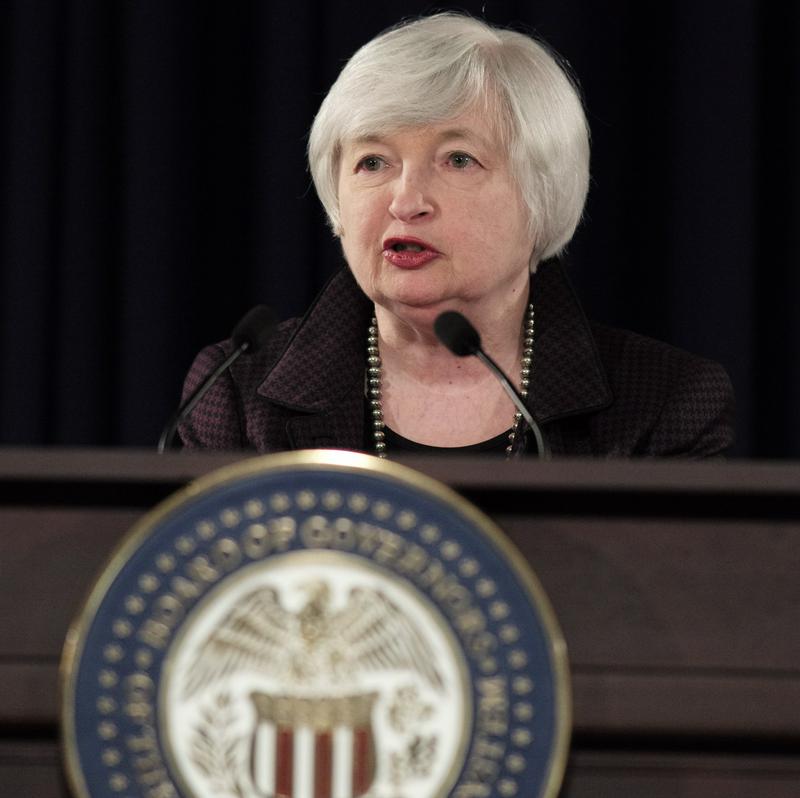


On October 9, 2013, Yellen was officially nominated to replace Bernanke as chair of the Federal Reserve, the first vice chair to be elevated to that post; via announcement, President Obama called her "one of the nation’s foremost economists and policymakers", and "exceptionally well-qualified for this role". During the nomination hearings held on November 14, 2013, Yellen defended the more than $3 trillion in stimulus funds that the Fed had been injecting into the U.S. economy.
On December 20, 2013, the U.S. Senate voted 59–34 for cloture on Yellen's nomination. On January 6, 2014, she was confirmed as chair of the Federal Reserve by a vote of 56–26, the narrowest margin ever for the position. In addition to being the first woman to lead U.S. central bank, or any major central bank, Yellen was also the first Democratic nominee to hold the job since Paul Volcker became chairman in 1979 (via President Jimmy Carter). She's notable also for being arguably the most liberal Fed leader since Marriner S. Eccles, who was appointed by President Franklin D. Roosevelt during the Great Depression. Until her appointment there has been only one female head of the central bank in history of Group of Eight ("G8") countries – Russia's Elvira Nabiullina. After being unanimously elected by the Federal Open Market Committee as its chair on January 30, 2014, she took office on February 3, 2014. In her 2014 semiannual testimony on monetary policy, Yellen said that while real estate, equities, and corporate bond prices "have risen appreciably and valuation metrics have increased" they were "generally in line with historical norms"; Yellen noted some concerns about valuations of "lower-rated corporate debt" (i.e., junk bonds), and noted that she and the Fed were monitoring trends, but did not believe that a so-called "everything bubble" was forming.
With Yellen as chair, the Federal Reserve increased its key interest rate on December 16, 2015. This was the first time the key interest rate was increased since 2006. During her tenure, the Fed has gradually raised rates four additional times, leaving its key rate in a still-low range of 1.25 percent to 1.5 percent – well low by historical standards. However, Fed policymakers once again have the ability to cut the rates to stimulate growth in case if the economy slows.
After the election of President Donald Trump in November 2016, Yellen argued that it would be inappropriate to weaken or repeal the Dodd–Frank Wall Street Reform and Consumer Protection Act.
Trump considered renominating Yellen for another term, but instead picked Fed Governor Jerome Powell, a Republican, to run the Federal Reserve once her term ended on February 3, 2018. After Trump's decision, Yellen announced that she would leave the Fed at the end of her term as chair. She was the briefest-serving Fed chair since G. William Miller from 1978 to 1979, and first in nearly 40 years to not receive a second term.
On February 2, 2018, her last day in office, Chair Yellen enforce unprecedented sanctions placed on Wells Fargo, the third largest U.S. bank, with a consent order that restrict the firm from future growth until the organisation fixes its internal problems. The move came in response to a string of "widespread consumer abuses and compliance breakdowns" at the company, including a fake accounts scandal. It marks the first time the Federal Reserve has imposed a cap on the entire assets of a financial institution.
Yellen has been called one of the most successful chairs of the Federal Reserve System from the perspective of the labor markets. During her term, the unemployment rate has dropped from 6.7 percent to 4.1 percent, the lowest in 17 years. It marks the first time the economy has added jobs throughout every month of any Fed chair's tenure. Yellen completed her time at the Fed with the lowest final unemployment rate of any Fed chair since William McChesney Martin in 1970. Under her tenure, the U.S. unemployment rate fell more than during any other chair's term in modern history when compared to the beginning of her term to its end. It has declined 2.6 percentage points, maximum in the post-World War II era. Meanwhile, inflation remains below the Fed's annual two percent target, which also led to suggestion that the Federal Reserve could have done more to bolster the economy without the risk of price increases.
Dr. Yellen holds a unique place in Federal Reserve history. In addition to being the first woman to lead the institution, she was also the first person ever to have served at the nation's central bank system with stints as a Fed Reserve chair (from 2014 to 2018), vice chair (from 2010 to 2014), president of the regional Federal Reserve Bank (at the San Francisco Fed, from 2004 to 2010), Fed governor (from 1994 to 1997), as well as Fed staff economist (from 1977 to 1978).
After the Federal Reserve (2018–2020)
On February 2, 2018, the Brookings Institution announced that Yellen would be joining the think tank as a distinguished fellow in residence with the Economic Studies program, effective February 5, 2018. She's been affiliated with the Hutchins Center on Fiscal and Monetary Policy at Brookings. Yellen was on a leave from position since selected as nominee to head the Treasury Department.
On June 27, 2017, Yellen stated that she did not expect another financial crisis "in our lifetime". Yellen explained that this assumption can be made due to her belief that banks are "very much stronger" as a result of Federal Reserve oversight. On December 11, 2018 Yellen later warned of the possibility of a financial crisis by citing "gigantic holes in the system" after her departure from the Federal Reserve.
On February 25, 2019, Yellen criticized President Trump's economic policies. When asked if she believes Trump has "a grasp of economic policy", Yellen said "No, I do not." In an interview with Marketplace, Yellen explained that she doubts that Trump could articulate the Federal Reserve's explicit goals of "maximum employment and price stability". Yellen pointed out Trump's claims that the Federal Reserve's goals involve trade, which she explains to be objectively false. This interview was a change in tone for Yellen, who traditionally handled her differences with Trump in a neutral manner.
On July 17, 2020, at the hearing of a select coronavirus subcommittee that was set up by the House Committee on Oversight and Reform, former Fed Chairs Bernanke and Yellen testifying to the United States Congress about the economic-policy response to the negative impact of the coronavirus pandemic. They urged lawmakers to act aggressively with fiscal stimulus on three areas: extending the supplementary unemployment payments; providing additional financial assistance to hard-hit states and local governments; and investing in the medical response to the pandemic.
On August 13, 2020, it has been reported that Yellen was among a handful of economists who briefed the Biden-Harris team on economic issues, but not officially joined the presidential campaign. The meeting made headlines for being one of the first times the Biden campaign announced who it was turning to for economic expertise. But few at the time predicted Yellen for any president's Cabinet posts. In the end, however, she edged out other top contenders to become the Biden's Treasury chief, including Fed Board Gov. Lael Brainard and Roger W. Ferguson Jr., a former vice chairman at the central bank. Yellen considered as somewhat unusual pick for treasury secretary, because her lack of experience in politics. Unlike predecessors, she wieved more of an academic thinker than traditional politican figure used to lawmaker horse-trading and dealmaking; qualities could be crucial to achieve goals of Biden's economic agenda in deeply partisan Congress.
Between 2018 and 2020, Yellen had received over $7 million in speaking fees from financial companies such as Barclays, Citigroup, Goldman Sachs, and the hedge fund Citadel after leaving the Federal Reserve. She's pledged to get official permission before taking part in any federal regulatory decisions involving companies that had paid speaking fees to her to avoid any conflicts of interest.
Secretary of the Treasury (2021–present)
Nomination and confirmation
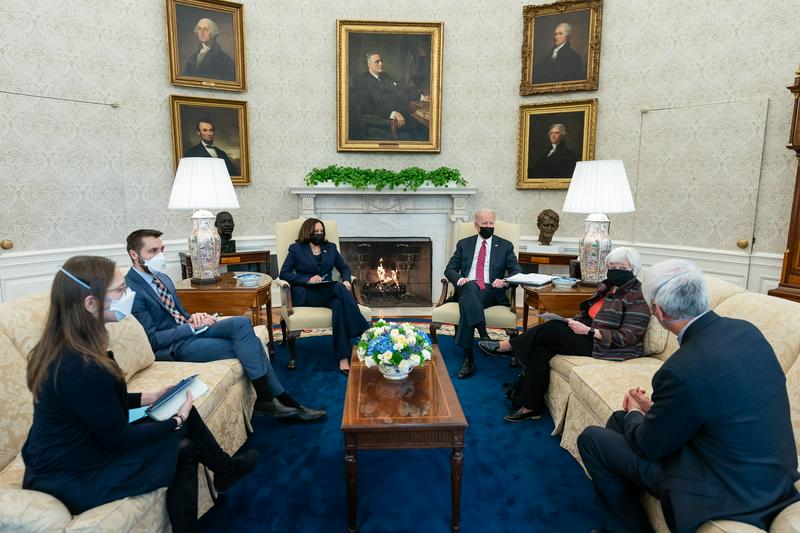
On November 30, 2020, President Joe Biden announced he would nominate Yellen to serve as secretary of the treasury in his Cabinet. All living former U.S. treasury secretaries from George Shultz to Jack Lew endorsed Yellen to the position in bipartisan letter calling on Senate to swiftly confirm her. The Senate Finance Committee unanimously approved Yellen's candidature by a 26–0 vote on January 22, 2021. The full U.S. Senate confirmed her nomination with a vote of 84–15 (with one abstention, Marco Rubio, R-FL) on January 25, 2021. With her oath of office administered by Vice President Kamala Harris the next day, Secretary Yellen became the first woman to serve as U.S. secretary of the treasury, and the first person in American history to lead the three most powerful economic bodies in the Federal government of the United States: the Treasury Department, the Federal Reserve, and the White House Council of Economic Advisers.
Yellen was appointed as the first female treasury secretary of the United States, and only two other women – France's Christine Lagarde and Canada's Chrystia Freeland – have held similar positions within the Group of Seven ("G7") nations.
Tenure
Proposed international tax reform
In April 2021, Yellen proposed a global minimum corporate tax rate, to prevent profit shifting used by multinational companies for purpose of tax avoidance. On June 5, 2021, finance ministers from the Group of Seven (G7) – the major advanced economies – have reached a historic agreement to reform the global tax system, agreed to back a minimum global corporate tax rate of at least 15%; while French Finance Minister Bruno Le Maire calling it "a starting point" that could be increased in the future. On June 10, 2021, Treasury Secretary Yellen joined with four foreign counterparts in penned op-ed that described the new accord as "a historic opportunity to end the race to the bottom in corporate taxation, restoring government resources at a time when they are most needed". On July 1, 2021, a US-backed measure to create wider global tax parity won support from a group of 130 nations, representing more than 90 percent of global GDP, establishing a new framework for international tax reform. Historic plan was prepared in negotiations within the Organization for Economic Cooperation and Development (OECD) which has been pushed by the Biden Administration. On July 10, 2021, financial leaders from the G20 countries come to an agreement on plans to put an end to global tax havens and force multinational corporations to pay an appropriate share of tax wherever they operate and create a "more stable and fairer international tax architecture".
On October 8, 2021, more than 130 countries, including several low-tax jurisdictions that had resisted the pact, enforced through OECD a landmark agreement to set a global minimum tax rate of 15% from 2023 for companies around the world. It said the deal could bring in an extra $150 billion of tax revenues a year. Although implementation of the treaty will need to be ratified via a two-thirds majority in the US Senate, which may be the hard task to Biden administration.
Debt ceiling crisis
On July 23, 2021, Yellen sent a letter to House Speaker Nancy Pelosi and other congressional leaders, urged lawmakers to increase or suspend the nation's debt limit as soon as possible before it will hit its statutory limit on Aug. 1, and government will be unable to pay its bills. She warned Congress that failure to meet those obligations would cause "irreparable harm" to the U.S. economy, and Treasury Department would begin taking “extraordinary measures” to prevent the United States from a government shutdown or even a debt default.
On September 19, 2021, Yellen, in the Wall Street Journal op-ed, called to address debt ceiling with bipartisan support otherwise, sometime in October, Treasury exhausts its cash reserves which would trigger a historic financial crisis and "permanently" weaken America. After Congress adopted a short-term debt-ceiling bill to raise the country’s borrowing into early December, Yellen said that it is imperative that lawmakers act with responsibility and provides longer-term certainty for the government. On November 1, 2021, Yellen expresses willingness to consider solutions to debt crisis without GOP support if necessary, using a budget procedure of reconciliation as viable alternative.
Economic philosophy
Yellen is widely considered to be a "dove" on monetary policy (i.e., more concerned with unemployment than with inflation) and as such generally favoring lower, rather than higher, Federal Reserve interest rates. However, on fiscal policy, publications often referred to her as "somewhat" of a deficit hawk. Prior to the COVID-19 recession, she expressed concern about the U.S. fiscal path, especially on U.S. debt; in 2018, Yellen said, "If I had a magic wand, I would raise taxes and cut retirement spending"; the following year, she again suggested that she favored both raising revenue and making changes to the Medicare, Medicaid and Social Security programs to control spending. In September 2021, at a House Financial Services Committee hearing, Yellen lends support to effort for complete removal of the debt ceiling, arguing that the borrowing cap is "very destructive" and poses unnecessary threat to the American economy.
She has supported tighter financial regulation to reduce systemic risks arising from vulnerabilities in the financial system. As chair of the Group of 30 Working Group on Climate Change and Finance, she addressed climate risks, supporting a phase-in carbon pricing to accelerate a shift to net zero carbon emissions.
Yellen is a Keynesian economist and has been described as a "Keynesian to her fingertips"; during the Great Recession, she "warned against an over-hasty removal of stimulus"; "insisted that the Fed pay as much attention to unemployment as to inflation"; and "believes the state has a duty to tackle poverty and inequality". When her appointment as Treasury secretary was announced in December 2020, Yellen was viewed by Wall Street "as a Treasury secretary who will push hard for expansionary policies aimed at boosting growth, profits and share prices", although the ability of Yellen to push through her preferred fiscal policies was seen as likely to be constrained by congressional gridlock.
Honors and awards
Dr. Yellen, has received numerous honors in recognition of her career in academia and politics. These include:
Scholastic
| Location | Date | Organization | Position |
|---|---|---|---|
 New York New York
|
1986-1987 | John Simon Guggenheim Memorial Foundation | Guggenheim Fellowship |
 Connecticut Connecticut
|
2000-2006 | Yale Corporation | Alumni Fellow |
 California California
|
2003-2004 | Western Economic Association International | President |
 Tennessee Tennessee
|
2004-2005 | American Economic Association | Vice President
|
| California
|
2012–present | University of California, Berkeley | Berkeley Fellow |
| Tennessee
|
2020-2021 | American Economic Association | President |
| Location | Date | School | Degree | Gave Commencement Address |
|---|---|---|---|---|
 Rhode Island Rhode Island
|
May 25, 1998 | Brown University | Doctor of Laws (LL.D.) | Yes |
| New York
|
May 27, 2000 | Bard College | Doctor of Humane Letters (DHL) | No |
| New York
|
May 21, 2014 | New York University | Doctor of Commercial Science (DCSc) | Yes |
 England England
|
May 15, 2015 | London School of Economics | Doctor of Science (DSc) | No |
| Connecticut
|
May 15, 2015 | Yale University | Doctor of Social Science (DSSc) | No |
| England
|
November 19, 2015 | University of Warwick | Doctor of Laws (LL.D.) | No |
 Maryland Maryland
|
December 19, 2016 | University of Baltimore | Doctor of Laws (LL.D.) | Yes |
 Israel Israel
|
June 5, 2019 | Tel Aviv University | Doctor of Philosophy (Ph.D.) | No |
 Michigan Michigan
|
December 15, 2019 | University of Michigan | Doctor of Laws (LL.D.) | No |
 Pennsylvania Pennsylvania
|
May 17, 2021 | University of Pennsylvania | Doctor of Laws (LL.D.) | No |
Memberships and fellowships
| Location | Date | Organization | Position |
|---|---|---|---|
 Massachusetts Massachusetts
|
1999-2010 | National Bureau of Economic Research | Research Associate (Monetary Economics) |
| Massachusetts
|
2001–present | American Academy of Arts and Sciences | Member |
| New York
|
2002-2010 | Economists for Peace and Security | Trustee |
| New York
|
2005–present | Council on Foreign Relations | Member |
 District of Columbia District of Columbia
|
2009–present | Group of Thirty | Senior Member |
| Tennessee
|
2012–present | American Economic Association | Distinguished Fellow |
| Connecticut
|
2014–present | Econometric Society | Fellow |
| District of Columbia
|
2015–present | National Association for Business Economics | NABE Fellow |
| England
|
2016–present | British Academy | Honorary Fellow |
Awards
| Location | Date | Organisation | Award |
|---|---|---|---|
| Connecticut
|
May 26, 1997 | Yale University | Wilbur Cross Medal |
| District of Columbia
|
October 11, 2010 | National Association for Business Economics | Adam Smith Award |
| New York
|
January 22, 2015 | Hobart and William Smith Colleges | Elizabeth Blackwell Award |
| Massachusetts
|
May 27, 2016 | Radcliffe Institute for Advanced Study | Radcliffe Medal |
| Rhode Island
|
May 5, 2017 | Brown University | The President's Medal |
 Illinois Illinois
|
November 7, 2017 | Institute of Government and Public Affairs | The Paul H. Douglas Award for Ethics in Government
|
| California
|
February 2, 2019 | University of California, Santa Cruz | The Foundation Medal |
| Connecticut
|
March 20, 2019 | Chief Executive Leadership Institute | The Legend in Leadership Award |
| Massachusetts
|
September 21, 2019 | Brandeis International Business School | Dean's Medal |
 Missouri Missouri
|
October 10, 2019 | Truman Library Institute | Truman Medal for Economic Policy |
Rankings
| Publisher | Listicle | Year(s) | Result | Ref. |
|---|---|---|---|---|
| Barron's | 100 Most Influential Women in U.S. Finance | 2020 | Placed | |
| 2021 | Placed | |||
| Bloomberg Markets | 50 Most Influential | 2012 | Placed | |
| 2013 | Placed | |||
| 2014 | Placed | |||
| 2015 | 1st | |||
| 2016 | 8th | |||
| Forbes | Forbes list of the world's most powerful people | 2014 | 6th | |
| 2015 | 7th | |||
| 2016 | 6th | |||
| Forbes list of the world's 100 most powerful women | 2014 | 2nd | ||
| 2015 | 4th | |||
| 2016 | 3rd | |||
| Global Finance | The Central Banker Report Cards | 2015 | A- | |
| 2016 | A- | |||
| 2017 | A | |||
| Time | Time 100 | 2014 | Placed | |
| 2015 | Placed | |||
| 2017 | Placed |
Other recognition
- In March 2018, The Janet L. Yellen professorship was endowed by Charles D. Ellis at the Yale School of Management, named in honor of Yellen. Professor Andrew Metrick has been invested as the inaugural Janet L. Yellen Professor of Finance and Management at the School.
- In December 2018, Federal Reserve Board presented an annual Janet L. Yellen Award for Excellence in Community Development to recognize the exemplary work of Federal Reserve System staff, and intended as honor of former chair Yellen's commitment to public service. Ariel Cisneros of the Federal Reserve Bank of Kansas City, has been named the first recipient of the newly created Award.
Personal life
Yellen is married to George Akerlof, an economist, 2001 Nobel Memorial Prize in Economic Sciences laureate, professor at the McCourt School of Public Policy at Georgetown University, and professor emeritus at the University of California, Berkeley. Yellen and Akerlof first crossed paths at the Fed in the fall of 1977 and married in June 1978, less than a year after meeting. They have one child, a son named Robert, who was born in 1981. Robert Akerlof, an economist by training himself, earning an AB degree in economics and mathematics, summa cum laude with special distinction, from Yale University in 2003 and received a PhD in economics from Harvard University in 2009, where he was a presidential scholar. He works as an associate professor of economics at the University of Warwick. Yellen and Akerlof have often collaborated on research, including topics such as poverty, unemployment and a paper on the costs of out-of-wedlock childbearing. One of their most talked-about papers at Berkeley, on why lower wages do not always lead to higher employment, came from the personal experience of hiring a nanny for the first time. Yellen says Akerlof (along with, as she cited "lifelong mentors," James Tobin and William Brainard) has been her biggest intellectual influence. Both frequently state that their lone disagreement is that she is a bit more supportive of free trade than he is.
Yellen has an estimated net worth of $20 million, accrued from stock holdings, speaking engagements and various government and academic positions. In February 2021, she divested holdings in corporations including Pfizer, ConocoPhillips and AT&T, among others when appointed to public office at U.S. Treasury.
Yellen is a philatelist, having reported a collection of postage stamps valued between $15,000 and $50,000 in her OGE financial disclosures released in 2014 and 2021.
In popular culture
"Who's Yellen Now?" is a song by musician Dessa, commissioned by Marketplace, following the joking suggestion by then President-elect Biden that Lin-Manuel Miranda should write a Hamiltonesque musical about Yellen, reflecting the historic nature of her nomination as nation's first female secretary of the Treasury, on December 1, 2020.
On the NBC sketch comedy show Saturday Night Live, Yellen has been parodied by an actress Kate McKinnon since 2021.
Selected works
Books
- Akerlof, George A.; Yellen, Janet L., eds. (October 31, 1986). Efficiency Wage Models of the Labor Market. Cambridge University Press. doi:10.1017/cbo9780511559594. ISBN 978-0-521-31284-4.
- Blinder, Alan S.; Yellen, Janet L. (2001). The Fabulous Decade: Macroeconomic Lessons from the 1990s. New York: The Century Foundation Press. ISBN 0-87078-467-6. OCLC 47018413.
Articles
- Adams, William James; Yellen, Janet L. (August 1976). "Commodity Bundling and the Burden of Monopoly". The Quarterly Journal of Economics. 90 (3): 475–498. doi:10.2307/1886045. JSTOR 1886045.
- Akerlof, George A.; Yellen, J. L. (January 1985). "A Near-Rational Model of the Business Cycle, with Wage and Price Inertia". The Quarterly Journal of Economics. 100: 823–838. doi:10.1093/qje/100.Supplement.823. ISSN 0033-5533.
- Akerlof, George A.; Yellen, Janet L. (May 1990). "The Fair Wage-Effort Hypothesis and Unemployment". The Quarterly Journal of Economics. 105 (2): 255–283. doi:10.2307/2937787. JSTOR 2937787.