
Introduction
Christina Alexandra Freeland PC MP (born August 2, 1968) is a Canadian politician serving since 2019 as the tenth deputy prime minister of Canada and since 2020 as the minister of finance. A member of the Liberal Party, Freeland represents the Toronto riding of University—Rosedale in the House of Commons. She was first appointed to Cabinet following the 2015 election and is the first woman to hold the finance portfolio.
Born in Peace River, Alberta, Freeland studied Russian history and literature at Harvard University, and earned a master's degree in Slavonic studies from Oxford University. She began her career in journalism working in a variety of editorial positions at the Financial Times, The Globe and Mail and Reuters, becoming managing director of the latter. Freeland is the author of Sale of the Century, a 2000 book about Russia's journey from Communist state rule to capitalism, and Plutocrats: The Rise of the New Global Super-Rich and the Fall of Everyone Else in 2012. Plutocrats was the winner of the 2013 Lionel Gelber Prize for non-fiction reporting on foreign affairs. It also won the 2013 National Business Book Award for the most outstanding Canadian business-related book.
Freeland was elected to represent Toronto Centre in the House of Commons following a 2013 by-election and would sit as a regular member of Parliament (MP) until 2015, when her government won its first mandate and she was appointed to Cabinet. Freeland has held a number of portfolios over her tenure in government, beginning as minister of international trade following the 2015 election, where she played an instrumental role in successfully negotiating the Canada-United States-Mexico Agreement and the Comprehensive Economic and Trade Agreement (CETA) with the European Union, earning her a promotion to minister of foreign affairs in 2017. She assumed her current role as deputy prime minister following the 2019 election where she also became minister of intergovernmental affairs until 2020, when she was made finance minister. Political commentators have given Freeland the informal title of "Minister of Everything," an honorific previously used for powerful 20th century Liberal cabinet minister C. D. Howe. Freeland was described in 2019 as one of the most influential Cabinet ministers of Trudeau's premiership.
Early life, education and student activism (1968–1993)
Freeland was born in Peace River, Alberta. Her father, Donald Freeland, was a farmer and lawyer and a member of the Liberal Party, and her mother, Halyna Chomiak (1946–2007), was also a lawyer and ran for the New Democratic Party (NDP) in Edmonton Strathcona in the 1988 federal election.
Freeland attended Old Scona Academic High School in Edmonton, Alberta for two years before attending the United World College of the Adriatic in Italy, on a merit scholarship from the Alberta government for a project that sought to promote international peace and understanding.
She received her Bachelor of Arts degree in Russian history and literature from Harvard University. During her time at Harvard, she visited the Soviet Union as an exchange student to study Ukrainian, although she was already fluent in the language. While there she attracted the attention of the KGB, which tagged her with the code name "Frida", and Soviet newspapers, who attacked her as a foreigner meddling in their internal affairs over her contacts with Ukrainian activists. The KGB surveilled Freeland and tapped her phone calls, and documented the young Canadian activist delivering money, video and audio recording equipment, and a personal computer to contacts in Ukraine. She used a diplomat at the Canadian embassy in Moscow to send material abroad in a secret diplomatic pouch, worked with foreign journalists on stories about life in the Soviet Union, and organised marches and rallies to attract attention and support from western countries. On return from a trip to London in March 1989, Freeland was denied re-entry to the USSR.
By the time her activism within Ukraine came to an end, Freeland had become the subject of a high level case study from the KGB on how much damage a single determined individual could inflict on the Soviet Union. In a 2021 interview with the Globe and Mail, one former member of the intelligence service called Freeland as "a remarkable individual", and described her as “erudite, sociable, persistent, and inventive in achieving her goals”.
She received her Master of Studies degree in Slavonic studies from the University of Oxford's St Antony's College as a Rhodes Scholar in 1993.
Journalism career (1993–2013)
Freeland started her journalism career as a stringer for the Financial Times, The Washington Post and The Economist while working in Ukraine. Freeland later worked for the Financial Times in London as a deputy editor, and then as an editor for its weekend edition, FT.com, and UK news. Freeland also served as Moscow bureau chief and Eastern Europe correspondent for the Financial Times.
From 1999 to 2001 Freeland served as the deputy editor of The Globe and Mail. Next she worked as the managing director and editor of consumer news at Thomson Reuters. She was also a weekly columnist for The Globe and Mail. Previously she was editor of Thomson Reuters Digital, a position she held since April 2011. Prior to that she was the global editor-at-large of Reuters news since March 1, 2010, having formerly been the United States managing editor at the Financial Times, based in New York City.
Published works
Freeland is the author of Sale of the Century: Russia's Wild Ride from Communism to Capitalism, a 2000 book about Russia's journey from communism to capitalism and Plutocrats: The Rise of the New Global Super-Rich and the Fall of Everyone Else in 2012.
Sale of the Century is an account of privatization in Russia that is informed by interviews with leading Russian businessmen that Freeland conducted during four years from 1994 to 1998 that she lived in Russia as Moscow bureau chief for the Financial Times. The book chronicles the challenges that the "young reformers" championing capitalism such as Anatoly Chubais and Yegor Gaidar had in wresting control of Russian industry out of the hands of the communist "red barons". The compromises they made, such as the loans for shares scheme, allowed businessmen such as Mikhail Friedman, Mikhail Khodorkovsky, and Vladimir Potanin to seize control of the economy and install themselves as Russian oligarchs.
Plutocrats was a New York Times bestseller, and the winner of the 2013 Lionel Gelber Prize for non-fiction reporting on foreign affairs. It also won the 2013 National Business Book Award for the most outstanding Canadian business-related book.
Political career (2013–present)
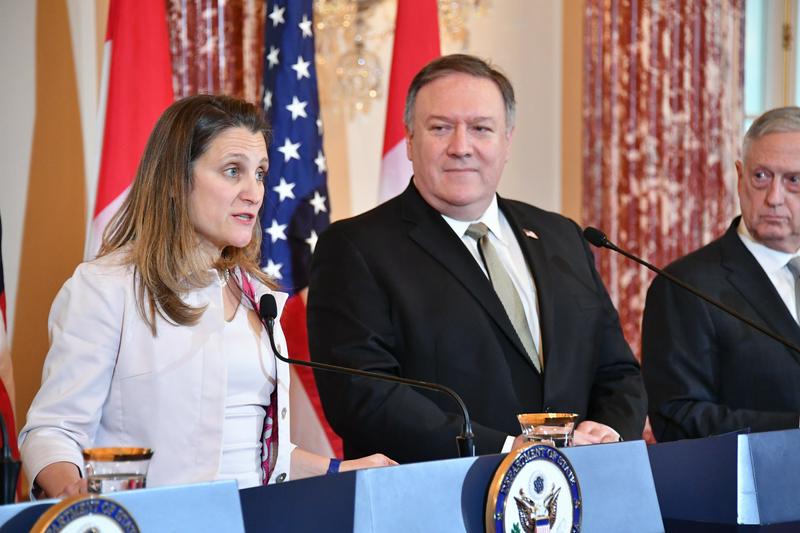
On July 26, 2013, Freeland left journalism to enter Canadian politics as a candidate for the nomination of the Liberal Party in the riding of Toronto Centre. On September 15, 2013, she won the nomination, with an opportunity to replace outgoing MP Bob Rae in the November 25, 2013, by-election. During the campaign she received criticism for purchasing a $1.3 million home, although the price was consistent with Toronto's home prices. Freeland won 49% of the vote and was elected.
On January 27, 2014, during the demonstrations leading up to the 2014 Ukrainian revolution, Freeland wrote an op-ed for The Globe and Mail, in which she excoriated the government of Viktor Yanukovich. She is a proponent of personal asset seizures and travel bans as part of economic sanction programs. Later, at the beginning of March, Freeland visited Ukraine on behalf of the Liberal Party, and tweeted her progress in meeting community leaders and members of the government in Kyiv. She lunched with the chief rabbi of Kyiv, met with Mustafa Dzhemilev, leader of the Crimean Tatars and an MP, and with Vitaly Klitchko, who is leader of the Ukrainian Democratic Alliance for Reform party, and with Ukrainian MP Petro Poroshenko, who was subsequently elected president of Ukraine in May 2014, Ukrainian presidential elections.
Freeland was one of thirteen Canadians banned from travelling to Russia under retaliatory sanctions imposed by Russian president Vladimir Putin in March 2014. She replied through her official Twitter feed, "Love Russ lang/culture, loved my yrs in Moscow; but it's an honour to be on Putin's sanction list, esp in company of friends Cotler & Grod."
In the riding redistribution of 2012 and 2013, much of Freeland's base was shifted from Toronto Centre to the new riding of University—Rosedale, while seemingly making Toronto Centre less safe for her. Then, in the 2015 federal election, Freeland opted to run in University—Rosedale, and defeated NDP challenger Jennifer Hollett.
Minister of international trade (2015–2017)
On November 4, 2015, newly-elected Prime Minister Justin Trudeau chose Freeland as minister of international trade in his first Cabinet.
Freeland was involved in negotiations leading up to the Comprehensive Economic and Trade Agreement (CETA), between Canada and the European Union, former-prime minister Stephen Harper's "legacy project". CETA is Canada's "biggest trade deal since NAFTA". After it was signed October 30, 2016, Freeland made comments about "building bridges and not building walls".
Minister of foreign affairs (2017–2019)
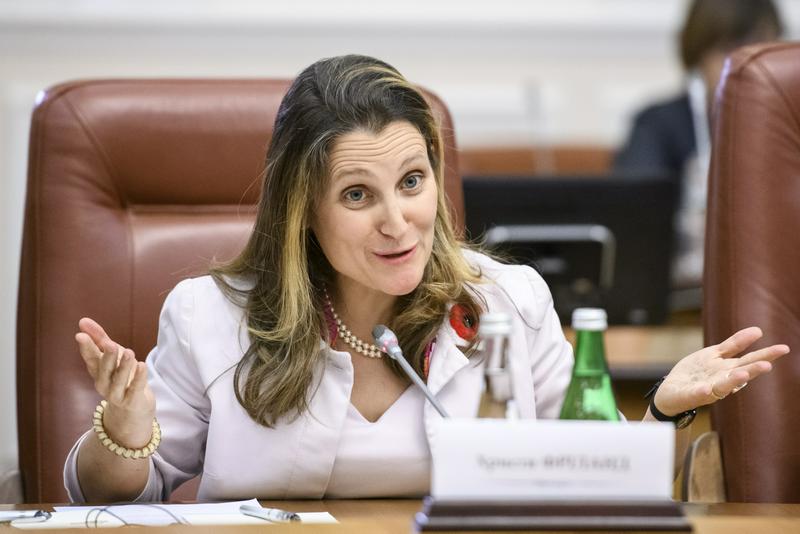
In a Cabinet reshuffle on January 10, 2017, Freeland was appointed minister of foreign affairs, replacing Stéphane Dion as the head of Trudeau's foreign policy. On March 6, 2017, together with National Defence Minister Harjit Sajjan, Freeland announced Canada's military training mission in Ukraine would be extended until March 2019, maintaining the 200 soldiers previously mandated by the Harper government.
In August 2017, Freeland has instructed her department and officials to 'energetically' review reports of Canadian-made military vehicles being used against civilians in Shia-populated city of Al-Awamiyah by Saudi Arabian security forces.
Freeland condemned the persecution of Rohingya Muslims in Myanmar. She said the violence against the Rohingya "looks a lot like ethnic cleansing and that is not acceptable."
Freeland issued a statement via Twitter on August 2, 2018, expressing Canada's concern over the recent arrest of Samar Badawi, a human rights activist and sister of imprisoned Saudi blogger Raif Badawi. She advocated their release. In response to Canada's criticism, Saudi Arabia expelled Canada's ambassador, and froze trade with Canada. Freeland asked for help from allies including Germany, Sweden, the United Arab Emirates and the United Kingdom.
In September 2018, Freeland raised the issue of Xinjiang re-education camps and human rights abuses against the Uyghur Muslim minority in a meeting with Chinese Foreign Minister Wang Yi.
In January 2019, at the request of the Office of the United Nations High Commissioner for Refugees, Canada granted asylum to 18-year-old Saudi teenager Rahaf Mohammed, who was fleeing her abusive family in Kuwait; Freeland personally greeted Mohammed at Toronto Pearson International Airport.
Freeland condemned Venezuelan president Nicolás Maduro, who had "seized power through fraudulent and anti-democratic elections."
On April 18, 2019, she was ranked 37th among the world's leading leaders in Fortune Magazine's annual list.
Freeland voiced support for the 2019–20 Hong Kong protests. In October 2019, Freeland condemned the unilateral Turkish invasion of the Kurdish areas in Syria.
Deputy prime minister (2019–present)
After the 2019 federal election, she was appointed deputy prime minister and minister of intergovernmental affairs. As deputy prime minister, Freeland has been entrusted with several key planks of Trudeau's domestic policy such as: strengthening Medicare, implementing the Pan-Canadian Framework, introducing firearms regulations, developing a pan-Canadian childcare system, facilitating interprovincial free trade, and reconciliation with Indigenous peoples. As minister of intergovernmental affairs, her primary task was to address renewed tensions between the federal government and the western provinces, most notably with the rise of Alberta separatism.
Furthermore, she remained in charge of Canada-US relations, including the ratification of the renegotiated free-trade agreement with the United States and Mexico (CUSMA), roles that have traditionally resided with the minister of foreign affairs. The CUSMA was ratified in March 2020 as the number of COVID-19 cases began to climb rapidly. In August 2020, the foreign affairs minister François-Philippe Champagne began taking a role in Canada-US relations as well, as Freeland took on the role of minister of Finance.
As of November 2019, Freeland was listed as a member of the Board of Trustees of Klaus Schwab's World Economic Forum.
Minister of intergovernmental affairs (2019–2020)
Freeland took over the intergovernmental affairs portfolio following the 2019 election when she was appointed deputy prime minister. In her new capacity she was responsible for handling regional issues such as western alienation—particularly in Alberta and Saskatchewan where the Liberals had failed to win a single seat—as well as the resurgence of the Bloc Québécois.
In March 2020, she was chosen as the chair for the Cabinet committee on the federal response to COVID-19. During the pandemic, Freeland developed a close working relationship with the premier of Ontario, Doug Ford—a Progressive Conservative—despite the Liberals having used the Ford government's track record to campaign against the federal Conservatives during previous fall's election campaign.
Minister of finance (2020–present)
Following the resignation of Bill Morneau on August 17, 2020, Justin Trudeau announced a cabinet shuffle with Freeland being appointed as minister of finance and Dominic LeBlanc, president of the Privy Council, replacing her as minister of intergovernmental affairs. It was the first appointment of a woman to the position.
She presented her first federal budget to the House of Commons on April 19, 2021. It announced the creation of a national childcare program in Canada. The federal government will cover 50 percent of the childcare program, with the provinces responsible for the other 50 percent.
During the 2021 Canadian federal election, she posted a video that received a manipulated media warning label by Twitter.
Family and personal life
Freeland's paternal grandfather, Wilbur Freeland, was a farmer and lawyer who rode in the annual Calgary Stampede; his sister, Beulah, was the wife of a federal member of Parliament, Ged Baldwin. Her paternal grandmother, Helen Caulfield, was a WWII war bride from Glasgow.
Freeland's mother, Halyna Chomiak, was born at a hospital administered by the US Army; her parents were staying at the displaced persons camp at the spa resort in Bad Wörishofen in Bavaria, Germany. Halyna's Ukrainian Catholic parents were Mykhailo Khomiak (anglicized as Michael Chomiak), born in Stroniatyn, Galicia, and Alexandra Loban, originally of Rudniki, near Stanislaviv (now Ivano-Frankivsk). Freeland, who grew up in Alberta, saw "first-hand" the consequences of "democratic backsliding" in Eastern Europe.
Freeland's maternal grandfather, Michael Chomiak (Ukrainian: Mykhailo Khomiak), had been a journalist before World War II. During the war in Nazi-occupied Poland and later in Nazi-occupied Austria he was chief editor of the Ukrainian antisemitic daily newspaper Krakivs'ki visti (News of Krakow) for the Nazi regime. After Chomiak's death in 1984, John-Paul Himka, a professor of history at the University of Alberta, who was Chomiak's son-in-law (and also Freeland's uncle by marriage), used Chomiak's records, including old issues of the newspaper, as the basis of several scholarly papers focused on the coverage of Soviet mass-murders of Ukrainian civilians. These papers also examined the use of these massacres as propaganda against Jews. In 2017, when Russian-affiliated websites further publicized Chomiak's connection to Nazism, Freeland and her spokespeople responded by claiming that this was a Russian disinformation campaign during her appointment to the position of minister of foreign affairs. Her office later denied Chomiak ever collaborated with the Nazi Germany. However, Freeland has known of her grandfather's Nazi ties since at least 1996, when she helped edit a scholarly article by Himka for the Journal of Ukrainian Studies.
Freeland is married to Graham Bowley, a British writer and The New York Times reporter. They have three children.
She has lived in Toronto since the summer of 2013 when she returned from abroad to run for election. She speaks Ukrainian at home with her children. She also speaks English, Russian, Italian, and French. In 2014 John Geddes reported that Freeland and her sister co-owned an apartment overlooking Independence square in Kyiv.
Electoral history
| 2019 Canadian federal election: University—Rosedale | ||||||||
|---|---|---|---|---|---|---|---|---|
| Party | Candidate | Votes | % | ±% | Expenditures | |||
| Liberal | Chrystia Freeland | 29,652 | 51.7 | +1.90 | $83,556.09 | |||
| New Democratic | Melissa Jean-Baptiste Vajda | 12,573 | 21.9 | -6.60 | $28,390.50 | |||
| Conservative | Helen-Claire Tingling | 9,342 | 16.3 | -1.03 | $38,588.65 | |||
| Green | Tim Grant | 4,861 | 8.5 | +5.57 | $33,386.65 | |||
| People's | Aran Lockwood | 510 | 0.9 | - | ||||
| Animal Protection | Liz White | 159 | 0.3 | +0.08 | ||||
| Communist | Drew Garvie | 143 | 0.2 | -0.02 | ||||
| Stop Climate Change | Karin Brothers | 124 | 0.2 | - | ||||
| Marxist–Leninist | Steve Rutschinski | 27 | 0.0 | -0.10 | ||||
| Total valid votes/expense limit | 57,391 | 100.0 | ||||||
| Total rejected ballots | 281 | |||||||
| Turnout | 57,672 | 71.6 | ||||||
| Eligible voters | 80,567 | |||||||
| Liberal hold | Swing | +4.25 | ||||||
| Source: Elections Canada | ||||||||
| 2015 Canadian federal election | ||||||||
|---|---|---|---|---|---|---|---|---|
| Party | Candidate | Votes | % | ±% | Expenditures | |||
| Liberal | Chrystia Freeland | 27,849 | 49.80 | +19.23 | $185,406.36 | |||
| New Democratic | Jennifer Hollett | 15,988 | 28.59 | -15.24 | $142,562.73 | |||
| Conservative | Karim Jivraj | 9,790 | 17.51 | -2.62 | $83,600.78 | |||
| Green | Nick Wright | 1,641 | 2.93 | -1.73 | $19,152.70 | |||
| Libertarian | Jesse Waslowski | 233 | 0.42 | – | $393.64 | |||
| Animal Alliance | Simon Luisi | 126 | 0.22 | – | $153.10 | |||
| Communist | Drew Garvie | 125 | 0.22 | – | – | |||
| Bridge | David Berlin | 122 | 0.21 | – | – | |||
| Marxist–Leninist | Steve Rutchinski | 51 | 0.10 | – | – | |||
| Total valid votes/Expense limit | 55,925 | 100.0 | $206,261.82 | |||||
| Total rejected ballots | – | – | – | |||||
| Turnout | – | – | – | |||||
| Eligible voters | 71,945 | |||||||
| Liberal notional gain from New Democratic | Swing | +17.24 | ||||||
| Source: Elections Canada | ||||||||
| Canadian federal by-election, November 25, 2013: Toronto Centre | ||||||||
|---|---|---|---|---|---|---|---|---|
| Party | Candidate | Votes | % | ±% | Expenditures | |||
| Liberal | Chrystia Freeland | 17,194 | 49.38 | +8.37 | $ 97,609.64 | |||
| New Democratic | Linda McQuaig | 12,640 | 36.30 | +6.09 | 99,230.30 | |||
| Conservative | Geoff Pollock | 3,004 | 8.63 | −14.01 | 75,557.39 | |||
| Green | John Deverell | 1,034 | 2.97 | −2.05 | 21,521.10 | |||
| Progressive Canadian | Dorian Baxter | 453 | 1.30 | – | ||||
| Libertarian | Judi Falardeau | 236 | 0.68 | +0.18 | – | |||
| Independent | Kevin Clarke | 84 | 0.24 | 560.00 | ||||
| Independent | John "The Engineer" Turmel | 56 | 0.16 | – | ||||
| Independent | Leslie Bory | 51 | 0.15 | 633.30 | ||||
| Online | Michael Nicula | 43 | 0.12 | 200.00 | ||||
| Independent | Bahman Yazdanfar | 26 | 0.07 | −0.12 | 1,134.60 | |||
| Total valid votes/Expense limit | 34,821 | 99.49 | – | $ 101,793.06 | ||||
| Total rejected ballots | 177 | 0.51 | +0.12 | |||||
| Turnout | 34,998 | 37.72 | −25.21 | |||||
| Eligible voters | 92,780 | |||||||
| Liberal hold | Swing | +1.14 | ||||||
| By-election due to the resignation of Bob Rae. | ||||||||
Source(s)
"November 25, 2013 By-elections Poll-by-poll results". Elections Canada. Retrieved August 20, 2020. "November 25, 2013 By-election – Financial Reports". Retrieved May 9, 2014. | ||||||||
Bibliography
Books
- Freeland, Chrystia (2000). Sale of the Century: Russia's Wild Ride from Communism to Capitalism. Crown Business. ISBN 0812932153.
- Freeland, Chrystia (2012). Plutocrats: The Rise of the New Global Super-Rich and the Fall of Everyone Else. Penguin Books. ISBN 9781846142529.