

Introduction
Sir William Huggins OM KCB PRS (7 February 1824 – 12 May 1910) was an English astronomer best known for his pioneering work in astronomical spectroscopy together with his wife Margaret Lindsay Huggins.
Biography
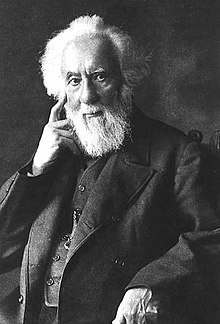
William Huggins was born at Cornhill, Middlesex, in 1824. In 1875 he married Margaret Lindsay, daughter of John Murray of Dublin, who also had an interest in astronomy and scientific research. She encouraged her husband's photography and helped to put their research on a systematic footing.
Huggins built a private observatory at 90 Upper Tulse Hill, London, from where he and his wife carried out extensive observations of the spectral emission lines and absorption lines of various celestial objects. On 29 August 1864, Huggins was the first to take the spectrum of a planetary nebula when he analysed NGC 6543. He was also the first to distinguish between nebulae and galaxies by showing that some (like the Orion Nebula) had pure emission spectra characteristic of gas, while others like the Andromeda Galaxy had the spectral characteristics of stars. Huggins was assisted in the analysis of spectra by his neighbour, the chemist William Allen Miller. Huggins was also the first to adopt dry plate photography in imaging astronomical objects.
With observations of Sirius showing a redshift in 1868, Huggins hypothesized that a radial velocity of the star could be computed.
Huggins won the Gold Medal of the Royal Astronomical Society in 1867, jointly with William Allen Miller. He later served as President of the Royal Astronomical Society from 1876 to 1878, and received the Gold Medal again (this time alone) in 1885. He served as an officer of the Royal Astronomical Society for a total of 37 years, more than any other person.
Huggins was elected a Fellow of the Royal Society in June 1865, was awarded their Royal Medal (1866), Rumford Medal (1880) and Copley Medal (1898) and delivered their Bakerian Lecture in 1885. He then served as President of the Royal Society from 1900 to 1905. For example, his Presidential Address in 1904 praised the fallen Fellows and distributed the prizes of that year.
He died at his home in Tulse Hill, London, after an operation for a hernia in 1910 and was buried at Golders Green Cemetery.
Honours and awards
Awards
- Royal Medal (1866)
- Gold Medal of the Royal Astronomical Society (jointly with William Allen Miller in 1867, solo in 1885)
- Rumford Medal (1880)
- Valz Prize (1882)
- Member of the Royal Swedish Academy of Sciences (1883)
- Knight Commander of the Order of the Bath (1897)
- Copley Medal (1898)
- Henry Draper Medal from the National Academy of Sciences (1901)
- Order of Merit (1902)
- Bruce Medal (1904)
Named after him
- Huggins (lunar crater)
- Huggins (Martian crater)
- Asteroid 2635 Huggins
- "The Valz Prize". Popular Astronomy. 1913. p. 384.
- "HUGGINS, Sir Wm., K.C.B. cr. 1897". Who's Who. 59: 889–890. 1907.
- "Henry Draper Medal". National Academy of Sciences. Retrieved 19 February 2011.
Publications

- 1870: Spectrum analysis in its application to the heavenly bodies. Manchester, (Science lectures for the people; series 2, no. 3)
- 1872: (editor) Spectrum analysis in its application to terrestrial substances and the physical constitution of heavenly bodies by H. Schellen, translated by Jane and Caroline Lassell, link from HathiTrust.
- 1899: (with Lady Huggins): An Atlas of Representative Stellar Spectra from 4870 to 3300, together with a discussion of the evolution order of the stars, and the interpretation of their spectra; preceded by a short history of the observatory. London, (Publications of Sir William Huggins's Observatory; v. 1)
- 1906: The Royal Society, or, Science in the state and in the schools. London.
- 1909: The Scientific Papers of Sir William Huggins; edited by Sir William and Lady Huggins. London, (Publications of Sir William Huggins's Observatory; v. 2)
