
Introduction
Theodore Edward Rokita /roʊˈkiːtə/ (born February 9, 1970) is an American lawyer and politician serving as the 44th and current Attorney General of Indiana. He served as the member of the United States House of Representatives from Indiana's 4th congressional district from 2011 to 2019. A member of the Republican Party, he served two terms as Secretary of State of Indiana from 2002 to 2010. When Rokita was elected to office in 2002 at age 32, he became the youngest secretary of state in the United States at the time.
Rokita was a candidate to replace Mike Pence in the 2016 Indiana gubernatorial election after Pence withdrew from the race to be Donald Trump's running mate in the 2016 U.S. presidential election. He lost to Eric Holcomb, Pence's lieutenant governor. Rokita unsuccessfully sought the Republican nomination for U.S. Senate in 2018. In 2020, Rokita defeated incumbent Curtis Hill for the Republican nomination for Indiana Attorney General, and in November 2020, Rokita won the election.
Early life and career
Rokita grew up in Munster, Indiana and attended Munster High School. He holds a Bachelor of Arts degree from Wabash College in Crawfordsville, Indiana, where he was an Eli Lilly Fellow and a member of the Sigma Chi fraternity. He has a J.D. degree from IUPUI Indiana University Robert H. McKinney School of Law.
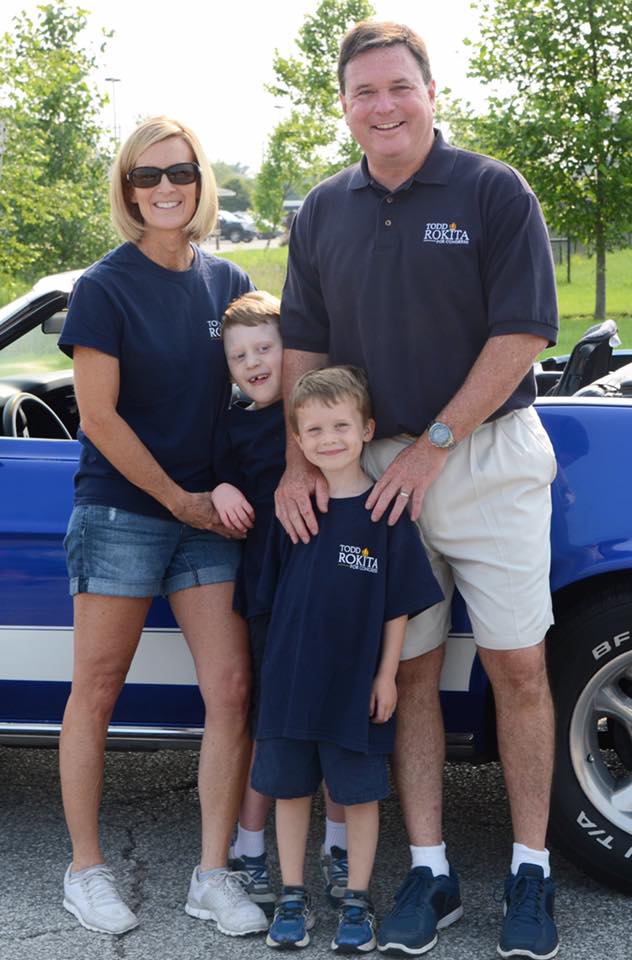
Rokita was a practicing attorney. In 1997 he joined the secretary of state's office as general counsel. He later became deputy secretary of state. In 2000, Rokita served as legal counsel for seven Florida counties during the recount for the George W. Bush presidential campaign.
Indiana Secretary of State
Rokita was Indiana Secretary of State from 2002 to 2010. Elected in 2002, Todd Rokita became the youngest Secretary of state in the United States at the time. Rokita was named as one of the "40 under 40" by the Indianapolis Business Journal in 2005.
Rokita was active in the National Association of Secretaries of State (NASS), and after serving as the elected treasurer, he became the President for the 2007–08 term. He was elected by his peers nationally to serve on the nine-member federal executive board of the Election Assistance Commission.
Voting rights
In 2005, Rokita helped craft and implement Indiana's voter photo identification law. The law required voters who cast their ballots at Indiana polling locations to show government issued photo identification. As one of the first states to require photo identification for voting, the Indiana law was viewed to be one of the strictest voter identification laws at the time.
Rokita was a named defendant when Indiana's voter identification case went before the U.S. Supreme Court on January 9, 2008; the combined cases of Crawford v. Marion County Election Board (07-21) and Indiana Democratic Party v. Rokita (07-25). In April 2008, the Supreme Court upheld Indiana's voter photo ID law. Rokita noted as a result of the Supreme Court decision that "The Indiana case is still very much the law of the land and I don’t expect that to change."
Redistricting
In September 2009, Rokita outlined a plan called "Rethinking Redistricting" to reform how Indiana's legislative districts are drawn to reduce gerrymandering. He proposed making it a felony for lawmakers to use political data or incumbents' addresses when drawing electoral maps. Rokita said boundaries should follow existing county and township lines, and that each of the 50 Senate districts should be divided into two House districts, claiming that would lead to more competitive legislative elections.
The reform plan sought to achieve these five objectives:
- Keep communities of interest together
- Create more compact and geographically uniform districts
- Reduce voters' confusion about who represents them by following already existing political boundaries, such as county and township lines
- Not use any political data, including incumbent addresses, for partisan reasons
- “Nest” two House districts under the existing lines of a Senate district
U.S. House of Representatives
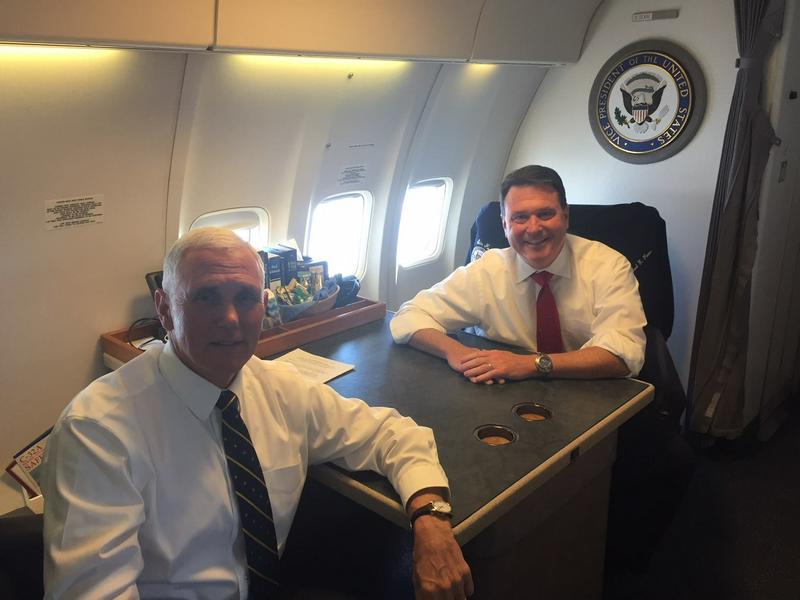
Rokita was a member of the U.S. House of Representatives from 2011 to 2019.
Attorney General of Indiana
In 2020, Rokita challenged incumbent Attorney General of Indiana Curtis Hill for the Republican nomination. Rokita accused Hill of "bad judgment, bad choices and not taking responsibilities" (Hill had been accused of groping three female legislative staffers, charges which he denied). Rokita defeated Hill for re-nomination in mail-in voting at the Republican state convention, gaining 52% of the vote on the third round. Rokita's nomination marked a political comeback after his unsuccessful runs for governor in 2016 and U.S. Senate in 2018. In the general election, Rokita faced Democratic nominee Jonathan Weinzapfel, a former mayor of Evansville. Rokita defeated Weinzapfel in the November election, the sixth consecutive election in which Republicans retained control of the AG's office.
Rokita was sworn in as Attorney General in January 2021. In 2021, Rokita faced scrutiny for collecting tens of thousands of dollars in payments for advisory roles from various healthcare and pharmaceutical companies while holding public office.
Election reform
Rokita led a letter signed by 20 Republican state attorneys general opposing the For the People Act, election reform legislation introduced by Democrats in the United States House of Representatives. In March 2021, Rokita testified in U.S. Senate Rules Committee in opposition to the legislation, threatening to sue if the bill became law. Rokita asserted that voting laws should be based on voters' perceptions, rather than any actual evidence of fraud. Democratic Senator Jon Ossoff, responding to Rokita's statement, said that he took exception to the notion "that public concern regarding the integrity of the recent election is born of anything but a deliberate and sustained misinformation campaign led by a vain former president unwilling to accept his own defeat" and that said that he found it disturbing that state attorney general "would indulge in that kind of misinformation and spread those kinds of conspiracies."
Lawsuits against Biden administration
Rokita joined other Republican state AGs in suing the Biden administration over an executive order on environmental protection and climate change.
Political positions
Education
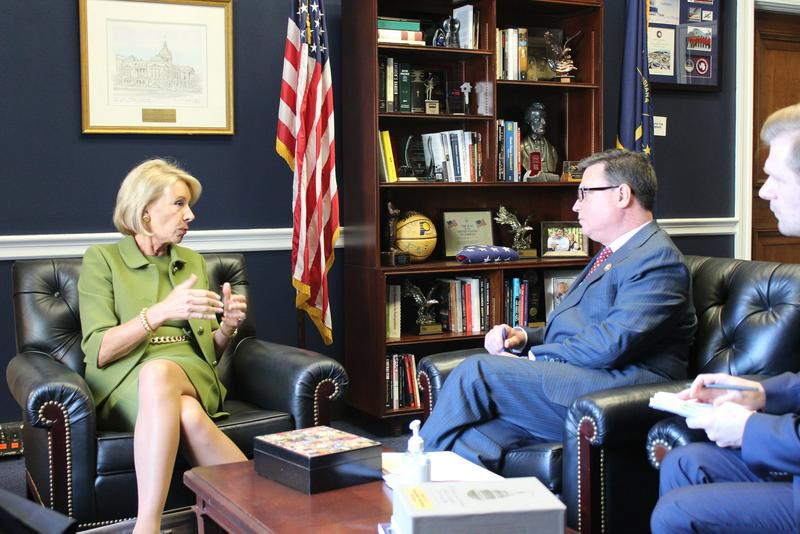
Rokita supports charter schools, school choice, and reducing the role of the Department of Education in setting education policy. In 2015, Rokita and Senator Marco Rubio introduced the Education Opportunities Act, a bill to expand choice options through the use of tax credits.
As Chairman of the Subcommittee on Early Childhood, Elementary, and Secondary Education, he had an active role in crafting the Every Student Succeeds Act, which reauthorized the 1965 Elementary and Secondary Education Act. In May, Rokita introduced bipartisan legislation with Alcee Hastings (D-FL) to help students and parents with student loan debt. His legislation would allow student loan borrowers to refinance loans and have access to lower market rate loans.
Environment
He does not accept the scientific consensus that human activity is the driving factor of climate change, and at a 2013 town-hall event called the idea that climate change was caused by human activity "arrogant." Rokita has a 4% lifetime voting rating from the League of Conservation Voters, an environmentalist group.
Guns
Rokita has stated: "I'm proud of my 'A' rating from the NRA" and has said that he will "protect our 2nd Amendment right to keep and bear arms."
Health care
Rokita opposes the Affordable Care Act and voted dozens of times to repeal it during his time in Congress. While running for Indiana Attorney General in 2020, Rokita pledged to support a lawsuit to have the Affordable Care Act deemed unconstitutional.
Economy
In 2017, Rokita voted in favor of the Tax Cuts and Jobs Act of 2017.
Immigration
In 2017, Rokita introduced the Stopping Lawless Actions of Politicians (SLAP) Act, some of the most aggressive anti-sanctuary city legislation to date in congress. The legislation would introduce fines and jail time for state and local politicians who implemented sanctuary city policies. The SLAP Act did not receive a vote and thus was not enacted into law.
Rokita supported President Trump's 2017 executive order temporarily banning citizens of seven Muslim-majority countries from entering the U.S.
Abortion
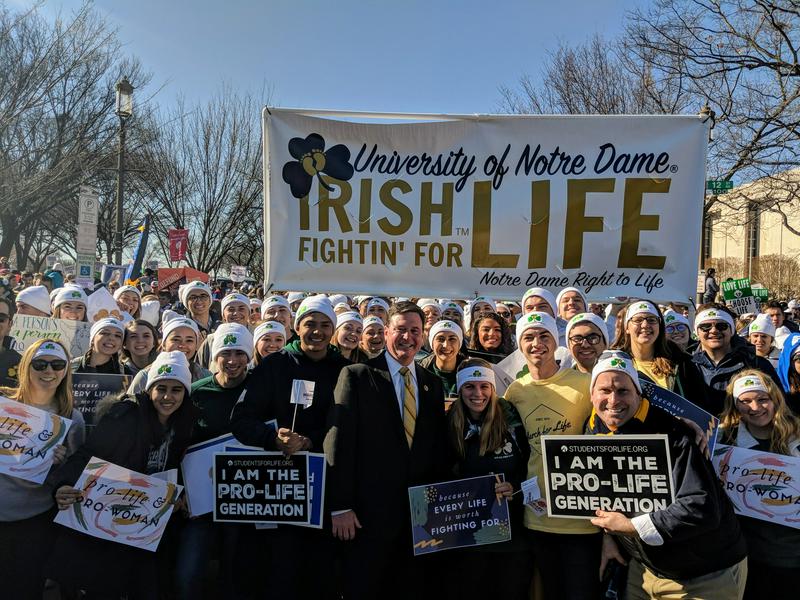
Rokita opposes abortion and has maintained a 100% pro-life voting record according to the National Right to Life Committee. He holds that "every life is a precious gift from God that begins from the moment of conception."
Cannabis
Rokita has a "D" rating from NORML for his voting history on cannabis-related causes. He opposes recreational use of marijuana, citing concern that it is a "gateway drug" to more dangerous narcotics. He expressed willingness to support legalization of some medical uses for marijuana only if the THC is removed, on the grounds that it may help people like his son, who has Angelman syndrome.
Rokita is a supporter of industrial hemp, having voted to allow its production. In December 2018 he told a group of local Republicans that legalizing industrial hemp "could help the farming community."
Tribal lands
Rokita authored the Tribal Labor Sovereignty Act. The bill would "make clear that the National Labor Relations Board has no jurisdiction over businesses owned and operated by an Indian tribe and located on tribal land." It cleared the House as of 2018, but has not been considered in the Senate.
Donald Trump
During his time in Congress, Rokita voted in line with President Donald Trump 90.3% of the time. During the Republican primary for the 2018 United States Senate election in Indiana, Rokita earned the support of the chair and vice chair of 2016 Trump campaign in Indiana.
In May 2019, the Trump White House announced that Trump would nominate Rokita to join the AMTRAK Board of Directors. The Senate did not act on the nomination, which expired on January 3, 2021, at the end of the 116th Congress.
Efforts to overturn the 2020 presidential election
In 2020, after Joe Biden won the 2020 presidential election and Trump refused to concede while making false claims of fraud, Rokita, as Attorney General-elect, endorsed a petition to the United States Supreme Court submitted by the Texas Attorney General Ken Paxton who sought to challenge the 2020 presidential election results. The Supreme Court rejected the petition.
After the 2021 storming of the United States Capitol in January 2021 Rokita declined to sign a National Association of Attorneys General letter condemning the attack, instead issuing his own statement with other Republican Attorneys General writing "we can uphold the critical Constitutional right to freedom of speech as we oppose any attempt to hijack a protest to condemn violence."Two days later, Rokita tweeted that "I will always be for our President." The next day he issued a statement saying that the tweets were an "experiment in free speech"; criticizing social media companies for "controlling the entire dialogue of a nation"; and said that "I also condemn the Capitol violence in the same way and terms that I have condemned the violence last summer." In February 2021, Rokita falsely implied on Twitter that the 2020 presidential election had been "stolen" from Trump. The platform initially restricted the distribution of Rokita's message, citing the risk of violence, but later found that the tweets in question did not violate policy.
Electoral history
- 2002
On June 15, 2002, Rokita won the Republican nomination for Indiana Secretary of State at the state convention over Mike Delph, then an aide to U.S. Representative Dan Burton, Marion County Coroner John McGodd, and then-Vanderburgh County Commissioner Richard Mourdock. Rokita went on to win the general election with 53.4% of the vote.
- 2006
Rokita received the Republican nomination again in 2006 and won the general election with 51.1% of the vote in a year when Democrats took five of Indiana's nine congressional seats.
- 2010
On February 1, 2010, three days after Congressman Steve Buyer of Indiana's 4th congressional district said that he would retire at the end of his term, Rokita posted an announcement on Facebook making clear his intentions to run for the open seat. Buyer's announcement touched off a free-for-all among area Republicans to succeed him. Ultimately, 13 candidates entered the Republican primary, including Rokita.
With a Cook Partisan Voting Index of R+14, the 4th is one of the most Republican districts in the Eastern Time Zone and tied for the second-most Republican in the state (behind the 5th District). It was taken for granted that whoever won the primary would be heavily favored to be the district's next representative. Rokita won the primary with 42% of the vote and the general election with 68.6% of the vote.
- 2012
Rokita won the general election in 2012 with 62% of the vote.
- 2014
Rokita won the Republican nomination in 2014 with 71% of the vote. He won the general election with 67% of the vote over John Dale, a teacher at Western Boone High School.
- 2016
Rokita won the Republican nomination in 2016 with 60% of the vote. In the general election, he faced John Dale in a rematch from 2014. Rokita was reelected with 65% of the vote to Dale's 30%. Libertarian Steven M. Mayoras received 5%.
- 2018
On August 8, 2017, Rokita announced his intention to run for the U.S. Senate in 2018 against Democratic incumbent Joe Donnelly. He lost the Republican primary election to Mike Braun, coming in second with 30% of the vote.
- 2020
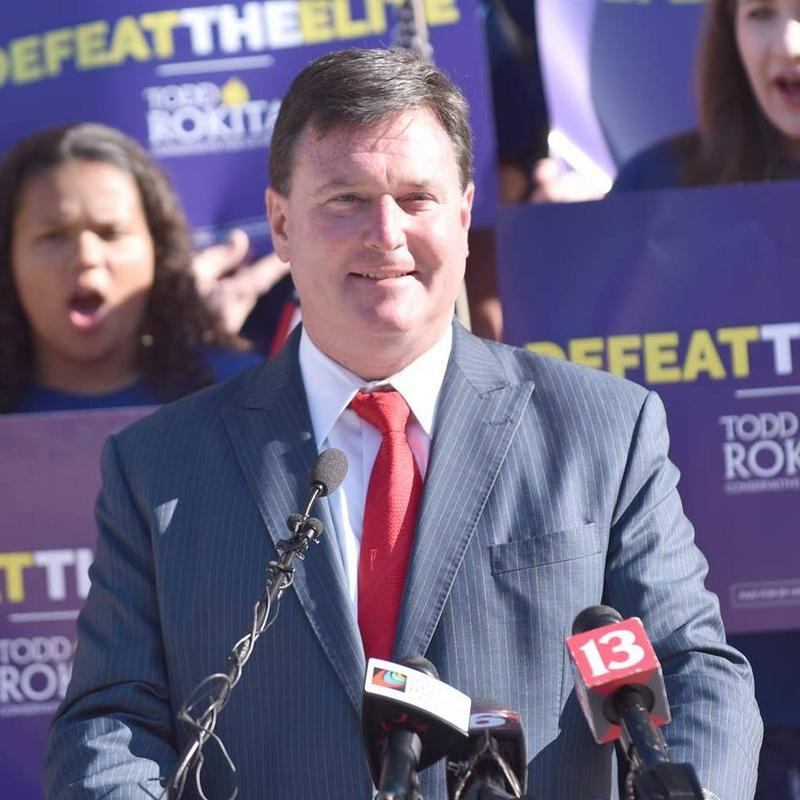
On July 10, 2020, Rokita defeated incumbent Indiana Attorney General Curtis Hill during the Indiana Republican Party Convention. Rokita went onto win the November general election, securing 58.34% of the vote. Democrat Jonathan Weinzapfel's only received 41.66%.
| Date | Position | Status | Opponent | Result | Vote share | Top-opponent vote share |
|---|---|---|---|---|---|---|
| 2002 | Secretary of State of Indiana | Open-seat | John Fernandez (D) | Elected | 53.41% | 42.46% |
| 2006 | Secretary of State of Indiana | Incumbent | Joe Pearson (D) | Re-elected | 51.06% | 45.60% |
| 2010 | U.S. Representative | Open-seat | David Sanders (D) | Elected | 68.57% | 26.28% |
| 2012 | U.S. Representative | Incumbent | Tara Nelson (D) | Re-elected | 61.96% | 34.16% |
| 2014 | U.S. Representative | Incumbent | John Dale (D) | Re-elected | 66.87% | 33.13% |
| 2016 | U.S. Representative | Incumbent | John Dale (D) | Re-elected | 64.60% | 30.47% |
| 2020 | Attorney General of Indiana | Open-seat | Jonathan Weinzapfel (D) | Elected | 58.34% | 41.66% |
Personal life and affiliations
Rokita is a member of the Director's Circle of the Indiana Council for Economic Education, the state bar association, the Knights of Columbus, and the National Rifle Association. He has also served as Chair of NASS's New Millennium Young Voters Summit of 2004, chair of the standing Voter Participation Committee and vice chair of the Securities Regulation Committee. He is a member of the Indiana chapter of the International Flying Farmers, and member of the Saint Vincent Hospital Foundation Board of Directors.
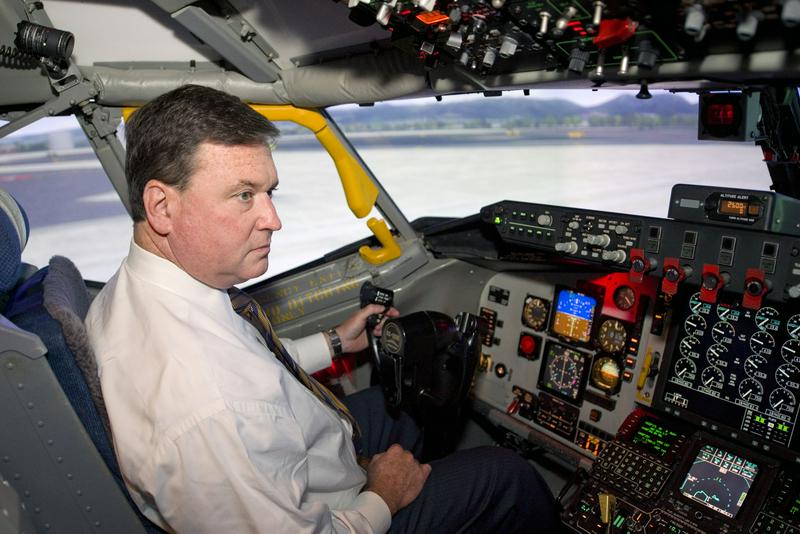
Rokita's oldest son, Teddy, suffers from Angelman syndrome. Rokita is a commercial-rated pilot.
Rokita formerly lived in Clermont, an "included town" in Indianapolis under the Unigov system. The 2010 round of redistricting cut out the 4th's share of Indianapolis and Marion County, leaving Rokita's home 500 yards outside the new 4th's eastern border. Members of Congress are required to live only in the state they represent, but it is a strong convention that they live within their district's borders. In 2012 Rokita ran for reelection from his home in Clermont, but he later bought a home near Brownsburg, a western suburb of Indianapolis within the 4th district.