

Introduction
Thomas Rowe (20 July 1829 – 14 January 1899) was a British-born architect, builder and goldminer who became one of Australia's leading architects of the Victorian era. He was also a politician, who was the first Mayor of Manly
Biography
Thomas Rowe was born in Penzance, Cornwall, United Kingdom, the eldest son of Richard Rowe and Ursula Mumford, and attended Barnes Academy. At 15 he became a draftsman in his father's building business before the family emigrated to Australia in 1848. From 1857 he practised as an architect in Sydney, Bathurst, Orange, Newcastle and Goulburn. In 1872 he was elected alderman for Bourke Ward of the Sydney City Council, which he held until 1876. During his time on the council he worked on sanitation efforts related to improving the Sydney water supply. Rowe Street, which runs from Pitt Street to Castlereagh Street, was at that time named after him by in a vote by the council. In February 1877 he was elected to the first Manly Municipal Council and was elected first Mayor of Manly, overseeing the first laying-out of the town of Manly, and serving as an alderman until 1880. Rowe was also the founder, and for many years president, of the New South Wales Institute of Architects, and was elected a Fellow of the Royal Institute of British Architects in 1884.
As an architect he was often successful in competitions and his firms built commercial premises, large houses and many Methodist churches. He died in 1899 in Mona, a heritage-listed house in Darling Point, New South Wales.
Key works
(Many of the following buildings are heritage-listed):
- Chatswood South Uniting Church, Artarmon, New South Wales (1871)
- Presbyterian Church, Bridge Road, Glebe, New South Wales (1881)
- Original Randwick Borough Chambers (later Parish Centre of St Jude's Church, Randwick) (1862)
- Catherine Hayes Building (based on design by John Horbury Hunt), Prince of Wales Hospital, Randwick, New South Wales (1870)
- Tresco, Elizabeth Bay, New South Wales (1868)
- F.L. Kelly and Company Building, Yass, New South Wales (1869)
- St Paul's Presbyterian Church, Hill End, New South Wales (1872)
- Presbyterian Church, Bathurst (1871)
- Aliiolani Hale, Honolulu, Hawaii (1872)
- Great Synagogue, Elizabeth Street, Sydney (1874)
- Sydney Hospital, including Nightingale Wing, Macquarie Street, Sydney (1879)
- Newington College, Stanmore (1878)
- Sydney Arcade, Pitt Street, Sydney (1874)
- Vickery's Building, Pitt Street, Sydney (1874)
- Ashton, Elizabeth Bay Road, Elizabeth Bay
- Imperial Arcade, Sydney (1891)
-
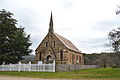
St Paul's Presbyterian Church, Hill End
-

Founders' Wing, Newington College
-
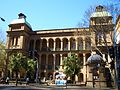
Sydney Hospital, Macquarie Street
-
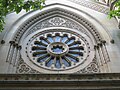
Great Synagogue, Elizabeth Street
-
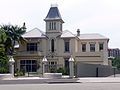
Ashton, Elizabeth Bay
-

Mona, where Rowe died


Architectural Partners
- W.B.Field
- Sydney Green
- Alfred Spain
- The Heritage of Australia, Macmillan Company, 1981, pp. 2/34,38,60,61,81,95,99,174,252,260
- Hawaii for visitors
- M Berry, A History of Colonel Thomas Rowe (B Arch thesis, UNSW, 1969)
- "THE IMPERIAL ARCADE.". The Sydney Morning Herald (16,635). New South Wales, Australia. 17 July 1891. p. 7. Retrieved 25 October 2016 – via National Library of Australia.
- J M Freeland, The Making of a Profession (Syd, 1971)
Harry Ruskin Rowe

Rowe's son Harry Ruskin Rowe was also successful as an architect. One of his most significant achievements was the creation in 1950 of Ruskin Rowe, an estate in the Sydney suburb of Avalon. Rowe acquired a house, The Cabbage Trees, in the estate and used it as a weekender. The estate still exists and is heritage-listed.