


Introduction
John Adams Estes (January 25, 1899 or 1900 – June 5, 1977), known as Sleepy John Estes, was an American blues guitarist, songwriter and vocalist.
Life and career
Estes was born in Ripley, Lauderdale County, Tennessee, either in 1899 (the date on his gravestone) or 1900 (the date on his World War I draft card). In 1915, his father, a sharecropper who played guitar, moved the family to Brownsville, Tennessee. Not long after, Estes lost the sight in his right eye when a friend threw a rock at him. At the age of 19, while working as a field hand, he began to perform professionally, mostly at parties and picnics, with the accompaniment of Hammie Nixon, a harmonica player, and James "Yank" Rachell, a guitarist and mandolin player. Estes continued to work on and off with both musicians for more than fifty years. He also performed in medicine shows with Willie Newbern.
At the suggestion of Jim Jackson, Estes made his debut as a recording artist in Memphis, Tennessee, in 1929, at a session organized by Ralph Peer for Victor Records. He recorded the tracks "Drop Down Mama" and "Someday Baby Blues" with Nixon in 1935. He later worked with Son Bonds and Charlie Pickett. He later recorded for Decca Records and Bluebird Records, with his last prewar recording session taking place in 1941. He made a brief return to recording at Sun Studio in Memphis in 1952, recording "Runnin' Around" and "Rats in My Kitchen", but otherwise was out of the public eye in the 1940s and 1950s.
Estes sang with a distinctive "crying" vocal style. He frequently teamed with more capable musicians, like Yank Rachell, Hammie Nixon, and the piano player Jab Jones. Estes sounded so much like an old man, even on his early records, that blues revivalists reportedly delayed looking for him because they assumed he would have to be long dead (and because the musician Big Bill Broonzy had written that he was dead). By the time he was tracked down by the blues historians Bob Koester and Samuel Charters in 1962, he was completely blind and living in poverty. He resumed touring with Nixon and recording for Delmark Records. His later records are generally considered less interesting than his prewar output. Estes, Nixon and Rachell appeared at the Newport Folk Festival in 1964.
Many of Estes's original songs were based on events in his life or people he knew in his hometown, Brownsville, such as the local lawyer ("Lawyer Clark Blues"), the local auto mechanic ("Vassie Williams' Blues"), or an amorously inclined teenage girl ("Little Laura Blues"). In "Lawyer Clark Blues", about the lawyer and later judge and senator Hugh L. Clarke, whose family lived in Brownsville, Estes sang that Clark let him "off the hook" for an offense.
He also dispensed advice on agricultural matters ("Working Man Blues") and chronicled his own attempt to reach a recording studio for a session by hopping a freight train ("Special Agent [Railroad Police Blues]"). His lyrics combined keen observation with an ability to turn an effective phrase.
Some accounts attribute the nickname Sleepy to a blood pressure disorder or narcolepsy. Bob Koester, the founder of Delmark Records, said that Estes simply had a "tendency to withdraw from his surroundings into drowsiness whenever life was too cruel or too boring to warrant full attention".
Death
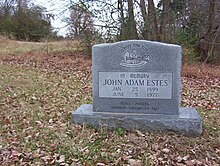
Estes suffered a stroke while preparing for a European tour and died on June 5, 1977, at his home of 17 years in Brownsville, Haywood County, Tennessee. He is buried at Elam Baptist Church Cemetery in Durhamville, Lauderdale County, Tennessee.
His grave marker reads:
Sleepy John Estes
".. ain't goin' to worry Poor John's mind anymore"
In Memory
John Adam Estes
Jan. 25, 1899
June 5, 1977
Blues Pioneer
Guitarist – Songwriter – Poet
The epitaph ".. ain't goin' to worry Poor John's mind anymore" is derived from his song "Someday Baby Blues." "I Ain't Gonna Be Worried No More" was recorded in 1935, and in his song "Drop Down Mama", also recorded in 1935, Estes referred to himself as "Poor John". His grave is located off a country road and at the far end of the cemetery, adjacent to a small grove of trees, secluded but not hidden.
In 1991, Estes was posthumously inducted into the Blues Hall of Fame.
Legacy
Led Zeppelin's lead singer, Robert Plant, named Estes as one of his earliest influences. Bob Dylan mentioned Estes in the sleeve notes for his album Bringing It All Back Home (1965).
Recordings
Albums
- Sleepy John Estes, 1929–1940 (RBF Records)
- Complete Recorded Works 1929–1941, vols. 1 and 2 (Document)
- I Ain't Gonna Be Worried No More 1929–1941 (Yazoo)
- The Legend of Sleepy John Estes (Delmark)
- Broke and Hungry (Ragged and Dirty, Too) (Delmark)
- Electric Sleep (Delmark)
- Brownsville Blues (Delmark)
- Down South Blues (Delamark)
- Sleepy John Estes in Europe (Delmark)
Songs
- "Leaving Trunk", a cover version of Estes's song "Milk Cow Blues", was included on Taj Mahal's self-titled 1968 album. It was also covered by the Derek Trucks Band on the album Live at Georgia Theatre. The Keef Hartley Band covered the song on their debut album, Halfbreed.
- "Diving Duck Blues" was recorded by Taj Mahal and Johnny Winter.
- "Special Agent" was included on The Country Blues and was later recorded by Martin Simpson.
- "Someday Baby Blues" was rewritten by Muddy Waters as "Trouble No More" and further amended to "Someday Baby" by Bob Dylan.
- "Drop Down Mama" was recorded by Tom Rush, Big Joe Williams, and the North Mississippi Allstars. Led Zeppelin borrowed parts of it for their song "Custard Pie", from the 1975 album Physical Graffiti.
- "Floating Bridge" is included on the compilation album The Blues and on Eric Clapton's 1981 album Another Ticket. It is the opening track on the 2011 album by Gregg Allman, Low Country Blues.
- "Little Laura" was recorded by Hill Country Revue.
- "Milk Cow Blues" has been covered by many artists, including Kokomo Arnold, Elvis Presley, the Kinks, and Aerosmith.
- "The Girl I Love She Got Long Black Wavy Hair" was covered by Led Zeppelin on their live album BBC Sessions.
- "President Kennedy" was recorded by Estes for Ry Cooder's 1972 album Boomer's Story.