


Introduction
Sir Robert Robinson OM PRS FRSE (13 September 1886 – 8 February 1975) was an English organic chemist and Nobel laureate recognised in 1947 for his research on plant dyestuffs (anthocyanins) and alkaloids. In 1947, he also received the Medal of Freedom with Silver Palm.
Biography
Early life
Born at Rufford House Farm, near Chesterfield, Derbyshire, Robinson went to school at the Chesterfield Grammar School, the private Fulneck School and the University of Manchester. In 1907 he was awarded an 1851 Research Fellowship from the Royal Commission for the Exhibition of 1851 to continue his research at the University of Manchester.
He was appointed as the first Professor of Pure and Applied Organic Chemistry in the School of Chemistry at the University of Sydney in 1912. He was the Waynflete Professor of Chemistry at Oxford University from 1930 and a Fellow of Magdalen College, Oxford.
Robinson Close in the Science Area at Oxford is named after him, as is the Robert Robinson Laboratory at the University of Liverpool, the Sir Robert Robinson Laboratory of Organic Chemistry at the University of Manchester and the Robinson and Cornforth Laboratories at the University of Sydney.
Robinson was a strong amateur chess player. He represented Oxford University in a friendly match with a team from Bletchley Park in December 1944; in which he lost his game to pioneering computer scientist I. J. Good. He was president of the British Chess Federation from 1950–53, and with Raymond Edwards he co-authored the book The Art and Science of Chess (Batsford, 1972).
Research
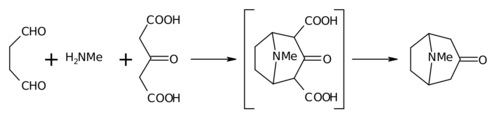
His synthesis of tropinone, a precursor of cocaine, in 1917 was not only a big step in alkaloid chemistry but also showed that tandem reactions in a one-pot synthesis are capable of forming bicyclic molecules.
He invented the symbol for benzene having a circle in the middle whilst working at St Andrews University in 1923. He is known for inventing the use of the curly arrow to represent electron movement, and he is also known for discovering the molecular structures of morphine and penicillin.
In 1957 Robinson founded the journal Tetrahedron with fifty other editors for Pergamon Press.
Robinson annulation has had application in the total synthesis of steroids.