


Introduction
Pedanius Dioscorides (Ancient Greek: Πεδάνιος Διοσκουρίδης, Pedianos Dioskorides; c. 40 – 90 AD) was a Greek physician, pharmacologist, botanist, and author of De Materia Medica (Ancient Greek: Περὶ ὕλης ἰατρικῆς) —a 5-volume Greek encyclopedia about herbal medicine and related medicinal substances (a pharmacopeia), that was widely read for more than 1,500 years. He was employed as a medic in the Roman army.
Life
A native of Anazarbus, Cilicia, Asia Minor, Dioscorides likely studied medicine nearby at the school in Tarsus, which had a pharmacological emphasis, and he dedicated his medical books to Laecanius Arius, a medical practitioner there. Though he says he served in the Roman army, his pharmacopeia refers almost solely to plants found in the Greek-speaking eastern Mediterranean, making it unlikely that he served in campaigns (or traveled) outside that region. The name Pedanius is Roman, suggesting that an aristocrat of that name sponsored him to become a Roman citizen.
De Materia Medica
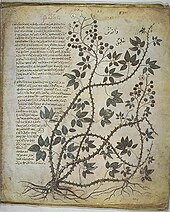
Between AD 50 and 70Dioscorides wrote a five-volume book in his native Greek, Περὶ ὕλης ἰατρικῆς, known in Western Europe more often by its Latin title De Materia Medica ("On Medical Material"), which became the precursor to all modern pharmacopeias.

In contrast to many classical authors, Dioscorides' works were not "rediscovered" in the Renaissance, because his book had never left circulation; indeed, with regard to Western materia medica through the early modern period, Dioscorides' text eclipsed the Hippocratic corpus. In the medieval period, De Materia Medica was circulated in Greek, as well as Latin and Arabic translation. While being reproduced in manuscript form through the centuries, it was often supplemented with commentary and minor additions from Arabic and Indian sources. Ibn al-Baitar's commentary on Dioscorides' Materia Medica, entitled “Tafsīr Kitāb Diāsqūrīdūs”, has been used by scholars to identify many of the flora mentioned by Dioscorides. A number of illustrated manuscripts of De Materia Medica survive. The most famous of these is the lavishly illustrated Vienna Dioscurides, produced in Constantinople in 512/513 AD. Densely illustrated Arabic copies survive from the 12th and 13th centuries, while Greek manuscripts survive today in the monasteries of Mount Athos.
De Materia Medica is the prime historical source of information about the medicines used by the Greeks, Romans, and other cultures of antiquity. The work also records the Dacian, Thracian, Roman, ancient Egyptian and North African (Carthaginian) names for some plants, which otherwise would have been lost. The work presents about 600 plants in all, although the descriptions are sometimes obscurely phrased, leading to comments such as: "Numerous individuals from the Middle Ages on have struggled with the identity of the recondite kinds", while some of the botanical identifications of Dioscorides' plants remain merely guesses.
De Materia Medica formed the core of the European pharmacopeia through the 19th century, suggesting that "the timelessness of Dioscorides' work resulted from an empirical tradition based on trial and error; that it worked for generation after generation despite social and cultural changes and changes in medical theory".
The Dioscorea genus of plants, which includes the yam, was named after him by Linnaeus.
Images
-
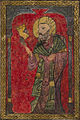
Dioscorides as depicted in a 1240 Arabic edition of De Materia Medica
-

De Materia Medica in Arabic, Spain, 12th-13th century
-

Cumin and dill from an Arabic book of simples (ca. 1334) after Dioscorides (British Museum)
-

Byzantine De Materia Medica, 15th century
-
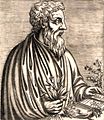
Later representation of Dioscorides


Translations
- De Materia Medica: Being an Herbal with many other medicinal materials, Englished by Tess Anne Osbaldeston, year 2000, based on the translation of John Goodyer of year 1655 (see below). (Publisher Ibidis Press: Johannesburg).
- De Materia Medica, translated by Lily Y. Beck (2005). (Publisher Hildesheim: Olms-Weidmann).
- The Greek Herbal of Dioscorides... Englished by John Goodyer A. D. 1655, edited by R.T. Gunter (1933).
- De Materia medica : libri V Eiusdem de Venenis Libri duo. Interprete Iano Antonio Saraceno Lugdunaeo, Medico, translated by Janus Antonius Saracenus (1598).
In literature
In Voltaire's Candide, the title character's injuries received at the hands of the Bulgarian army, into which he had been conscripted, are healed using "emollients taught by Dioscorides."