
LS


The basics
Quick facts
Intro
Dutch painter
A.K.A.
Lambertus de Amsterdam, Lambertus Sustris, Lambrecht Suster, Lambrecht Sustris, Lamberto Veneziano Sustris, Lambrecht Zustris, Lambert, Lamberto, Lamberto Sustris, Lambert Van Amsterdam Sustris, Federigo Lamberto, Lamberto Veneziano, Lambrecht Zustrus, Lambert d'Amsterdam, Lamberto Tedesco Sustris, Lambert Zustris, Lamberto Fiammingo, Lambert Susterus, Lambertus, Lambert Zustrus, Lamberto D'Amsterdam; Lamberto Fiammingo Sustris, Lambert van Amsterdam, Lamberto Tedesco, Lambertus De Amsterdam Sustris, Lambrecht Susterus, Lambert Suster, Lamberto d'Amsterdam
Gender:
Male
Places:
Is:
Work field:
Birth:
1 January 1515(Amsterdam, Amsterdam, North Holland, Netherlands)
Death:
1 January 1584(Padua, Province of Padua, Veneto, Italy)
The details
Biography
Introduction
Lambert Sustris (c. 1515-1520 – c. 1584) was a Dutch painter active mainly in Venice in the Mannerist style. He is also referred to as Alberto de Olanda (Albert of Holland). He was born in Amsterdam, and only came to Venice when over 40 years old. His training is unknown, but he was utilized by the studio of Titian for the depiction of landscapes. He accompanied Titian on his trips to Augsburg in 1548 and 1550–1551, and there executed portraits. Returning to Venice, he was influenced by Parmigianino and Andrea Meldolla. He was a teacher to Girolamo Muziano. His son was Friedrich Sustris.
Works
- Hermippe (between 1540 and 1565)
- The Baptism of the Ethiopian Eunuch by the Deacon Philip (between 1545 and 1550)
- Noli me tangere (between 1548 and 1553), now at the Palais des Beaux-Arts de Lille
- Hans Christoph Vöhlin von Frickenhausen (1552)
- Judith with the head of Holofernes, oil on canvas, Palais des Beaux-Arts de Lille
- Jupiter and Io (between 1557 and 1563), Hermitage Museum, Saint Petersburg
- Otto von Waldburg (16th century)
- Pietà and Angels (16th century)
- Virgin and Child with Saint Anne and Infant Saint John (second half of the 16th century)
-

Judith with the head of Holofernes
-
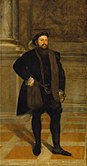
Hans Christoph Vöhlin von Frickenhausen
-

Virgin and Child with St Anne and the Infant St John


-

Noli me tangere
-

Venus

