

Introduction
James Burton (29 July 1761 – 31 March 1837) was a British property developer, "probably the most significant builder of Georgian London," who built large parts of the Bloomsbury district, Chester Terrace, Cornwall Terrace and York Terrace at Regent's Park, Russell Square and Tavistock Square. He also conceived, planned, and developed the town of St Leonards-on-Sea, now part of Hastings. By the time of his death, he had built over 3000 properties and his buildings covered over 250 acres of London.
James financed and built the projects of John Nash around Regent’s Park, most of which were predominantly designed by James's son, Decimus, rather than Nash himself. Such were James Burton’s contributions to the project that the Commissioners of Woods described James, not Nash, as ‘the architect of Regent’s Park’.
As the most successful property developer of the Regency and Georgian periods, James, together with his children William Ford, Henry, Septimus, Decimus, Alfred, and Jessy, was leading member of Regency London society. James and Decimus were founding members of the Athenaeum Club, London, whose Clubhouse the former built and the latter designed, together with their friends John Wilson Croker, Sir Humphry Davy, and Lord Palmerston.
He was also the father of James Burton, the pioneering Egyptologist.
He also served as Master of the Worshipful Company of Tylers and Bricklayers and Sheriff of Kent.
Family
James Burton was born as James Haliburton on 29 July 1761, son of William Haliburton (1731–1785), a London property developer of Scottish descent, and Mary Johnson (1735–1785), daughter of Nicholas Foster of Kirkby Fleetham, Yorkshire. William Haliburton was the second husband of Mary Foster. They married in 1760. They had two children, James and another who died in infancy.
James was christened 'James Haliburton' at Presbyterian Chapel, Soho, London. He changed his name to Burton in 1794 (following a family dispute), between the birth of his fourth child and the birth of his fifth child.
Burton's father William Haliburton's paternal grandparents were Rev. James Haliburton (1681–1756) and Margaret Eliott, daughter of Sir William Eliott, 2nd Baronet and aunt of George Augustus Eliott, 1st Baron Heathfield. They had 7 daughters and 2 sons, William (father of James), and Andrew. Burton's father William was descended from John Haliburton (1573–1627), from whom Sir Walter Scott, 1st Baronet could trace his descent on the maternal side. He was a cousin of the American judge and author Thomas Chandler Haliburton and thence the lawyer and anthropologist Robert Grant Haliburton and Arthur Lawrence Haliburton, 1st Baron Haliburton.
Education
James was educated at a day school in Covent Garden before being privately tutored. In July 1776 he was articled to a surveyor named Dalton, with whom he remained for six years.
Property developments
- St Leonards-on-Sea
- Russell Square
- Bloomsbury Square and surrounding streets
- St John's Wood
- Burton Street and Burton Crescent (now Cartwright Gardens)
- Tavistock Square, including Tavistock House (for himself)
- The Holme, Inner Circle, Regent's Park. Designed by James's son, Decimus Burton and built by James. The residence of the Burton family. Architectural critic Ian Nairn wrote of the house, "If you want a definition of western civilization in a single view, then here it is".
- York Terrace, Regent's Park
- Chester Terrace Regent's Park
- Cornwall Terrace, Regent's Park
-
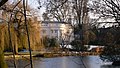
The Holme
-

Cornwall Terrace
-

Chester Terrace
-

Tavistock Square
-
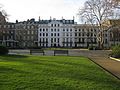
Bloomsbury Square


In 1787, Burton was already known as architect and builder in Southwark, having built the Blackfriars Rotunda in Great Surrey Street (now Blackfriars Road) to house the Leverian Museum for land agent and museum proprietor James Parkinson.
At 28 years old he made his first proposition to build on the land made available by the Foundling Hospital. In 1792 he asked the Foundling Governors for an option on the whole of Brunswick Square. They were cautious and refused, not knowing the capacity of this man and also having a policy of not allowing any one speculator to undertake more than a moderate proportion of the ground. He was given a bit of the south side and part of Guildford Street. Burton rapidly added to this site by site until most of the western property was under his control and by 1802 had built nearly 600 houses on the estate.
In 1800 he bought the Duke of Bedford's London mansion, Bedford House, and began to lay out houses over its site (facing Bloomsbury Square) and to create Russell Square. He went on to build the south side of Russell Square. He exhibited a view of these houses in the Royal Academy Exhibition 1800. In 1807 he continued his Bloomsbury development north, and he was also involved in the early development of St John's Wood He then left London for a project in Tunbridge Wells but returned in 1807 to build over the Skinners Company ground between the Bedford Estate and the Foundling lands. Here he built Burton Street and Burton Crescent (now Cartwright Gardens) including the villa Tavistock House for himself on ground now occupied by the British Medical Association. Here he lived until he moved to The Holme in Regent's Park, designed by his son Decimus Burton.
Relationship with John Nash
After the Crown Estate refused to advance finance for the building projects of John Nash at Regent’s Park James financed the projects, which he also built, himself, in return for which Nash agreed to promote the career of James's son, Decimus. Such were James Burton’s contributions to the project that the Commissioners of Woods described James, not Nash, as ‘the architect of Regent’s Park’. Contrary to popular belief, the dominant architectural influence in many of the Regent's Park projects - including Cornwall Terrace, York Terrace, Chester Terrace and the villas of the Inner Circle, including The Holme - was Decimus Burton, not John Nash, who was appointed architectural 'overseer' for Decimus's projects. To the chagrin of Nash, Decimus largely disregarded his advice and developed the Terraces according his own style, to the extent that Nash sought the demolition and complete rebuilding of Chester Terrace, but in vain. Decimus also emerged as the dominant force in the design of Carlton House Terrace.
Gunpowder manufacturer
In addition to his property development enterprises, James Burton, together with his eldest son, William Ford, owned and managed a successful gunpowder manufacturing enterprise, based at Powder Mills, Leigh, from his office in the City of London The mills, which were initially known as the Ramhurst Powder Mills, and later as the Tunbridge Gunpowder Works, were that he established in 1811 in partnership with Sir Humphry Davy. After the retirement of James Burton in 1824, William Ford became the sole owner of the mills until his death in 1856, at which point the gunpowder business to his brother, Alfred Burton JP, Mayor of Hastings.
Personal life
James's residences were Tavistock House (later the residence of Charles Dickens), the The Holme, and Mabledon House, Kent. The family also had offices at Spring Gardens, Westminster, Old Broad-Street, City of London, and Lincoln's Inn Fields, where Septimus Burton and William Warwick were solicitors at Lincoln’s Inn.
James Burton was a founding member of the Athenaeum Club, London, as was his son, Decimus Burton. Burton was Master of the Worshipful Company of Tylers and Bricklayers in 1801–2. Burton served as Sheriff of Kent in 1810.
In 1804, in response to the cessation of amicable relations with the French Republic, Burton raised a 1600 strong company of volunteers, the Loyal British Artificers, at his own expense, recruited from the large body of artificers that were in his employ, of which he made himself colonel.
He attended the funeral of Horatio Nelson in 1806.
James is buried in a distinctive pyramidal tomb in the churchyard of St Leonards-on-Sea.
Marriage and children
On 1 March 1783 at St Clement Danes, London, James Burton married Elizabeth Westley (12 December 1761 – 14 January 1837), of Loughton, Essex, daughter of John and Mary Westley. They had six sons and six daughters:
- William Ford (11 January 1784 – 18 October 1856). William Ford was named after his maternal granduncle, William Ford. He was prevented from attending university by a severe injury caused by a fall from his horse in 1806. He began farming with his father in 1807. The office of the Burton family was in the City of London from William Ford managed the Powder Mills, Leigh - which were initially known as the Ramhurst Powder Mills, and later as the Tunbridge Gunpowder Works – that he established in 1811 in partnership with his father, James Burton, and Sir Humphry Davy, both of whom were founders of the Athenaeum Club, London. After the retirement of James Burton in 1824, William Ford became the sole owner of the mills until his death in 1856, at which point the gunpowder business to his brother, Alfred Burton JP. Mayor of Hastings. William Ford lived at St John's Wood, The Holme, and South Lodge, St Leonards. He never married but had two illegitimate sons:, Henry Marley Burton FRIBA (1821 - 1880) and William Warwick Burton (d. 21 October 1861). Henry Marley was baptized as Henry Marley on 12 Dec 1821: at his baptism, he was claimed to be the son of William Marley and Sally Marley, London neighbours of the Burtons. Henry Marley trained in the office of his uncle, Decimus Burton, to whose practice he succeeded on Decimus’s retirement in 1869. In 1866, Henry Marley was commissioned by John George Dodson, 1st Baron Monk Bretton to design a mansion at Coneyborough. His uncle Decimus had designed Bineham in Chailey for Dodson's brother-in-law John George Blencowe. Henry Marley trained the architect Edward John May. His residence was 14 Spring Gardens, Westminster. He was a Captain in the Queen’s (Westminster) Rifle Corps. Henry Marley had at least one son, Edgar Burton. The second illegitimate son of William Ford Burton was William Warwick Burton, who live at Lincoln's Inn Fields, where he was articled as a solicitor to his uncle, Septimus Burton (27 July 1794 – 25 November 1842) of Lincoln’s Inn. William Warwick Burton had three children, William Edgar Burton, Edmund Burton, and Jessy Burton. each of whom were left property in the will of their uncle, Decimus, who never married and died without issue.
- Emma Elizabeth (4 August 1785 – 13 December 1785). Died from smallpox.
- Eliza (29 September 1786 – 6 February 1877) Lived for a time at 36 Marina and later at No. 5 West Hill. Did not marry.
- James FGS (22 September 1788 – 22 February 1862). Egyptologist.
- Emily (10 August 1791 – 20 May 1792)
- Jane (4 April 1792 – 11 December 1879) Married Thomas Walker (who changed his surname to Wood in 1817) of Tonbridge at Tonbridge, 1812. Had 1 son George James (1813–1831) and 3 daughters, Emily (1815–1892), Helen (1816–1903) and Rose Anne (born 1818). Lived at North Lodge, St. Leonards.
- Septimus (27 July 1794 – 25 November 1842). Educated at Lincoln's Inn, where he was articled to J. W. Lyon in 1810, and where, subsequently, he established his practice. He dealt with much of his father’s business. Married Charlotte Lydia Elizabeth Middleton in 1824. Had 1 son, Arthur (b.1830) who married Lilian Margaret Robertson in 1860 and one son, Francis Arthur (1861–64). Lived at Serle Street, London. Died 25 November 1842. Buried at Chiswick.
- Octavia (b. 20 May 1796) Married Edmund Hopkinson of St. Albans, banker, at Tonbridge in 1813. No issue.
- Henry FRCP (27 February 1799 – 10 August 1849) Physician and chemist, discoverer of the Burton line.
- Decimus FRS FRSA RA FSA FRIBA (30 September 1800 – 14 December 1881). Architect.
- Alfred (18 June 1802 – 24 April 1877) JP. Mayor of Hastings. In St Leonards, Steward of the Races, President of the Mechanics Institute, Vice-President of the Infirmary, Trustee of Hastings & Flimwell Turnpike. Member of the Queen’s Royal St. Leonards Archers. Manager of Burton family estates. Clerk to Thomas Wood (husband of Jane Burton) and to Decimus Burton. Married Anna Delicia Adams in 1843. Had 1 son, Alfred Henry (1845–1917) JP, J.P. of Hastings Lodge and High Sheriff of Sussex 1902, who married Ellen Amelia Dickson, and had four children, and 1 daughter Louisa Charlotte (1849–1873), who did not marry.
- Jessy (12 April 1804 – after 24 April 1877). Married John Peter Fearon (1804–1873), lawyer of Great George Street, Westminster, 1833. Had 3 daughters, Jessy Tyndale (1834–1910), Constance Mary (1835–1915), and Ethel Anna (1839–1901) (who married Thomas Ayscough and had issue) and 1 son, Francis (1837–1914) (who married Julia Mary Woodward and had issue). Jessy's middle daughter, Constance Mary Fearon, was the founder of the Francis Bacon Society and author (under the pseudonym Mrs Henry Pott) of numerous books supporting the theory that Francis Bacon, 1st Viscount St Alban was the author of the works attributed to William Shakespeare.