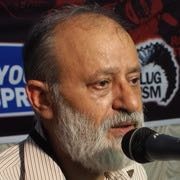

Introduction
Gauhar Raza (born 17 August 1956) is an Indian scientist by profession, and a leading Urdu poet, social activist and documentary filmmaker working to popularize the understanding of science among general public, known for his films like Jung-e-Azadi, on the India's First War of Independence, and Inqilab (2008) on Bhagat Singh. He was also the honorary director of Jahangirabad Media Institute.
Early life and education
Born in a left liberal family in Allahabad, UP, India on 17 August 1956. His family shifted to Aligarh in 1958. His father Wizarat Husain (1919 to 2007) was a freedom fighter, a communist party member and a renowned educationist and science teacher in Aligarh Muslim University, Aligarh. His mother, a social worker, was also intensely involved in freedom struggle and had worked with Indira Gandhi in Allahabad.
He completed B.Sc. Engineering from Aligarh Muslim University, in 1977 and M. Tech. (Power Apparatus and Systems) from Indian Institute of Technology, Delhi 1979.
Career
In 1979 he joined Eicher Goodearth Ltd., a multinational company as an electrical engineer and worked there for 3 years. Solved a few major design problems that the company was facing and within a short span of time he rose to Executive-Engineer level. In 1982 he joined National Institute of Science, Technology and Development Studies (NISTADS) as a scientist and still continues there.

Poetry
Gauhar Raza's poetry collection Jazbon Ki Lau Tez Karon has been noticed for the frankness of tone and for the social concerns that they take up and treat sensitively. In his most famous poem "Main Chahta hoon"(I like to), he express his helplessness to write a romantic poem in the days of darkness. He also wrote lyrics for a Hindi film Say Salaam India released in 2007.
Personal life
He is married to activist Shabnam Hashmi, sister of the slain theatre activist Safdar Hashmi, and the couple has a son, Sahir Raza, and a daughter, Seher.
Works
- Plague, Media and People, NITADS, 1996 (co-writers: Bharvi Dutt and Surjit Singh)
- Confluence of Science and Peoples' Knowledge at the Sangam, NISTADS, 1996 (co-writers: Surjit Singh, Bharvi Dutt and Jagdish Chander)
- A Delicate Space Ship, Youth for Disarmament, Delhi, 1998
- Jazbon Ki Lau Tez Karo, Raj Kamal, Delhi, 1999
- Walk the Sky, A play on violence against women, V-Day, Delhi, 2001
- Science Crafts and Knowledge: Understanding of Science Among Artisans in India and South Africa: a Cross-cultural Endeavour, Protea Book House, Pretoria, 2002 edited along with Hester du Plessis
- HIV/AIDS Public Understanding and Attitude, NYKS, 2007 (co-writers: Surjit Singh and Chader Shekhar Pran)
Awards
- Best subject expert for educational film in 1999 by the University Grants Commission.
- Creative Literature Award, Hindi Academy, 2001, for the collection of poems 'Jazbon Ki Lau Tez Karo'.
- For contribution to Science writings and propagation of Science, Urdu Academy, Delhi, 2002