


Introduction
Friedrich Alpers (25 March 1901 – 3 September 1944) was a German Nazi politician and SS leader. He was also a Minister of the Free State of Brunswick, and Minister for Forestry. Alpers was responsible for numerous political crimes in Brunswick. Alpers committed suicide in 1944, while in US custody.
NSDAP and SS career
Born in 1901, Alpers studied law and political science at the Heidelberg University, Ludwig Maximilian University of Munich and University of Greifswald. He became a lawyer in 1929. In June 1929, Alpers joined the NSDAP (membership number 132,812). In May 1930 he joined the SA. On 1 March 1931 he joined the SS (membership number 6,427). He was an active member in the SS, rising to the rank of Obergruppenführer. Since October 1930, he was Minister of the Brunswick State Parliament. Alpers was twice temporarily suspended from the SS in 1933 following complaints of excessive violence made against him during the Nazi takeover of Brunswick.
Minister of the Free State of Brunswick
After the Nazi seizure of power Alpers became Finance and Justice Minister of Brunswick on 8 May 1933 (a position in which he served until 1934) under the Ministerpräsident Dietrich Klagges. Along with Klagges and Friedrich Jeckeln, Alpers was one of the main persons responsible for the Gleichschaltung and persecution of political opponents in the Free State of Brunswick.
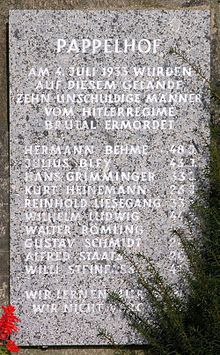
Subordinated to Alpers was Klagges "Hilfspolizei" ("Auxiliary Police"). This force was directly answerable to Klagges and consisted of SA, SS and "Stahlhelm" men. On 4 July 1933, Alpers was directly involved in the Rieseberg-murder of eleven communists and labor organizers in Rieseberg, about 15 miles (24 km) east of Braunschweig.
Awards
- German Cross in Gold on 9 April 1942 as Hauptmann in the 3.(F)/Aufklärungs-Gruppe 121
- Knight's Cross of the Iron Cross on 14 October 1942 as Major and commander of Fernaufklärungs-Gruppe 4