

Introduction
Edward Alexander Bouchet (September 15, 1852 – October 28, 1918) was an American physicist and educator and was the first African American to earn a Ph.D. from any American university, completing his dissertation in physics at Yale in 1876. On the basis of his academic record he was elected to the Phi Beta Kappa Society.In 1874, he had become one of the first African Americans to graduate from Yale College.
Although Bouchet was elected to Phi Beta Kappa along with other members of the Yale class of 1874, the official induction did not take place until 1884, when the Yale chapter was reorganized after thirteen years of inactivity. Because of the circumstances, Bouchet was not the first African American elected to Phi Beta Kappa, as many historical accounts state; that honor belongs to George Washington Henderson (University of Vermont). Bouchet was also among the first 20 Americans (of any race) to receive a Ph.D. in physics and was the sixth to earn a Ph.D. in physics from Yale.
Early life
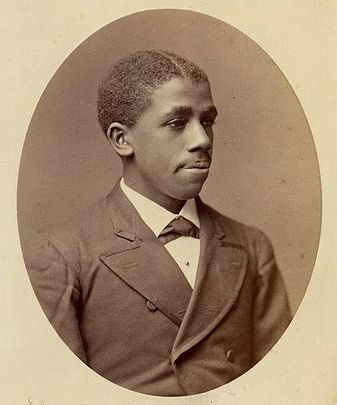
Edward Bouchet was born at home in New Haven, Connecticut, to parents William Bouchet, a former slave, who worked as a servant and later as a porter at Yale University, and Susan (Cooley) Bouchet. At that time, there were only three schools in New Haven that accepted black children. Bouchet was enrolled in the Artisan Street Colored School with only one teacher, who nurtured Bouchet's academic abilities. He attended the New Haven High School from 1866 to 1868 and then Hopkins School from 1868 to 1870, where he was named valedictorian. He ranked sixth in his class on graduation from Yale. Bouchet's doctoral thesis centered on measuring the refractive indices of various glasses.
Professional life
Bouchet was unable to find a university teaching position after college, because of racial discrimination. He moved to Philadelphia in 1876 and took a position at the Philadelphia's Institute for Colored Youth (now Cheyney University of Pennsylvania), where he taught physics and chemistry for the next 26 years. He resigned in 1902 at the height of the W. E. B. Du Bois-Booker T. Washington controversy over the need for an industrial vs. collegiate education for Blacks.
Bouchet spent the next 14 years holding a variety of jobs around the country. Between 1905 and 1908, he was director of academics at St. Paul's Normal and Industrial School in Lawrenceville, Virginia (presently, St. Paul's College). He was then principal and teacher at Lincoln High School in Gallipolis, Ohio, from 1908 to 1913.He joined the faculty of Bishop College in Marshall, Texas, in 1913.Illness finally forced him to retire in 1916 and he moved back to New Haven. He died there, in his childhood home, in 1918, at the age of 66. He had not married, had no children and was a Republican.
Legacy
The American Physical Society (APS Physics) confers the Edward A. Bouchet Award on some of the nation's outstanding physicists for their contribution to physics.
The Edward Bouchet Abdus Salam Institute (EBASI) was founded in 1988 by the late Nobel Laureate Professor Abdus Salam, under the direction of the founding chairman Charles S. Brown.
In 2005, Yale and Howard University founded the Edward A. Bouchet Graduate Honor Society in his name. The current chair of EBASI is Professor Milton Dean Slaughter.