


Introduction
Denis (or Denys) Calvaert (about 1540 – 16 April 1619) was a Flemish painter born at Antwerp, who lived in Italy for most of his life, where he was known as Dionisio Fiammingo or simply Il Fiammingo (the Fleming). Calvaert was a profound student of architecture, anatomy, and history, his works are characterized by their advanced composition and colouring.
Biography
After studying landscape-painting for some time in his native city (the Antwerp "Record of Artists" or "Liggeren" (1556–57), gives his name as Caluwaert), he first studied under Christiaen van Queecborn.
He then went to Bologna, where worked under Prospero Fontana. His paintings acquired the mannerism of Flemish art and appeared to be the work of an Italian. From Bologna he went to Rome in 1572, where he assisted Lorenzo Sabbatini in his works for the papal palace of the Vatican, and devoted much of his time to copying and studying the works of Raphael.
He returned to Bologna and founded a studio. He had a number of prominent young apprentices, including Guido Reni, Giovanni Battista Bertusio, Francesco Albani and Domenichino, who soon followed Annibale Carracci's example and took prominent commissions in Rome. Vicenzio Gotti, Francesco Gessi, and Giacomo Semenza also worked in his studio, before joining the studio of Guido Reni. Vincenzo Spisanelli and Gabriello Ferrantini worked under Calvaert as well.
Calvaert was respected by his fellow citizens in Bologna and by his colleagues, as shown by the presence of Ludovico Carracci, then leader of a competing studio, accompanied by all of his students, at Calvaert's funeral in the Basilica di Santa Maria dei Servi.
Style and legacy
Calvaert typically used chiaroscuro techniques to set stylized foreground figures derived from Correggio against northern European landscapes. His use of colour also reflects the influence of Barocci. While continuing to pursue a mannerist aesthetic throughout his career, Calvaert became a significant contributor the brand of classicism that came to characterize the Bolognese school of painting from the start of the 17th century.
His principal works are to be seen at Bologna, Florence, St. Petersburg, Parma, and Caen, and many of his pictures have been engraved. Many of his works are in the National Art Gallery of Bologna, while "St Michael", one of his most renowned works, is in the Basilica of San Petronio.
Works
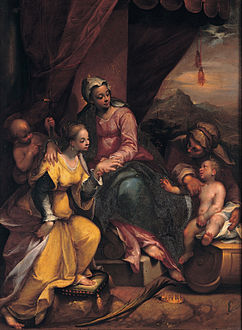
Mystic marriage of Saint Catherine
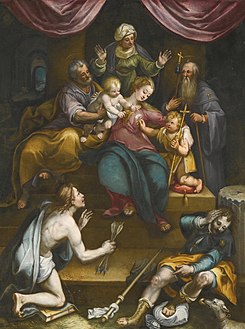
Holy Family with Saint John the Baptist and Saint Anne

Noli me tangere

Holy Family with Saint John and Archangel Michael, San Giacomo Maggiore, Bologna