


Introduction
Bruno Schmitz (21 November 1858 – 27 April 1916), was a German architect best known for his monuments in the early 20th century. He worked closely with sculptors such as Emil Hundrieser, Nikolaus Geiger and Franz Metzner for integrated architectural and sculptural effect.
Schmitz was born in Düsseldorf. His single most famous work is the massive 1913 Völkerschlachtdenkmal (Monument to the Battle of the Nations) located in Leipzig, Saxony, designed with local architect Clemens Thieme. The Monument was inaugurated in 1913 by Kaiser Wilhelm II. Bohemian sculptor Franz Metzner designed the architectural figures, including the powerful and strangely scaled Masks of Fate in the monument's crypt.
Along with the Leipzig monument, Schmitz designed the Kyffhäuser Monument and the Kaiser Wilhelm Monument at Porta Westfalica, bringing him the distinction of designing the three largest war monuments in Germany. All of them are rough, primitive masonry structures in a style that blends Romanesque precedents with modernist touches, and all of them are associated with German nationalism in the period before World War I.
Schmitz's daughter Angelica Schmitz (1893–1957) was the wife of the Ukrainian-American sculptor Alexander Archipenko.
Selected works

- Geschäftshaus (commercial building) (1883), Düsseldorf.
- Kyffhäuser Monument (1889–96), Porta Westfalica, with Emil Hundrieser and Nikolaus Geiger, sculptors.
- Kaiser Wilhelm Monument (1890–96), Teutoburg Forest, Porta Westfalica, with Caspar von Zumbusch, sculptor.
- Deutsches Eck Monument (1894–97), Koblenz, with Emil Hundrieser, sculptor.
- Kaiserin Augusta Monument (1896), Koblenz, with Karl Friedrich Moest, sculptor.
- Völkerschlachtdenkmal (Monument to the Battle of the Nations) (1898–1913), Leipzig, with Clemens Thieme, architect, and Franz Metzner, sculptor.
- Bismarckturm (Bismark Tower) (1899–1900), Unna.
- Villa Stockwerk (1899–1902), Cologne.
- Mannheimer Rosengarten (1899–1903), Friedrichsplatz, Mannheim.
- Kaiser Wilhelm Monument (1901), Halle.
- Automat Commercial Building (1904–05), Berlin.
- Weinhaus Rheingold (Rheingold Wine House) (1905–06), Berlin (destroyed).
- Carl Hoffman Tomb, Old St. Matthew's Church, Berlin, with Nikolaus Geiger, sculptor.
- A number of the Bismarck towers.
United States
- Indiana Soldiers and Sailors' Monument (1888–1902), Monument Circle, Indianapolis, Indiana.
- German Pavilion (1904), Saint Louis World's Fair, Saint Louis, Missouri.
-
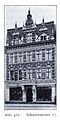
Geschäftshaus (commercial building) (1883), Düsseldorf.
-

The Symbol of Indiana. Schmitz's 1888 rendering for the Soldiers' and Sailors' Monument in Indianapolis, Indiana.
-

Kyffhäuser Monument (1889–96), Porta Westfalica.
-
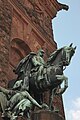
Equestrian statue of Kaiser Wilhelm I by Emil Hundrieser, Kyffhäuser Monument, Porta Westfalica.
-
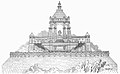
Schmitz's ca. 1890 rendering for the Kaiser Wilhelm Monument in Porta Westfalica.
-

Kaiser Wilhelm Monument (1890–96), Teutoburg Forest, Porta Westfalica, Caspar von Zumbusch, sculptor.
-
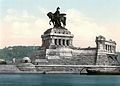
Deutsches Eck Monument (1894–97), Koblenz.
-

Emil Hundrieser's colossal Equestrian statue of Kaiser Wilhelm I atop the Deutsches Eck was severely damaged in World War II. A copy by Raymond Kittl was installed in 1993.
-
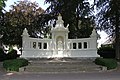
Kaiserin Augusta Monument (1896), Koblenz, Karl Friedrich Moest, sculptor.
-

Bismarckturm (Bismark Tower) (1899–1900), Unna.
-

Schmitz's 1899 rendering for the Villa Stockwerk in Cologne.
-
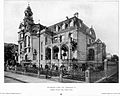
Villa Stockwerk (1899–1902), Cologne.
-
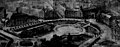
Schmitz's 1901 rendering of Friedrichsplatz, Mannheim.
-
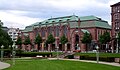
Rosengarten Concert Hall (1899–1903), Friedrichsplatz, Mannheim.
-

German Pavilion (1904), Saint Louis World's Fair, Saint Louis, Missouri.
-

Automat Commercial Building (1904–05), Berlin.
-

Schmitz's 1905 rendering for the Weinhaus Rheingold (Rheingold Wine House) in Berlin.
-
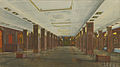
Weinhaus Rheingold (Rheingold Wine House) interior, 1906 (destroyed).
-

Carl Hoffmann Tomb, Old St. Matthew's Church, Berlin. Weeping Woman by Nikolaus Geiger.
-
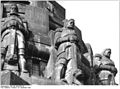
Wächterfiguren (Guards), by Franz Metzner, encircling the dome of the Völkerschlachtdenkmal.
-

Masks of Fate, by Franz Metzner, crypt of the Völkerschlachtdenkmal.


