


Arsinoe II
Introduction
Arsinoë II (Ancient Greek: Ἀρσινόη, 316 BC – unknown date between July 270 and 260 BC) was a Ptolemaic Greek Princess of Ancient Egypt. Through marriage she became Queen of Thrace, Asia Minor and Macedonia as wife of King Lysimachus (Greek: Λυσίμαχος), and later co-ruler of Egypt with her brother-husband Ptolemy II Philadelphus (Greek: Πτολεμαῖος Φιλάδελφος, "Ptolemy the sibling-loving").
Biography
Arsinoë was the first daughter of Pharaoh Ptolemy I Soter (Greek: Πτολεμαίος Σωτήρ, "Ptolemy the Savior"), founder of the Hellenistic state of Egypt, and his second wife Berenice I of Egypt.
At about age 15, Arsinoë married King Lysimachus (who was then around 60 years old), to whom she bore three sons: Ptolemy I Epigone, Lysimachus and Philip. In order to position her sons for the throne, she had Lysimachus' first son, Agathocles, poisoned on account of treason. After Lysimachus' death in battle in 281 BC, she fled to Cassandreia (Greek: Κασσάνδρεια) and married her paternal half-brother Ptolemy Keraunos, one of the sons of Ptolemy I from his previous wife, Eurydice of Egypt. The marriage was for political reasons as they both claimed the throne of Macedonia and Thrace (by the time of his death Lysimachus was ruler of both regions, and his power extended to Southern Greece and Asia Minor). Their relationship was never good. As Ptolemy Keraunos was becoming more powerful, she decided it was time to stop him and conspired against him with her sons. This action caused Ptolemy Keraunus to kill two of her sons, Lysimachus and Philip, while the eldest, Ptolemy, was able to escape and to flee north, to the kingdom of the Dardanians. She herself went to Alexandria, Egypt to seek protection from her brother, Ptolemy II Philadelphus.
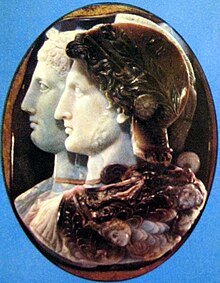
In Egypt, she continued her intrigues and probably instigated the accusation and exile of her brother Ptolemy II's first wife, Arsinoë I. Arsinoë II then married her brother; as a result, both were given the epithet "Philadelphoi" (Greek: Φιλάδελφοι, "Sibling-loving (plural)") by the presumably scandalized Greeks. Sharing in all of her brother's titles, she apparently was quite influential, having towns dedicated to her, her own cult (as was Egyptian custom), appearing on coinage and contributing to foreign policy, including Ptolemy II's victory in the First Syrian War between Egypt and the Seleucid Empire.
According to Posidippus, she won three chariot races at the Olympic Games, probably in 272 BC.
After her death, Ptolemy II continued to refer to her on official documents, as well as supporting her coinage and cult. In establishing her worship as a goddess he justified his own cult.