

Introduction
Albert Smith Barker (March 31, 1845 – January 30, 1916) was an admiral in the United States Navy who served during the American Civil War and the Spanish–American War.
Biography
Born in Hanson, Massachusetts, Barker graduated from the Naval Academy in 1862. He served aboard the Mississippi, Monongahela and Niagara during the Civil War.
In July 1883, Albert Barker was commander of the screw-sloop USS Enterprise while on the East Coast of Africa at Zanzibar. He wrote a report on the "Trade of Zanzibar" of imports and exports for the years 1882–83. The trade of the port principally being with the United States, England, Germany, and France. Many vessels from these countries were employed in this trade process with America, such as the British man-of-war HMS London stationed at Zanzibar as a store ship.
During the Spanish–American War he commanded the battleship USS Oregon and participated in the bombardment of Santiago on July 1, 1898. He was Commander-in-Chief of the North Atlantic Fleet from 1903 to 1905.
Rear Admiral Barker died January 30, 1916 at Washington, D.C.
Namesake
The destroyer USS Barker (DD-213) was named for him.
Dates of Rank
 United States Naval Academy Midshipman – Class of 1862
 United States Naval Academy Midshipman – Class of 1862
| Ensign | Lieutenant | Lieutenant Commander | Commander | Captain |
|---|---|---|---|---|
| O-1 | O-3 | O-4 | O-5 | O-6 |
 |  |  |  | 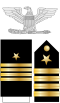 |
| 1862 | February 22, 1864 | July 25, 1866 | March 28, 1877 | May 5, 1892 |
| Commodore | Rear Admiral |
|---|---|
| O-7 | O-8 |
 | 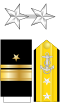 |
| 1899 | October 10,1905 |
Barker never held the rank of LTJG (O-2) due to it not being created until later years. As well, Commodore is the modern day equivalent to Rear Admiral (lower half) and Rear Admiral then is equivalent to today's Rear Admiral (Upper Half).