

Introduction
Al-Mansur or Abu Ja'far Abdallah ibn Muhammad al-Mansur (95 AH – 158 AH (714 AD– 6 October 775 AD); Arabic: أبو جعفر عبدالله بن محمد المنصور) was the second Abbasid Caliph reigning from 136 AH to 158 AH (754 AD – 775 AD) and succeeding his brother Abu al-'Abbas al-Saffah. Al-Mansur is generally regarded as the real founder of the Abbasid Caliphate, one of the largest polities in world history, for his role in stabilizing and institutionalizing the dynasty. He is also known for founding the 'round city' of Madinat al-Salam which was to become the core of imperial Baghdad.
Biography
Al-Mansur was born at the home of the 'Abbasid family after their emigration from the Hejaz in 95 AH (714 CE). "His father, Muhammad, was reputedly a great-grandson of Abbas ibn Abd al-Muttalib, the youngest uncle of Mohammad; his mother, as described in the 14th-century Moroccan historical work Rawd al-Qirtas was one Sallama, "a Berber woman given to his father."He reigned from Dhu al-Hijjah 136 AH until Dhu al-Hijjah 158 AH (754 CE – 775 CE). In 762 he founded as new imperial residence and palace city Madinat as-Salam (the city of peace), which became the core of the Imperial capital Baghdad. Al-Mansur was concerned with the solidity of his regime after the death of his brother Abu'l `Abbas (later known as as-Saffah). In 754 he defeated Abdallah ibn Ali's bid for the Caliphate, and in 755 he arranged the assassination of Abu Muslim. Abu Muslim was a loyal freed man from the eastern Iranian province of Khorasan who had led the Abbasid forces to victory over the Umayyads during the Third Fitna in 749–750; he was subordinate to al-Mansur but also the undisputed ruler of Iran and Transoxiana. The assassination seems to have been made to preclude a power struggle in the empire; some findings suggest that Abu Muslim became incredulous and paranoid and that this 'necessitated' the assassination.
When Isa ibn Musa, al-Mansur's intended successor, fell under suspicion of corruption, al-Mahdi was appointed in his stead and publicly swore allegiance. Like his elder brother Saffah he wanted to unite the land, so he got rid of all of his opposition.
During his reign, Islamic literature and scholarship in the Islamic world began to emerge in full force, supported by the Abbasid promotion of scholarly research, best exemplified by the Abbasid-sponsored Translation Movement. It was under al-Mansur that a committee, mostly made up of Syriac-speaking Christians, was set up in Baghdad with the purpose of translating extant Greek works into Arabic. Due to the Abbasid's orientation toward the East, many Persians came to play a crucial role in the Empire, both culturally as well as politically. This was in contrast to the preceding Umayyad era, in which non-Arabs were kept out of these affairs. Shu'ubiya emerged at this time, due to the rising of Iranian autonomy; it was a literary movement among Persians which expressed their belief in the superiority of Persian art and culture, and catalyzed the emergence of Arab-Persian dialogues in the 9th century CE.
In 756, al-Mansur sent over 4,000 Arab mercenaries to assist the Chinese in the An Shi Rebellion against An Lushan; after the war, they remained in China. Al-Mansur was referred to as "A-p'u-ch'a-fo" in the Chinese T'ang Annals.
Al-Mansur died in 775 on his way to Mecca to make hajj. He was buried somewhere along the way in one of hundreds of graves dug in order to hide his body from the Umayyads. He was succeeded by his son, al-Mahdi.
According to a number of sources, Abu Hanifa an-Nu'man (who founded a school of jurisprudence) was imprisoned by al-Mansur. Malik ibn Anas, the founder of another school, was flogged during his rule, but al-Mansur himself did not condone this – in fact, it was his cousin, the governor of Madinah at the time, who ordered it (and was punished for doing so).
Character
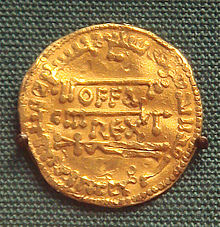
Al-Masudi in Meadows of Gold tells of a blind poet, on two occasions, reciting poems of praise for the Umayyads to one he didn't realize was this Abbasid; al-Mansur nonetheless rewarded the poet for the verses. Another tale describes an arrow, with verses inscribed on feathers and shaft, landing near al-Mansur; these verses prompt him to investigate a notable from Hamadan who had been unjustly imprisoned, and release him. Imam Ja'far al-Sadiq was the victim of some harassment by the Abbasid caliphs, and was eventually, according to most Shia Muslims, poisoned at the orders of the Caliph al-Mansur . There is also an account of foreboding verses al-Mansur saw written on the wall just before his death.
When al-Mansur died, the caliphate's treasury contained 600,000 dirhams and fourteen million dinars.
In 2008, MBC 1 depicted the life and leadership of al-Mansur in a historical series aired during the holy month of Ramadan.
Time line
|
Al-Mansur
of the Ahl al-Bayt Banu Hashim
Clan of the Banu Quraish
Born: ≈ 714 CEDied: ≈ 775 CE |
||
| Shia Islam titles | ||
|---|---|---|
| Preceded by Abu'l-`Abbas `Abdu'llāh ibn Muhammad The Eighth Imām of Hashimiyya Kaysanites Shia |
Abu Ja`far `Abdu'llāh ibn Muhammad "al-Imām" The ninth and last Imam of Hashimiyya Kaysanites Shia 10 June 754 – 6 October 775 |
Succeeded by Abu `Abdu'llāh Muhammad "al-Mahdi" Adopted Sunni Islam as state religion |
|
Al-Mansur
Abbasid
Born: 714 Died: 6 October 775 |
||
| Sunni Islam titles | ||
| Preceded by As-Saffah |
Caliph of Islam 10 June 754 – 6 October 775 |
Succeeded by Al-Mahdi |